Catalog ID: GLC-93
AGEL023211+001339A
Confirmed — spectroscopy [1]
AGEL023211+001339A is an AGEL gravitational lens. Gottemoller et al. classify the deflector as group-scale; their separately estimated galaxy environment does not define the lens scale. The foreground spectroscopic redshift has limited precision beyond its formal quoted error. [4] [1] [3]
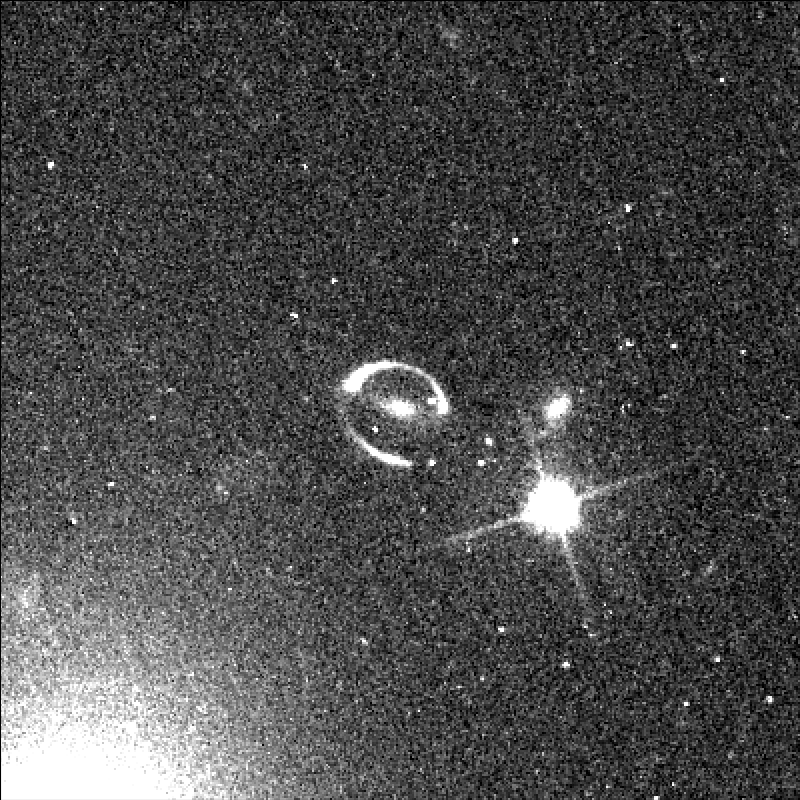
Credit: Tania Barone / AGEL Survey; HST program 17307 (PIs Tran and Shajib) · Image source · Reuse information
Image details
Hubble Space Telescope / ACS; F606W
CC0 1.0
- Other names
- HSCJ023211+001339 [4]
Name origin
AGEL HST cross-identificationDESJ0232+0013 [5]Name origin
Jacobs 2019 full preprint catalogName variants and source provenance
Published spellings and paper abbreviations retained for matching and traceability.
AGEL023211+001339A [1]AGEL DR2
- Catalog source
- AGEL
- Right ascension
- 38.04683°
02h 32m 11.24s [1] [2] - Declination
- 0.22756°
+00° 13′ 39.22″ - Coordinates
- Equatorial J2000 · adopted catalog position
- Lens → Source
- Group → Galaxy [3]
- Appearance
- Not yet classified
- Lens redshift
- 0.893 [1]
Measurement details
Reported uncertainty: −0.0005 / +0.0005
Formal uncertainty only; measured foreground galaxy redshift, not a group mean. Limited precision; Section 3.1 gives alternative spectral limitations, not a target-specific diagnosis.
Method: Spectroscopy, Keck/ESI
Source location: Table 1, PDF p6, row AGEL023211+001339A, columns 5-7; Section 3.1 pp15-16.
- Discovery report
- Not available
- Explore
- External object viewer
Background sources
AGEL023211+001339A background source [1]
- Source redshift
- 2.366 [1]
Measurement details
Reported uncertainty: −0.0005 / +0.0005
Formal uncertainty only. Multiple well-detected spectral features; object-specific systematic errors are not quantified. Section 3.1 also discusses possible interstellar-line velocity offsets and internal rotation; neither is assigned here.
Method: Spectroscopy, Keck/NIRES; Gaussian-feature fitting and/or MARZ templates (survey method).
Source location: Table 1 p6, row AGEL023211+001339A, columns 2-4; Section 3.1 pp15-16.
- Einstein radius
- Not available
Evidence & coordinate notes
- Confirmation: Table 1, PDF p6, row AGEL023211+001339A; Sections 3.1 pp14-16 and 4.2 p18: accepted sample has deflector and/or source spectroscopy; Table 3 p18 false-positive exceptions exclude this target. [1]
- Coordinates: Table 1, PDF p6, row AGEL023211+001339A, columns 10-11; decimal degrees, published system/deflector pointing. [1]
- Coordinates: Table 2 pp8-9 J2000 column headers establish AGEL survey convention; applied to DR2 coordinates without epoch conversion. [2]
- Description: Historical name mapping only: Appendix HST mapping / Table 1 exact AGEL designation; final journal science adopted separately. [4]
- Description: Table 1, PDF p6, row AGEL023211+001339A; Section 3.1 pp15-16 for redshift interpretation; source designation note p10. [1]
- Description: Table 2 p15, row AGEL023211+001339, col9 Defl. Scale=Group; Table 2 notes p15; Section 3.3.4 p8. [3]
- Source:source a: Table 1 p6, row AGEL023211+001339A; p10 note: A main arc, B second arc; these are author source labels, not counts of images. [1]
- System class: Table 2 p15, row AGEL023211+001339, col9 Defl. Scale=Group; Table 2 notes p15; Section 3.3.4 p8. [3]
References
- Barone et al. (2026), The AGEL Survey Data Release 2, AJ 171, 57; final journal version DOI: 10.3847/1538-3881/ae1f86
- Tran et al. (2022), AGEL survey first spectroscopic release, AJ 164, 148 DOI: 10.3847/1538-3881/ac7da2
- Gottemoller et al. (2026), Most Strong Lensing Deflectors in the AGEL Survey Are in Group and Cluster Environments, AJ 171, 218 DOI: 10.3847/1538-3881/ae4480
- Barone et al. (2025), AGEL DR2, arXiv:2503.08041v1; historical HST name mapping
- Jacobs et al. (2019), extended catalog, arXiv:1905.10522v1; historical full Table 3 name mapping