Catalog ID: GLC-91
AGEL020707-272645A
Confirmed — spectroscopy [1]
AGEL020707-272645A is an AGEL gravitational lens. The foreground redshift is a photometric estimate; AGEL DR2 reports no foreground spectroscopic value. The authors label arcs A and B at redshifts 1.679 and 1.677. These labels are preserved without asserting physical association or distinct source planes. [1] [3]
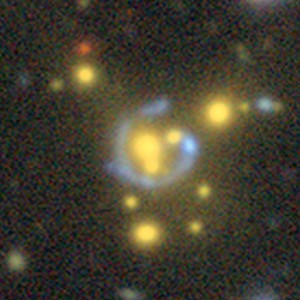
Credit: Legacy Surveys / D. Lang (Perimeter Institute) · Image source · Reuse information
Image details
/ ;
CC BY 4.0
- Other names
- DESJ0207-2726 [4]
Name origin
Jacobs 2019 full preprint catalogName variants and source provenance
Published spellings and paper abbreviations retained for matching and traceability.
AGEL020707-272645A [1]AGEL DR2
- Catalog source
- AGEL
- Right ascension
- 31.77773°
02h 07m 06.66s [1] [2] - Declination
- -27.44577°
−27° 26′ 44.77″ - Coordinates
- Equatorial J2000 · adopted catalog position
- Lens → Source
- Not yet classified
- Appearance
- Not yet classified
- Lens redshift
- 0.42 [3]
Measurement details
Photometric estimate for the matched putative deflector; not spectroscopic confirmation. No numeric uncertainty is supplied; printed precision is not an error estimate.
Method: BPZ photometric redshift from DES photometry.
Source location: Full machine-readable Table 1, row DESJ0207-2726, z column; Note 1 BPZ photometric redshifts (no spectroscopic reference in this row).
- Discovery report
- Not available
- Explore
- External object viewer
Background sources
AGEL020707-272645A background source [1]
- Source redshift
- 1.679 [1]
Measurement details
Reported uncertainty: −0.0005 / +0.0005
Formal uncertainty only. Multiple well-detected spectral features; object-specific systematic errors are not quantified. Section 3.1 also discusses possible interstellar-line velocity offsets and internal rotation; neither is assigned here.
Method: Spectroscopy, VLT/X-shooter; Gaussian-feature fitting and/or MARZ templates (survey method).
Source location: Table 1 p6, row AGEL020707-272645A, columns 2-4; Section 3.1 pp15-16.
- Einstein radius
- Not available
AGEL020707-272645B background source [1]
- Source redshift
- 1.677 [1]
Measurement details
Reported uncertainty: −0.0005 / +0.0005
Formal uncertainty only. Multiple well-detected spectral features; object-specific systematic errors are not quantified. Section 3.1 also discusses possible interstellar-line velocity offsets and internal rotation; neither is assigned here.
Method: Spectroscopy, VLT/X-shooter; Gaussian-feature fitting and/or MARZ templates (survey method).
Source location: Table 1 p6, row AGEL020707-272645B, columns 2-4; Section 3.1 pp15-16.
- Einstein radius
- Not available
Evidence & coordinate notes
- Confirmation: Table 1, PDF p6, row AGEL020707-272645A; Sections 3.1 pp14-16 and 4.2 p18: accepted sample has deflector and/or source spectroscopy; Table 3 p18 false-positive exceptions exclude this target. [1]
- Coordinates: Table 1, PDF p6, row AGEL020707-272645A, columns 10-11; decimal degrees, published system/deflector pointing. [1]
- Coordinates: Table 2 pp8-9 J2000 column headers establish AGEL survey convention; applied to DR2 coordinates without epoch conversion. [2]
- Description: Table 1, PDF p6, row AGEL020707-272645A; Section 3.1 pp15-16 for redshift interpretation; source designation note p10. [1]
- Description: Full machine-readable Table 1, row DESJ0207-2726, z column; Note 1 BPZ photometric redshifts (no spectroscopic reference in this row). [3]
- Source:source a: Table 1 p6, row AGEL020707-272645A; p10 note: A main arc, B second arc; these are author source labels, not counts of images. [1]
- Source:source b: Table 1 p6, row AGEL020707-272645B; p10 note: A main arc, B second arc; these are author source labels, not counts of images. [1]
References
- Barone et al. (2026), The AGEL Survey Data Release 2, AJ 171, 57; final journal version DOI: 10.3847/1538-3881/ae1f86
- Tran et al. (2022), AGEL survey first spectroscopic release, AJ 164, 148 DOI: 10.3847/1538-3881/ac7da2
- Jacobs et al. (2019), An Extended Catalog of Galaxy-Galaxy Strong Gravitational Lenses Discovered in DES Using Convolutional Neural Networks, ApJS 243, 17; full machine-readable Table 1 DOI: 10.3847/1538-4365/ab26b6
- Jacobs et al. (2019), extended catalog, arXiv:1905.10522v1; historical full Table 3 name mapping