Catalog ID: GLC-9
Einstein Cross
A foreground galaxy gravitationally lenses one background quasar into four point-like images arranged around the galaxy's nucleus, producing the Einstein Cross. [4]
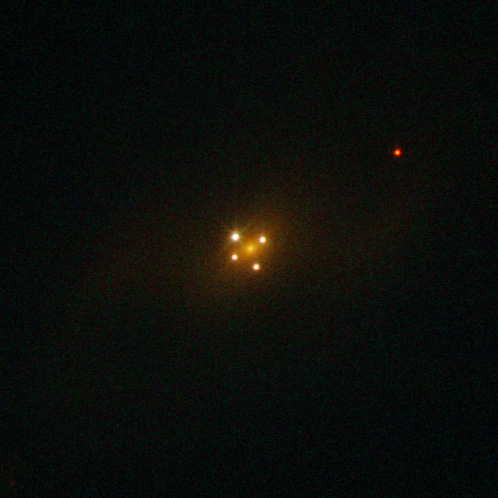
Credit: ESA/Hubble & NASA · Image source · Reuse information
Image details
Hubble Space Telescope / WFPC2;
Field of view: 0.41 × 0.41 arcmin (publisher coordinate metadata)
Orientation: North is 124.3° right of vertical (publisher metadata)
CC BY 4.0; retain the full image credit
- Other names
- QSO 2237+0305 [1]
Name origin
Huchra et al. (1985), quasar/lens system designationName variants and source provenance
Published spellings and paper abbreviations retained for matching and traceability.
Einstein Cross [4]ESA/Hubble, Seeing quadruple (2012)
- Catalog source
- Cited Paper
- Right ascension
- 340.12597696°
22h 40m 30.23s [3] - Declination
- 3.35850806°
+03° 21′ 30.63″ - Coordinates
- Equatorial J2000 · adopted catalog position
- Lens → Source
- Galaxy → Quasar [1]
- Appearance
- Quadruple image [2]
- Lens redshift
- 0.0394 [1]
Measurement details
Method: Optical spectroscopy; published adopted lens redshift
Source location: Abstract and Table I, galaxy redshift; no uncertainty adopted here
- Discovery report
- 1985-05 [1]
Background sources
Background quasar (four lensed images A–D) [1]
- Source redshift
- 1.695 [1]
Measurement details
Method: Quasar emission-line spectroscopy; galactocentric value as labeled in Table I
Source location: Section II and Table I, QSO redshift; no uncertainty adopted here
- Einstein radius
- Not available
Evidence & coordinate notes
- Confirmation: Abstract and sections I–II: distinct foreground galaxy and background quasar redshifts [1]
- Confirmation: Abstract: four resolved point sources and a gravitational lens model reproducing their configuration [2]
- Coordinates: Basic data: ICRS coordinates, epoch J2000, 22 40 30.23447 +03 21 30.6290; converted to decimal degrees rounded to eight places. SIMBAD cites 2006AJ....131.1163S; extra conversion digits do not imply astrometric accuracy. [3]
- Description: Opening two paragraphs: galaxy nucleus and four images of one distant quasar [4]
- Discovery date: Journal issue: May 1985, earliest public report located in this research. Day unknown. Observations in September 1984 are not the publication date. [1]
- System class: Abstract: foreground spiral galaxy and background quasar [1]
References
- Huchra et al. (1985), 2237+0305: A new and unusual gravitational lens, Astronomical Journal 90, 691–696. DOI: 10.1086/113777
- Schneider et al. (1988), High-resolution CCD imaging and derived gravitational lens models of 2237+0305, Astronomical Journal 95, 1619–1628. DOI: 10.1086/114758
- SIMBAD Astronomical Database, PGC 69457 / Z 378-15, coordinates and identifiers; accessed 17 October 2026.
- ESA/Hubble (2012), Seeing quadruple, image potw1204a, released 23 January 2012.