Catalog ID: GLC-80
AGEL013003-374458A
Confirmed — published expert assessment [4] [6]
AGEL013003-374458A is an AGEL strong gravitational lens. The foreground redshift is 0.68 (photometric). The primary background source has reported redshift 2.282. The galaxy-to-galaxy classification is an inference from the cited target and sample context; it does not imply an isolated halo. The reported Einstein-radius estimate is 5.33 ± 0.91 arcsec from image geometry, not a precision mass model. [1] [4] [5]
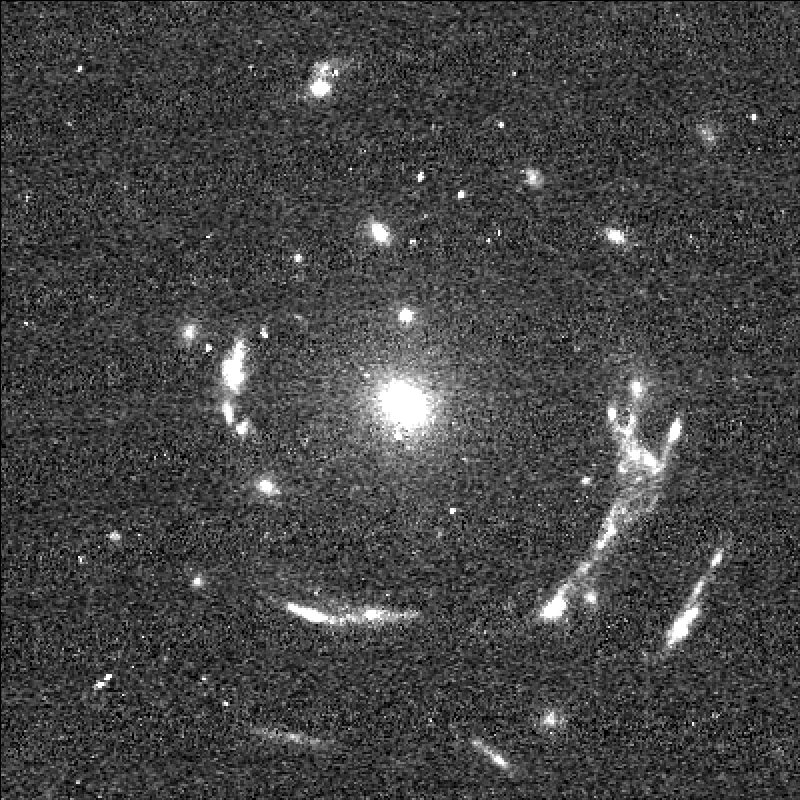
Credit: Tania Barone / AGEL Survey; HST program 17307 (PI Kim-Vy Tran) · Image source · Reuse information
Image details
Hubble Space Telescope / ACS; F606W
CC0 1.0
- Other names
- DES0130-3744 [2]
Name origin
AGEL source cross-identificationName variants and source provenance
Published spellings and paper abbreviations retained for matching and traceability.
AGEL013003-374458A [1]AGEL DR2
- Catalog source
- AGEL
- Right ascension
- 22.51201°
01h 30m 02.88s [1] [3] - Declination
- -37.74938°
−37° 44′ 57.77″ - Coordinates
- Equatorial J2000 · adopted catalog position
- Lens → Source
- Galaxy → Galaxy [4] [6]
- Appearance
- Not yet classified
- Lens redshift
- 0.68 [4]
Measurement details
Photometric estimate; target-specific uncertainty not reported in this table. DR2 has no deflector spectroscopic redshift.
Method: BPZ photometric redshift of the foreground galaxy from DES Y3A1; not spectroscopy.
Source location: Table 3, arXiv:1905.10522v1 PDF p12, row DESJ0130-3744; final Table 1 note p3 and Sections 2.4–2.5 pp5–6.
- Discovery report
- Not available
- Explore
- External object viewer
Background sources
AGEL013003-374458A primary background source A [1]
- Source redshift
- 2.282 [1]
Measurement details
Reported uncertainty: −0.0005 / +0.0005
AGEL DR2 flag 3: multiple well-detected features. Formal uncertainty; possible ISM outflow and internal rotation systematics discussed in Section 3.1 are not quantified for this target.
Method: AGEL spectroscopy with X-shooter; Section 3.1 line/template fitting.
Source location: Table 1, final PDF p5, row AGEL013003-374458A; columns 2–7; table note p10; Section 3.1 pp14–16.
- Einstein radius
- 5.33 arcsec [5]
Measurement details
Reported uncertainty: −0.91 / +0.91
Scatter of separations, or 10% for a single image, combined in quadrature with 0.263 arcsec pixel scale; not a mass-model posterior.
Method: Mean separation of primary deflector and source images in DES imaging; approximate image-plane Einstein radius.
Source location: Table 3 PDF p10, row DESJ0130-3744; Section 4 PDF pp15–16.
Evidence & coordinate notes
- Confirmation: Table 3, arXiv:1905.10522v1 PDF p12, row DESJ0130-3744; final Table 1 note p3 and Sections 2.4–2.5 pp5–6. [4]
- Confirmation: Section 2.4 PDF pp5–6: grade 3 means definitely a lens; mean of four author assessments. [6]
- Coordinates: Table 1 PDF p5, row AGEL013003-374458A, RA/Decl; J2000 is a survey-convention inference from Tran Table 2 and mapping headers. [1]
- Coordinates: Table 2 PDF pp8–9, explicit alpha_J2000/delta_J2000 headers; survey-frame inference applied to DR2, not a new astrometric measurement. [3]
- Description: Table 1, final PDF p5, row AGEL013003-374458A; columns 2–7; table note p10; Section 3.1 pp14–16. [1]
- Description: Table 3, arXiv:1905.10522v1 PDF p12, row DESJ0130-3744; final Table 1 note p3 and Sections 2.4–2.5 pp5–6. [4]
- Description: Table 3 PDF p10, DESJ0130-3744; Section 4 pp15–16 radius definition. [5]
- Source:source a: Table 1 PDF p5, AGEL013003-374458A; table note p10; distinct source labels, not individual image knots. [1]
- System class: Table 3, arXiv:1905.10522v1 PDF p12, row DESJ0130-3744; final Table 1 note p3 and Sections 2.4–2.5 pp5–6. [4]
- System class: Sections 2.1,2.5,3.5 and final Table 1 note p3; explicit sample-context inference, not an object mass model. [6]
References
- Barone et al. (2026), The AGEL Survey Data Release 2, AJ 171, 57; final journal version. DOI: 10.3847/1538-3881/ae1f86
- Barone et al. (2025), AGEL DR2, arXiv:2503.08041v1; original alias mapping only, not final measurements.
- Tran et al. (2022), The AGEL Survey: Spectroscopic Confirmation of Strong Gravitational Lenses in the DES and DECaLS Fields Selected Using Convolutional Neural Networks, AJ 164,148. DOI: 10.3847/1538-3881/ac7da2
- Jacobs et al. (2019), extended DES strong-lens catalog; arXiv:1905.10522v1 Table 3 full rows. Final ApJS 243,17 Table 1 is abbreviated in the PDF. DOI: 10.3847/1538-4365/ab26b6
- O’Donnell et al. (2022), The Dark Energy Survey Bright Arcs Survey: Candidate Strongly Lensed Galaxy Systems from the Dark Energy Survey 5000 Square Degree Footprint, ApJS 259,27. DOI: 10.3847/1538-4365/ac470b
- Jacobs et al. (2019), An Extended Catalog of Galaxy–Galaxy Strong Gravitational Lenses Discovered in DES Using Convolutional Neural Networks, ApJS 243,17; final definitions. DOI: 10.3847/1538-4365/ab26b6