Catalog ID: GLC-8
Twin Quasar
Confirmed — combined [1]
A massive elliptical galaxy, aided by its surrounding cluster, splits the light of one background quasar into two images. The Twin Quasar was the first recognized gravitationally lensed quasar. [4]
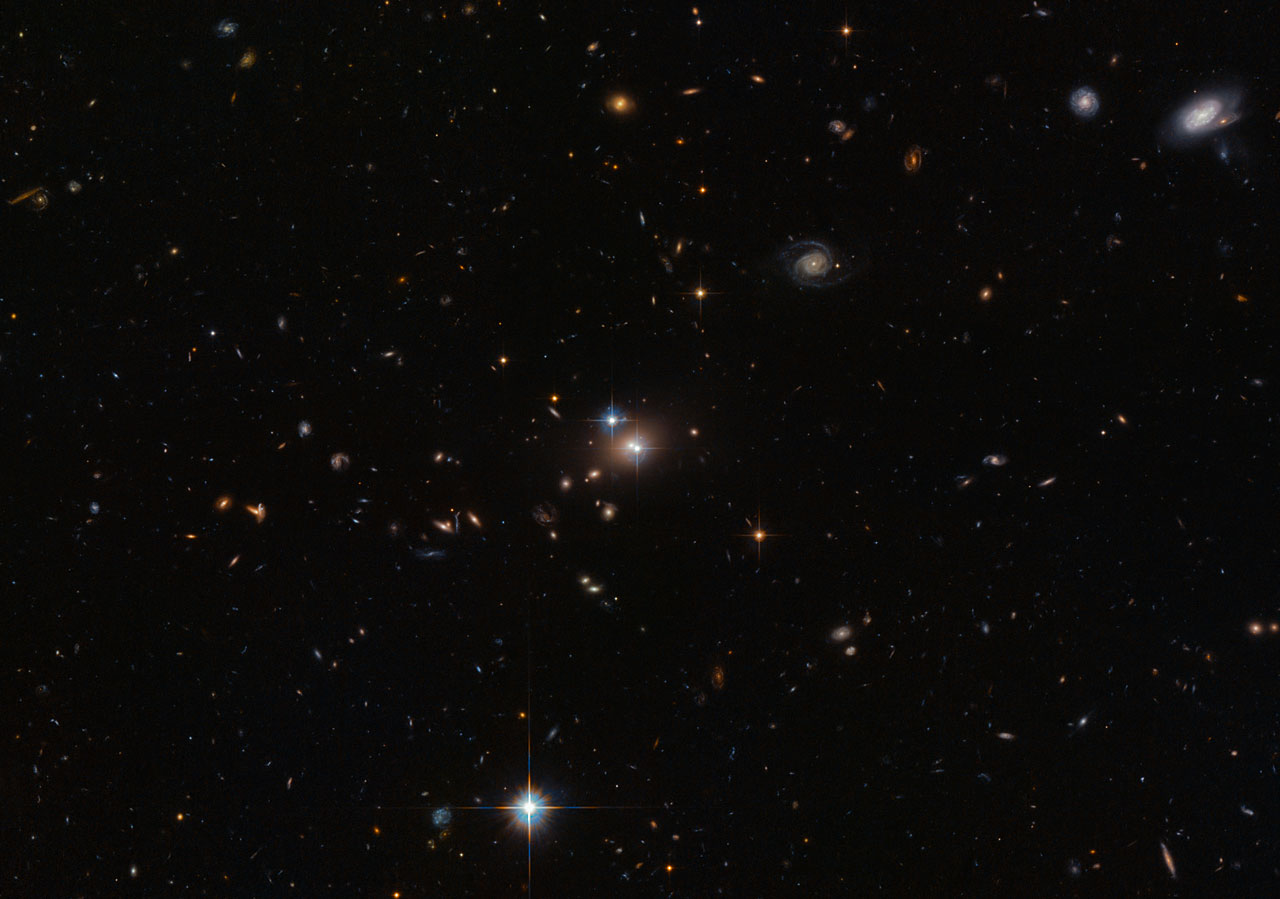
Credit: ESA/Hubble & NASA · Image source · Reuse information
Image details
Hubble Space Telescope / ACS; V (555 nm), I (814 nm)
Field of view: 3.50 × 2.46 arcmin
Orientation: North 53.2° left of vertical
CC BY 4.0; retain the full image credit; publisher JPEG unchanged
- Other names
- QSO 0957+561 [1]
Name origin
Nakajima et al. (2009), Improved Constraints on the Gravitational Lens Q0957+561. I. Weak Lensing.Name variants and source provenance
Published spellings and paper abbreviations retained for matching and traceability.
Twin Quasar [4]ESA/Hubble (2014), Seeing double, potw1403a.
- Catalog source
- Cited Paper
- Right ascension
- 150.33691667°
10h 01m 20.86s [3] - Declination
- 55.89741667°
+55° 53′ 50.70″ - Coordinates
- Equatorial J2000 · adopted catalog position
- Lens → Source
- Galaxy → Quasar [1]
- Appearance
- Double image [4]
- Lens redshift
- 0.355 [1]
Measurement details
Method: Published adopted spectroscopic redshift
Source location: Section 2.3: adopted primary lens galaxy G1 redshift; uncertainty not adopted
- Discovery report
- Not available
Background sources
One background quasar, lensed images A and B [1]
- Source redshift
- 1.41 [1]
Measurement details
Method: Published adopted spectroscopic redshift
Source location: Section 2.3: adopted quasar redshift; rounded published value
- Einstein radius
- Not available
Evidence & coordinate notes
- Confirmation: Published spectroscopy and gravitational lens interpretation; see cited paper. [1]
- Coordinates: SIMBAD YGKOW G1 lens galaxy: ICRS epoch J2000 10 01 20.86 +55 53 50.7; quality D (coarse astrometry). Converted to decimal degrees; conversion digits do not imply additional astrometric accuracy. [3]
- Description: Publisher description of the observed gravitational lens. [4]
- System class: Foreground deflector and background source types described in the cited work. [1]