Catalog ID: GLC-77
AGEL010257-291122A
AGEL010257-291122A is an AGEL strong gravitational lens. The foreground redshift is 0.273. The primary background source has reported redshift 0.815. A unique galaxy/group deflector classification is not adopted because the cited classifications or definitions disagree. The reported Einstein-radius estimate is 3.6 ± 1.2 arcsec from image geometry, not a precision mass model. [1] [4]
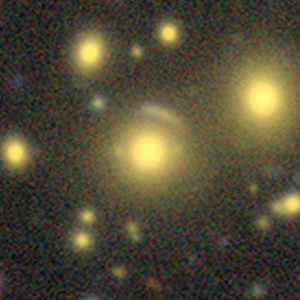
Credit: Legacy Surveys / D. Lang (Perimeter Institute) · Image source · Reuse information
Image details
Blanco 4-meter telescope / DECam;
CC BY 4.0
- Other names
- DESJ0102-2911 [2]
Name origin
Jacobs et al. 2019 DES catalogName variants and source provenance
Published spellings and paper abbreviations retained for matching and traceability.
AGEL010257-291122A [1]AGEL DR2
- Catalog source
- AGEL
- Right ascension
- 15.73954°
01h 02m 57.49s [1] [3] - Declination
- -29.18939°
−29° 11′ 21.80″ - Coordinates
- Equatorial J2000 · adopted catalog position
- Lens → Source
- Not yet classified
- Appearance
- Not yet classified
- Lens redshift
- 0.273 [1]
Measurement details
Literature redshift reproduced by final DR2; original per-object uncertainty not supplied here. Do not apply the new AGEL-measurement formal error to this compilation value.
Method: Spectroscopy: Blake et al. 2016; literature value compiled by AGEL DR2.
Source location: Table 1, final PDF p5, row AGEL010257-291122A; columns 2–7; table note p10; Section 3.1 pp14–16.
- Discovery report
- Not available
- Explore
- External object viewer
Background sources
AGEL010257-291122A primary background source A [1]
- Source redshift
- 0.815 [1]
Measurement details
Reported uncertainty: −0.0005 / +0.0005
AGEL DR2 flag 3: multiple well-detected features. Formal uncertainty; possible ISM outflow and internal rotation systematics discussed in Section 3.1 are not quantified for this target.
Method: AGEL spectroscopy with X-shooter; Section 3.1 line/template fitting.
Source location: Table 1, final PDF p5, row AGEL010257-291122A; columns 2–7; table note p10; Section 3.1 pp14–16.
- Einstein radius
- 3.6 arcsec [4]
Measurement details
Reported uncertainty: −1.2 / +1.2
Includes half arc-width/PSF contribution and empirical scatter against HST models (Section 3.3.2). Target-specific fit family is not tabulated.
Method: Approximate image-position MCMC fit to DECaLS source light (ring or separation models); not a full mass model.
Source location: Table 4, PDF p17, row AGEL010257-291122, columns 4,5,9–12; Sections 3.3.1–3.3.4 pp6–8; Table 1 p9.
Evidence & coordinate notes
- Confirmation: Table 1, final PDF p5, row AGEL010257-291122A; columns 2–7; table note p10; Section 3.1 pp14–16. Section 4.1/Table 3 impostors checked: not listed. [1]
- Confirmation: Table 4, PDF p17, row AGEL010257-291122, columns 4,5,9–12; Sections 3.3.1–3.3.4 pp6–8; Table 1 p9. Section 2.1 strong-lens sample. [4]
- Coordinates: Table 1 PDF p5, row AGEL010257-291122A, RA/Decl; J2000 is a survey-convention inference from Tran Table 2 and mapping headers. [1]
- Coordinates: Table 2 PDF pp8–9, explicit alpha_J2000/delta_J2000 headers; survey-frame inference applied to DR2, not a new astrometric measurement. [3]
- Description: Table 1, final PDF p5, row AGEL010257-291122A; columns 2–7; table note p10; Section 3.1 pp14–16. [1]
- Description: Table 4, PDF p17, row AGEL010257-291122, columns 4,5,9–12; Sections 3.3.1–3.3.4 pp6–8; Table 1 p9. [4]
- Source:source a: Table 1 PDF p5, AGEL010257-291122A; table note p10; distinct source labels, not individual image knots. [1]
References
- Barone et al. (2026), The AGEL Survey Data Release 2, AJ 171, 57; final journal version. DOI: 10.3847/1538-3881/ae1f86
- Jacobs et al. (2019), extended DES strong-lens catalog; arXiv:1905.10522v1 Table 3 full rows. Final ApJS 243,17 Table 1 is abbreviated in the PDF. DOI: 10.3847/1538-4365/ab26b6
- Tran et al. (2022), The AGEL Survey: Spectroscopic Confirmation of Strong Gravitational Lenses in the DES and DECaLS Fields Selected Using Convolutional Neural Networks, AJ 164,148. DOI: 10.3847/1538-3881/ac7da2
- Gottemoller et al. (2026), Most Strong Lensing Deflectors in the AGEL Survey Are in Group and Cluster Environments, AJ 171,218; archived 18-page journal-layout PDF. DOI: 10.3847/1538-3881/ae4480