Catalog ID: GLC-74
AGEL004144-233905A
AGEL004144-233905A is an AGEL strong gravitational lens. The foreground redshift is 0.439. The primary background source has reported redshift 2.203. Earlier imaging classified it as a possible lens with faint or small suggestive features; later KCWI spectroscopy provides the adopted redshifts. A unique galaxy/group deflector classification is not adopted because the cited classifications or definitions disagree. The reported Einstein-radius estimate is 4.5 ± 1.3 arcsec from image geometry, not a precision mass model. [1] [3] [4]
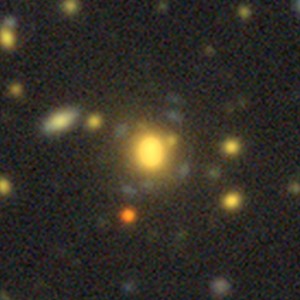
Credit: Legacy Surveys / D. Lang (Perimeter Institute) · Image source · Reuse information
Image details
Blanco 4-meter telescope / DECam;
CC BY 4.0
- Other names
- No additional distinct designations
Name variants and source provenance
Published spellings and paper abbreviations retained for matching and traceability.
AGEL004144-233905A [1]AGEL DR2
- Catalog source
- AGEL
- Right ascension
- 10.43410°
00h 41m 44.18s [1] [2] - Declination
- -23.65150°
−23° 39′ 05.40″ - Coordinates
- Equatorial J2000 · adopted catalog position
- Lens → Source
- Not yet classified
- Appearance
- Not yet classified
- Lens redshift
- 0.439 [1]
Measurement details
Reported uncertainty: −0.0005 / +0.0005
AGEL DR2 flag 3: multiple well-detected features. Formal uncertainty; possible ISM outflow and internal rotation systematics discussed in Section 3.1 are not quantified for this target.
Method: Spectroscopy: KCWI; AGEL line/template redshift measurement.
Source location: Table 1, final PDF p5, row AGEL004144-233905A; columns 2–7; table note p10; Section 3.1 pp14–16.
- Discovery report
- Not available
- Explore
- External object viewer
Background sources
AGEL004144-233905A primary background source A [1]
- Source redshift
- 2.203 [1]
Measurement details
Reported uncertainty: −0.0005 / +0.0005
AGEL DR2 flag 3: multiple well-detected features. Formal uncertainty; possible ISM outflow and internal rotation systematics discussed in Section 3.1 are not quantified for this target.
Method: AGEL spectroscopy with KCWI; Section 3.1 line/template fitting.
Source location: Table 1, final PDF p5, row AGEL004144-233905A; columns 2–7; table note p10; Section 3.1 pp14–16.
- Einstein radius
- 4.5 arcsec [3]
Measurement details
Reported uncertainty: −1.3 / +1.3
Includes half arc-width/PSF contribution and empirical scatter against HST models (Section 3.3.2). Target-specific fit family is not tabulated.
Method: Approximate image-position MCMC fit to DECaLS source light (ring or separation models); not a full mass model.
Source location: Table 4, PDF p17, row AGEL004144-233905, columns 4,5,9–12; Sections 3.3.1–3.3.4 pp6–8; Table 1 p9.
Evidence & coordinate notes
- Confirmation: Table 1, final PDF p5, row AGEL004144-233905A; columns 2–7; table note p10; Section 3.1 pp14–16. Section 4.1/Table 3 impostors checked: not listed. [1]
- Confirmation: Table 4, PDF p17, row AGEL004144-233905, columns 4,5,9–12; Sections 3.3.1–3.3.4 pp6–8; Table 1 p9. Section 2.1 strong-lens sample. [3]
- Coordinates: Table 1 PDF p5, row AGEL004144-233905A, RA/Decl; J2000 is a survey-convention inference from Tran Table 2 and mapping headers. [1]
- Coordinates: Table 2 PDF pp8–9, explicit alpha_J2000/delta_J2000 headers; survey-frame inference applied to DR2, not a new astrometric measurement. [2]
- Description: Table 1, final PDF p5, row AGEL004144-233905A; columns 2–7; table note p10; Section 3.1 pp14–16. [1]
- Description: Table 4, PDF p17, row AGEL004144-233905, columns 4,5,9–12; Sections 3.3.1–3.3.4 pp6–8; Table 1 p9. [3]
- Description: Table 6 DESI-010.4341-23.6515; Section IV defines Grade C as faint/small suggestive features, with several possible limitations. [4]
- Source:source a: Table 1 PDF p5, AGEL004144-233905A; table note p10; distinct source labels, not individual image knots. [1]
References
- Barone et al. (2026), The AGEL Survey Data Release 2, AJ 171, 57; final journal version. DOI: 10.3847/1538-3881/ae1f86
- Tran et al. (2022), The AGEL Survey: Spectroscopic Confirmation of Strong Gravitational Lenses in the DES and DECaLS Fields Selected Using Convolutional Neural Networks, AJ 164,148. DOI: 10.3847/1538-3881/ac7da2
- Gottemoller et al. (2026), Most Strong Lensing Deflectors in the AGEL Survey Are in Group and Cluster Environments, AJ 171,218; archived 18-page journal-layout PDF. DOI: 10.3847/1538-3881/ae4480
- Huang et al. (2021), Discovering New Strong Gravitational Lenses in the DESI Legacy Imaging Surveys; inspected arXiv:2005.04730v2, Tables 5–6 and Section IV.