Catalog ID: GLC-69
AGEL001702-100911A
Confirmed — published expert assessment [5]
AGEL001702-100911A is an AGEL strong gravitational lens. The primary background source has reported redshift 1.831 with limited precision. The foreground redshift remains unadopted: an earlier paper reports 0.5536, but the linked project table leaves spectroscopy blank and its association with the deflector has not been verified. A photometric alternative is retained in provenance. The group-lens classification follows the target-specific HST paper. [1] [4] [7] [6] [5]
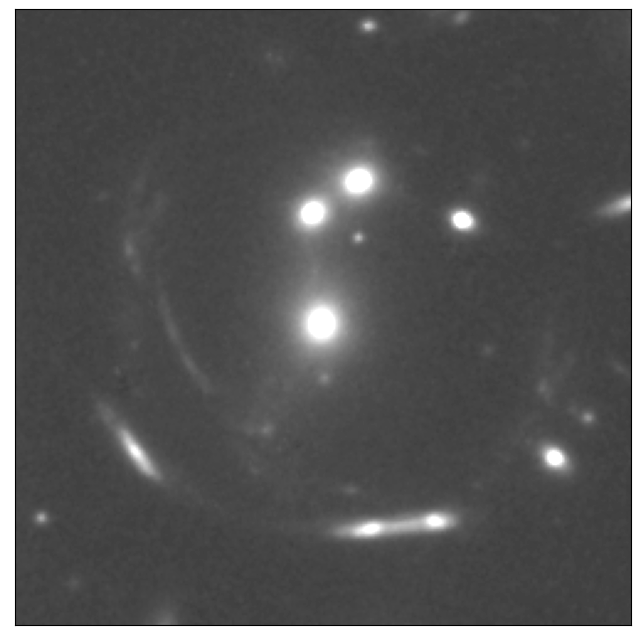
Credit: Tania Barone / AGEL Survey; HST program 15867 (PI Xiaosheng Huang) · Image source · Reuse information
Image details
Hubble Space Telescope / WFC3/IR; F140W
CC0 1.0
- Other names
- DESI-004.2564-10.1530 [2]
Name origin
AGEL source cross-identificationName variants and source provenance
Published spellings and paper abbreviations retained for matching and traceability.
AGEL001702-100911A [1]AGEL DR2
- Catalog source
- AGEL
- Right ascension
- 4.25640°
00h 17m 01.54s [1] [3] - Declination
- -10.15300°
−10° 09′ 10.80″ - Coordinates
- Equatorial J2000 · adopted catalog position
- Lens → Source
- Group → Galaxy [5]
- Appearance
- Not yet classified
- Lens redshift
- Not available
- Discovery report
- Not available
- Explore
- External object viewer
Background sources
AGEL001702-100911A primary background source A [1]
- Source redshift
- 1.831 [1]
Measurement details
Reported uncertainty: −0.0005 / +0.0005
AGEL DR2 flag 2: limited precision; one strong line with weak/obscured second line, or several low-S/N features, are alternative causes. No target-specific cause is inferred. Formal error is not the complete uncertainty.
Method: AGEL spectroscopy with NIRES; Section 3.1 line/template fitting.
Source location: Table 1, final PDF p5, row AGEL001702-100911A; columns 2–7; table note p10; Section 3.1 pp14–16.
- Einstein radius
- Not available
Evidence & coordinate notes
- Confirmation: Section 2.2 PDF p4 and Figure 1 caption p5, DESI-004.2564-10.1530; sole ambiguous exception DESI-186.8281+17.4311 is a different object. [5]
- Coordinates: Table 1 PDF p5, row AGEL001702-100911A, RA/Decl; J2000 is a survey-convention inference from Tran Table 2 and mapping headers. [1]
- Coordinates: Table 2 PDF pp8–9, explicit alpha_J2000/delta_J2000 headers; survey-frame inference applied to DR2, not a new astrometric measurement. [3]
- Description: Table 1, final PDF p5, row AGEL001702-100911A; columns 2–7; table note p10; Section 3.1 pp14–16. [1]
- Description: arXiv v2 Table 5, row S7.T5.2.4 DESI-004.2564-10.1530, z_spec column; Table 5 note; Section IV.3. Historical 0.5536 is not an adopted lens measurement. [4]
- Description: Grade A gallery archive: header row 1; row 3 (0R2), index 218, DESI-004.2564-10.1530; Spec-z [6] empty, Photo-z [7]=0.414±0.080. No underlying SDSS identifier is supplied in this row; blank does not prove retraction. [7]
- Description: arXiv v3 Section IV.3, paragraphs S4.SS3.p1.1 and S4.SS3.p6.1; Table 4 note. Neither target occurs in the abbreviated printed table. [6]
- Description: Section 2.2 PDF p4 and Figure 1 caption p5; exact DESI target. [5]
- Source:source a: Table 1 PDF p5, AGEL001702-100911A; table note p10; distinct source labels, not individual image knots. [1]
- System class: Final Section 2.2 PDF p4 and Figure 1 caption PDF p5, DESI-004.2564-10.1530. [5]
References
- Barone et al. (2026), The AGEL Survey Data Release 2, AJ 171, 57; final journal version. DOI: 10.3847/1538-3881/ae1f86
- Barone et al. (2025), AGEL DR2, arXiv:2503.08041v1; original alias mapping only, not final measurements.
- Tran et al. (2022), The AGEL Survey: Spectroscopic Confirmation of Strong Gravitational Lenses in the DES and DECaLS Fields Selected Using Convolutional Neural Networks, AJ 164,148. DOI: 10.3847/1538-3881/ac7da2
- Huang et al., Discovering New Strong Gravitational Lenses in the DESI Legacy Imaging Surveys, arXiv:2005.04730v2 (31 July 2020), Table 5; historical value withheld, not the current v3 table.
- Huang et al. (2026), DESI Strong Lens Foundry I: HST Observations and Modeling with GIGA-Lens, ApJ 998,69; final publication. DOI: 10.3847/1538-4357/ae22d2
- Huang et al. (2021), Discovering New Strong Gravitational Lenses in the DESI Legacy Imaging Surveys; accepted manuscript arXiv:2005.04730v3 (10 January 2021), Section IV.3; related journal DOI 10.3847/1538-4357/abd62b. DOI: 10.3847/1538-4357/abd62b
- Huang et al. (2021), NeuraLens linked candidate gallery, archived 2 November 2026; Grade A sheet, row 3/index 218.