Catalog ID: GLC-62
AGEL232128-463049A
Confirmed — published expert assessment [3] [5]
AGEL232128-463049A is an AGEL strong gravitational lens. The foreground redshift is 0.64 (photometric). The primary background source has reported redshift 1.749. The source redshift has limited precision. The dominant deflector scale remains unclassified. The reported Einstein-radius estimate is 3.13 ± 0.32 arcsec from image geometry, not a precision mass model. [1] [3] [4]
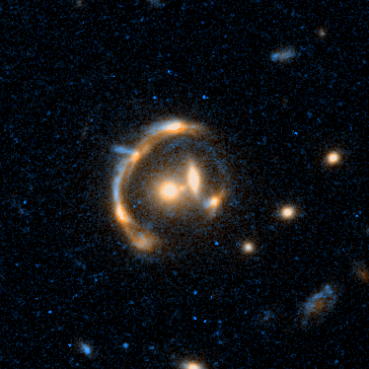
Credit: Tania Barone / AGEL Survey; HST program 16773 (PI Karl Glazebrook); reduced data: Hannah Skobe · Image source · Reuse information
Image details
Hubble Space Telescope / WFC3/UVIS; WFC3/IR; F200LP; F140W
CC0 1.0
- Other names
- DESJ2321-4630 [2]
Name origin
AGEL source cross-identificationName variants and source provenance
Published spellings and paper abbreviations retained for matching and traceability.
AGEL232128-463049A [1]AGEL DR2
- Catalog source
- AGEL
- Right ascension
- 350.368208°
23h 21m 28.37s [2] - Declination
- -46.513706°
−46° 30′ 49.34″ - Coordinates
- Equatorial J2000 · adopted catalog position
- Lens → Source
- Not yet classified
- Appearance
- Not yet classified
- Lens redshift
- 0.64 [3]
Measurement details
Photometric estimate; target-specific uncertainty not reported in this table. DR2 has no deflector spectroscopic redshift.
Method: BPZ photometric redshift of the foreground galaxy from DES Y3A1; not spectroscopy.
Source location: Table 3, arXiv:1905.10522v1 PDF p20, row DESJ2321-4630; final Table 1 note p3 and Sections 2.4–2.5 pp5–6.
- Discovery report
- Not available
- Explore
- External object viewer
Background sources
AGEL232128-463049A primary background source A [1]
- Source redshift
- 1.749 [1]
Measurement details
Reported uncertainty: −0.0005 / +0.0005
AGEL DR2 flag 2: limited precision; one strong line with weak/obscured second line, or several low-S/N features, are alternative causes. No target-specific cause is inferred. Formal error is not the complete uncertainty.
Method: AGEL spectroscopy with X-shooter; Section 3.1 line/template fitting.
Source location: Table 1, final PDF p10, row AGEL232128-463049A; columns 2–7; table note p10; Section 3.1 pp14–16.
- Einstein radius
- 3.13 arcsec [4]
Measurement details
Reported uncertainty: −0.32 / +0.32
Scatter of separations, or 10% for a single image, combined in quadrature with 0.263 arcsec pixel scale; not a mass-model posterior.
Method: Mean separation of primary deflector and source images in DES imaging; approximate image-plane Einstein radius.
Source location: Table 3 PDF p13, row DESJ2321-4630; Section 4 PDF pp15–16.
Evidence & coordinate notes
- Confirmation: Table 3, arXiv:1905.10522v1 PDF p20, row DESJ2321-4630; final Table 1 note p3 and Sections 2.4–2.5 pp5–6. [3]
- Confirmation: Section 2.4 PDF pp5–6: grade 3 means definitely a lens; mean of four author assessments. [5]
- Coordinates: Official AGEL_HST_objnames.tab line 67, exact row AGEL232128-463049A; headers RAJ2000/DECJ2000 [2]
- Description: Table 1, final PDF p10, row AGEL232128-463049A; columns 2–7; table note p10; Section 3.1 pp14–16. [1]
- Description: Table 3, arXiv:1905.10522v1 PDF p20, row DESJ2321-4630; final Table 1 note p3 and Sections 2.4–2.5 pp5–6. [3]
- Description: Table 3 PDF p13, DESJ2321-4630; Section 4 pp15–16 radius definition. [4]
- Source:source a: Table 1 PDF p10, AGEL232128-463049A; table note p10; distinct source labels, not individual image knots. [1]
References
- Barone et al. (2026), The AGEL Survey Data Release 2, AJ 171, 57; final journal version. DOI: 10.3847/1538-3881/ae1f86
- AGEL DR2 official AGEL_HST_objnames.tab, dataset version 1.0.
- Jacobs et al. (2019), extended DES strong-lens catalog; arXiv:1905.10522v1 Table 3 full rows. Final ApJS 243,17 Table 1 is abbreviated in the PDF. DOI: 10.3847/1538-4365/ab26b6
- O’Donnell et al. (2022), The Dark Energy Survey Bright Arcs Survey: Candidate Strongly Lensed Galaxy Systems from the Dark Energy Survey 5000 Square Degree Footprint, ApJS 259,27. DOI: 10.3847/1538-4365/ac470b
- Jacobs et al. (2019), An Extended Catalog of Galaxy–Galaxy Strong Gravitational Lenses Discovered in DES Using Convolutional Neural Networks, ApJS 243,17; final definitions. DOI: 10.3847/1538-4365/ab26b6