Catalog ID: GLC-57
AGEL213758-012924A
AGEL213758-012924A is an AGEL gravitational lens with one catalogued primary background source. [1]
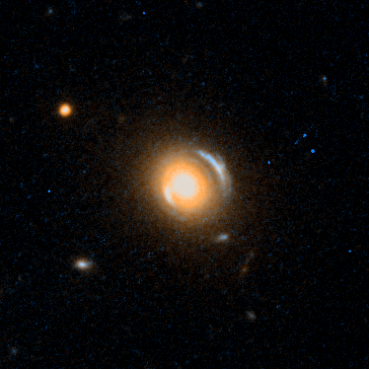
Credit: Tania Barone / AGEL Survey; HST program 16773 (PI Karl Glazebrook); reduced data: Hannah Skobe · Image source · Reuse information
Image details
Hubble Space Telescope / WFC3/UVIS; WFC3/IR; F200LP; F140W
CC0 1.0
- Other names
- DESJ2137-0129 [2]
Name origin
Official AGEL/HST mappingName variants and source provenance
Published spellings and paper abbreviations retained for matching and traceability.
AGEL213758-012924A [2]Official AGEL/HST mapping
- Catalog source
- AGEL
- Right ascension
- 324.49176°
21h 37m 58.02s [2] - Declination
- -1.48996°
−01° 29′ 23.86″ - Coordinates
- Equatorial J2000 · adopted catalog position
- Lens → Source
- Galaxy → Galaxy [3]
- Appearance
- Not yet classified
- Lens redshift
- 0.273 [1]
Measurement details
Reported uncertainty: −0.0005 / +0.0005
Reliable multiple-feature measurement in the survey. Formal error excludes possible tracer/rotation systematics discussed in section 3.1.
Method: Keck/ESI spectroscopy; Gaussian feature fits or MARZ templates (survey methods)
Source location: Table 1 p.9, AGEL213758-012924A; section 3.1 pp.14-16
- Discovery report
- Not available
- Explore
- External object viewer
Background sources
AGEL213758-012924A background source A [1]
- Source redshift
- 1.458 [1]
Measurement details
Reported uncertainty: −0.0005 / +0.0005
Reliable multiple-feature measurement in the survey. Formal error excludes possible tracer/rotation systematics discussed in section 3.1.
Method: Keck/ESI spectroscopy; Gaussian feature fits or MARZ templates (survey methods)
Source location: Table 1 p.9, AGEL213758-012924A; section 3.1 pp.14-16
- Einstein radius
- 2.1 arcsec [3]
Measurement details
Reported uncertainty: −0.9 / +0.9
Approximate image-position radius; not a precision HST mass-model parameter. Errors include measurement method limitations described in section 3.3.
Method: MCMC ring/line fit to source-image positions/light in DECaLS imaging
Source location: Table 2 p.15, AGEL213758-012924; section 3.3.1
Evidence & coordinate notes
- Confirmation: Table 1 p.9, AGEL213758-012924A; Figure 3 p.11 includes the named HST-program lens; section 3.1 distinguishes spectral quality from lensing. [1]
- Confirmation: Table 2 p.15, AGEL213758-012924; abstract/section 2: sample of spectroscopically confirmed strong lenses. [3]
- Coordinates: AGEL_HST_objnames.tab line 63 (AGEL213758-012924A / DESJ2137-0129); RAJ2000, DECJ2000 columns; catalog lens-system position, not source-plane astrometry. [2]
- Description: Table 1 p.9, AGEL213758-012924A; section 3.1 pp.14-16 (redshift methods and limitations). [1]
- Source:a: Table 1 p.9, AGEL213758-012924A; physical A/B naming explained p.4 and Table 1 note p.10. [1]
- System class: Table 2 p.15, AGEL213758-012924; Table 2 column definitions; sections 2 and 3.3.4 [3]
References
- Barone et al. (2026), The AGEL Survey Data Release 2, AJ 171, 57; final published article. DOI: 10.3847/1538-3881/ae1f86
- AGEL Survey, AGEL_HST_objnames.tab, Harvard Dataverse v1.0.
- Gottemoller et al. (2026), Most Strong Lensing Deflectors in the AGEL Survey Are in Group and Cluster Environments, AJ 171, 218; revised v2. DOI: 10.3847/1538-3881/ae4480