Catalog ID: GLC-52
AGEL205616-423857A
Candidate — published expert assessment [1] [3]
AGEL205616-423857A is an AGEL lens candidate with one catalogued primary background source. A galaxy-to-galaxy interpretation is inferred from its CNN-selected sample context, not from a measured halo mass. The original expert mean grade lies between probable and definite; no source redshift is reported in DR2. The deflector redshift has limited accuracy and/or precision. [1]
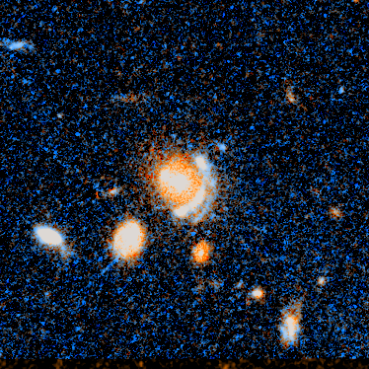
Credit: Tania Barone / AGEL Survey; HST program 16773 (PI Karl Glazebrook); reduced data: Hannah Skobe · Image source · Reuse information
Image details
Hubble Space Telescope / WFC3/UVIS; WFC3/IR; F200LP; F140W
CC0 1.0
- Other names
- DESJ2056-4238 [2]
Name origin
Official AGEL/HST mappingName variants and source provenance
Published spellings and paper abbreviations retained for matching and traceability.
AGEL205616-423857A [2]Official AGEL/HST mapping
- Catalog source
- AGEL
- Right ascension
- 314.0659°
20h 56m 15.82s [2] - Declination
- -42.64923°
−42° 38′ 57.23″ - Coordinates
- Equatorial J2000 · adopted catalog position
- Lens → Source
- Galaxy → Galaxy [1] [3]
- Appearance
- Not yet classified
- Lens redshift
- 0.720 [1]
Measurement details
Reported uncertainty: −0.0005 / +0.0005
Accuracy and/or precision is limited; a single feature or low signal-to-noise can cause this flag, but no target-specific cause is assigned. Formal uncertainty does not capture all uncertainty.
Method: VLT/X-shooter spectroscopy; Gaussian feature fits or MARZ templates (survey methods)
Source location: Table 1 p.9, AGEL205616-423857A; section 3.1 pp.14-16
- Discovery report
- Not available
- Explore
- External object viewer
Background sources
AGEL205616-423857A background source A [1]
- Source redshift
- Not available
- Einstein radius
- Not available
Evidence & coordinate notes
- Confirmation: Table 1 p.9, AGEL205616-423857A; Figure 3 p.11 includes the named HST-program lens; section 3.1 distinguishes spectral quality from lensing. [1]
- Confirmation: Final Table 1 online full table, DESJ2056-4238, line 493; header note (1) BPZ, note (2) selection flags; PDF p.3; section 2.4 pp.5-6 defines mean expert grades. [3]
- Coordinates: AGEL_HST_objnames.tab line 55 (AGEL205616-423857A / DESJ2056-4238); RAJ2000, DECJ2000 columns; catalog lens-system position, not source-plane astrometry. [2]
- Description: Table 1 p.9, AGEL205616-423857A; section 3.1 pp.14-16 (redshift methods and limitations). [1]
- Source:a: Table 1 p.9, AGEL205616-423857A; physical A/B naming explained p.4 and Table 1 note p.10. [1]
- System class: Table 1 p.9, AGEL205616-423857A; section 3.1 source-galaxy context [1]
- System class: Final Table 1 online full table, DESJ2056-4238, line 493; header note (1) BPZ, note (2) selection flags; PDF p.3; sections 2.1, 2.4 pp.3-6 and 3.5 p.8; sample-context inference, not measured halo mass. [3]
References
- Barone et al. (2026), The AGEL Survey Data Release 2, AJ 171, 57; final published article. DOI: 10.3847/1538-3881/ae1f86
- AGEL Survey, AGEL_HST_objnames.tab, Harvard Dataverse v1.0.
- Jacobs et al. (2019), An Extended Catalog of Galaxy-Galaxy Strong Gravitational Lenses Discovered in DES Using Convolutional Neural Networks, ApJS 243, 17; final article and online Table 1. DOI: 10.3847/1538-4365/ab26b6