Catalog ID: GLC-50
AGEL172703+110008A
AGEL172703+110008A is an AGEL gravitational lens with one catalogued primary background source. The source redshift is measured, while the deflector redshift and dominant mass scale remain unspecified in the adopted evidence. [1]
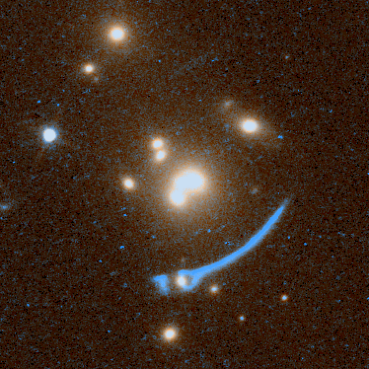
Credit: Tania Barone / AGEL Survey; HST program 16773 (PI Karl Glazebrook); reduced data: Hannah Skobe · Image source · Reuse information
Image details
Hubble Space Telescope / WFC3/UVIS; WFC3/IR; F200LP; F140W
CC0 1.0
- Other names
- DCLS1727+1100 [2]
Name origin
Official AGEL/HST mappingName variants and source provenance
Published spellings and paper abbreviations retained for matching and traceability.
AGEL172703+110008A [2]Official AGEL/HST mapping
- Catalog source
- AGEL
- Right ascension
- 261.7636919°
17h 27m 03.29s [2] - Declination
- 11.00210541°
+11° 00′ 07.58″ - Coordinates
- Equatorial J2000 · adopted catalog position
- Lens → Source
- Not yet classified
- Appearance
- Not yet classified
- Lens redshift
- Not available
- Discovery report
- Not available
- Explore
- External object viewer
Background sources
AGEL172703+110008A background source A [1]
- Source redshift
- 1.337 [1]
Measurement details
Reported uncertainty: −0.0005 / +0.0005
Reliable multiple-feature measurement in the survey. Formal error excludes possible tracer/rotation systematics discussed in section 3.1.
Method: Keck/NIRES spectroscopy; Gaussian feature fits or MARZ templates (survey methods)
Source location: Table 1 p.9, AGEL172703+110008A; section 3.1 pp.14-16
- Einstein radius
- Not available
Evidence & coordinate notes
- Confirmation: Table 1 p.9, AGEL172703+110008A; Figure 3 p.11 includes the named HST-program lens; section 3.1 distinguishes spectral quality from lensing. [1]
- Confirmation: Table 2 AGEL172703+110008 with source Qz=2; section 3.1 secure one-redshift strong-lens sample. [3]
- Coordinates: AGEL_HST_objnames.tab line 51 (AGEL172703+110008A / DCLS1727+1100); RAJ2000, DECJ2000 columns; catalog lens-system position, not source-plane astrometry. [2]
- Description: Table 1 p.9, AGEL172703+110008A; section 3.1 pp.14-16 (redshift methods and limitations). [1]
- Source:a: Table 1 p.9, AGEL172703+110008A; physical A/B naming explained p.4 and Table 1 note p.10. [1]
References
- Barone et al. (2026), The AGEL Survey Data Release 2, AJ 171, 57; final published article. DOI: 10.3847/1538-3881/ae1f86
- AGEL Survey, AGEL_HST_objnames.tab, Harvard Dataverse v1.0.
- Tran et al. (2022), AGEL Survey: Spectroscopic Confirmation of Strong Gravitational Lenses, AJ 164, 148. DOI: 10.3847/1538-3881/ac7da2