Catalog ID: GLC-49
AGEL150745+052256A
Confirmed — combined [1] [3] [4]
A galaxy-scale double-source-plane lens with a dominant foreground galaxy and nearby perturbers. Source A/S1 at redshift 2.163 forms the bright cusp arc; source B/S2 at 2.591 has four images. The 2.875 arcsecond radius is the earlier source-A major-axis model parameter; the 3.10 arcsecond effective radius is for source B. The mass-threshold group label in the environment study is retained in provenance. [1] [4]
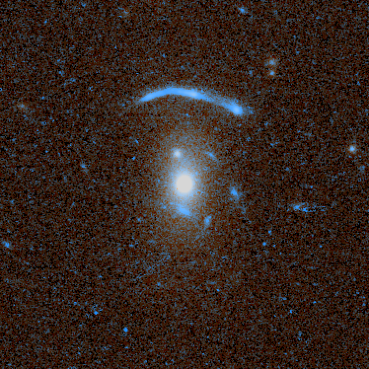
Credit: Tania Barone / AGEL Survey; HST program 16773 (PI Karl Glazebrook); reduced data: Hannah Skobe · Image source · Reuse information
Image details
Hubble Space Telescope / WFC3/UVIS; WFC3/IR; F200LP; F140W
CC0 1.0
- Other names
- DCLS1507+0522 [2]
Name origin
Official AGEL/HST mappingName variants and source provenance
Published spellings and paper abbreviations retained for matching and traceability.
AGEL150745+052256A [2]Official AGEL/HST mapping
- Catalog source
- AGEL
- Right ascension
- 226.9381065°
15h 07m 45.15s [2] - Declination
- 5.38230017°
+05° 22′ 56.28″ - Coordinates
- Equatorial J2000 · adopted catalog position
- Lens → Source
- Galaxy → Galaxy [3] [4]
- Appearance
- Arc [4]Quadruple image [4]
- Lens redshift
- 0.594 [4]
Measurement details
Numerical redshift error not supplied here; retained at dedicated-study precision. DR2 Table 1 gives 0.595; no averaging.
Method: SDSS-BOSS spectroscopy reported by dedicated lens study
Source location: Final article section 3.1 p.4, main deflector DG1
- Discovery report
- Not available
- Explore
- External object viewer
Background sources
AGEL150745+052256A background source A [1]
- Source redshift
- 2.163 [4]
Measurement details
No numerical redshift uncertainty reported in this section. Prefer source-specific photospheric determination to DR2 NIRES 2.164; tracer explanation is not asserted as the cause of discrepancy.
Method: Keck/KCWI stellar photospheric absorption spectroscopy
Source location: Final article section 3.1 p.4 and Figure 3: S1
- Einstein radius
- 2.875 arcsec [5]
Measurement details
Reported uncertainty: −0.047 / +0.047
Projected Einstein radius along major axis, not circularized. Source A only; 68% posterior bounds (16th/84th percentiles), section 4.1.
Method: HST/F140W GLEE single-source SPEMD power-law mass model
Source location: Final Table A1 p.15, R_Eins row, AGEL1507 column; section 3.1 p.5 and 4.1 p.7
AGEL150745+052256B background source B [1]
- Source redshift
- 2.591 [4]
Measurement details
No numerical redshift uncertainty supplied in this section; Ly-alpha is not assumed to equal systemic velocity exactly.
Method: Keck/KCWI Ly-alpha emission in four lensed images
Source location: Final article section 3.1 p.4 and Figure 4: S2
- Einstein radius
- 3.10 arcsec [4]
Measurement details
Reported uncertainty: −0.04 / +0.08
68% credible region; DG1 effective projected radius enclosing mean convergence 1 for farther S2/B, not A.
Method: HST/F140W composite NFW plus stellar model, multiplane lenstronomy
Source location: Final article Table 1 p.10 DG1(total); section 5 p.8 first result
Evidence & coordinate notes
- Appearance:arc: Figure 2 p.4 and section 3.3 p.5: S1 bright cusp arc. [4]
- Appearance:quadruple: Figure 2 p.4: four images of S2/B, not of source A. [4]
- Confirmation: Table 1 p.8, AGEL150745+052256A; Figure 3 p.11 includes the named HST-program lens; section 3.1 distinguishes spectral quality from lensing. [1]
- Confirmation: Table 2 p.15, AGEL150745+052256; abstract/section 2: sample of spectroscopically confirmed strong lenses. [3]
- Confirmation: Sections 3.1/3.3 pp.4-5 and Figure 2; two spectroscopically distinct lensed galaxies, not two images of one source. [4]
- Coordinates: AGEL_HST_objnames.tab line 50 (AGEL150745+052256A / DCLS1507+0522); RAJ2000, DECJ2000 columns; catalog lens-system position, not source-plane astrometry. [2]
- Description: Table 1 p.8, AGEL150745+052256A; section 3.1 pp.14-16 (redshift methods and limitations). [1]
- Description: Sections 3.1/3.3 pp.4-5; Table 1 p.10; source A/S1 naked cusp, B/S2 four images; satellite redshifts assumed, not measured. [4]
- Source:a: Table 1 p.8, AGEL150745+052256A; physical A/B naming explained p.4 and Table 1 note p.10. [1]
- Source:b: Table 1 p.8, AGEL150745+052256B; Table 4 p.21 A/B redshift mapping; physical A/B naming explained p.4 and Table 1 note p.10. [1]
- System class: Table 2 p.15 exact row; section A.4 visual central deflector versus mass threshold [3]
- System class: Introduction p.2 exact AGEL150745+052256 galaxy-scale DSPL; sections 3.1/3.3 pp.4-5 and 4-5 [4]
References
- Barone et al. (2026), The AGEL Survey Data Release 2, AJ 171, 57; final published article. DOI: 10.3847/1538-3881/ae1f86
- AGEL Survey, AGEL_HST_objnames.tab, Harvard Dataverse v1.0.
- Gottemoller et al. (2026), Most Strong Lensing Deflectors in the AGEL Survey Are in Group and Cluster Environments, AJ 171, 218; revised v2. DOI: 10.3847/1538-3881/ae4480
- Sahu et al. (2025), Cosmography with the Double-source-plane Strong Gravitational Lens AGEL150745+052256, ApJ 991, 72; final article inspected through institutional PDF web extraction. DOI: 10.3847/1538-4357/adf442
- Sahu et al. (2024), AGEL: Is the Conflict Real? ApJ 970, 86; final institutional PDF and accepted manuscript v2 inspected. DOI: 10.3847/1538-4357/ad4ce3