Catalog ID: GLC-44
AGEL094412+322039A
Confirmed — spectroscopy [1] [3]
AGEL094412+322039A is an AGEL strong gravitational lens with a background source at reported redshift 2.828. The deflector redshift is 0.5952291. The environment study classifies the deflector as group-scale from its estimated enclosed lensing mass; this is distinct from the surrounding photometric environment. The reported 2.1 arcsec Einstein radius is an approximate image-position estimate. The same study visually identifies one enclosed deflector galaxy. The group-scale label is a mass convention, not established physical group membership. [1] [3]
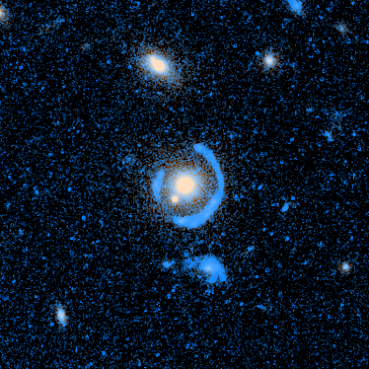
Credit: Tania Barone / AGEL DR2; HST program 16773 (PI Glazebrook); reduced data: Hannah Skobe. · Image source · Reuse information
Image details
Hubble Space Telescope / WFC3; F200LP, F140W
CC0 1.0
- Other names
- DCLS0944+3220 [2]
Name origin
AGEL HST mappingName variants and source provenance
Published spellings and paper abbreviations retained for matching and traceability.
AGEL094412+322039A [2]AGEL HST mapping
- Catalog source
- AGEL
- Right ascension
- 146.0493047°
09h 44m 11.83s [2] - Declination
- 32.34410368°
+32° 20′ 38.77″ - Coordinates
- Equatorial J2000 · adopted catalog position
- Lens → Source
- Group → Galaxy [3] [5]
- Appearance
- Not yet classified
- Lens redshift
- 0.5952291 [4]
Measurement details
Reported uncertainty: −0.0001782509 / +0.0001782509
SDSS spectral-fit zErr; zWarning=0. Not an AGEL quality flag or lens-confirmation statistic.
Method: SDSS pipeline spectroscopy
Source location: Table1.Rows[0], specObjID 6537206137313581056; plate 5806, MJD 56310, fiber 841.
- Discovery report
- Not available
- Explore
- External object viewer
Background sources
Background source A [1]
- Source redshift
- 2.828 [1]
Measurement details
Reported uncertainty: −0.0005 / +0.0005
Formal ±0.0005; reliable multiple-feature measurement. Section 3.1 notes possible internal-rotation and interstellar-line offsets in applicable spectra; no target-specific cause is assumed.
Method: Spectroscopy; AGEL barycentric redshift
Source location: Table 1, PDF/printed p.8, row AGEL094412+322039A; columns 2–7; Section 3.1 pp.14–16.
- Einstein radius
- 2.1 arcsec [3]
Measurement details
Reported uncertainty: −0.9 / +0.9
Approximate image-based radius. Uncertainty includes half arc width and systematic scatter against HST models; no object-specific ring/line branch is asserted.
Method: DECaLS source-light/image-position MCMC; ring or line estimator
Source location: Table 3, PDF p.16, row AGEL094412+322039; column 4; Sections 3.3.1–3.3.3 pp.6–8.
Evidence & coordinate notes
- Confirmation: Table 1, PDF/printed p.8, row AGEL094412+322039A; columns 2–7; Section 3.1 pp.14–16. Spectroscopy and HST sample context; Section 4.1/Table 3 pp.17–18 lists false positives. [1]
- Confirmation: Abstract and Section 2.1 pp.1–2 define the 89 spectroscopically confirmed lenses; exact target row in Table 3 p.16. [3]
- Coordinates: AGEL_HST_objnames.tab line 38 (header line 1), columns AGEL objname, HST objnames, RAJ2000, DECJ2000 [2]
- Description: Table 1, PDF/printed p.8, row AGEL094412+322039A; columns 2–7; Section 3.1 pp.14–16. [1]
- Description: Table 3, PDF p.16, row AGEL094412+322039; column 4; Sections 3.3.1–3.3.3 pp.6–8. [3]
- Source:source a: Final AJ 171:57 (2026), Table 1 PDF/printed p. 8, row AGEL094412+322039A; naming paragraph p. 4 [1]
- System class: Gottemoller Table 3 p.16 AGEL094412+322039, columns 5,9–12 and Section 3.3.4 p.8. Adopt the author’s mass-scale convention; physical group membership is not established. [3]
- System class: Sections 2.1.1–2.1.2 pp.2–4 and Figure 1 p.3: galaxy-source selection context, with group/cluster deflector exceptions. Full group_galaxy mapping is inference, not a direct full-pair statement. [5]
References
- Barone et al. (2026), The AGEL Survey Data Release 2, AJ 171, 57. DOI: 10.3847/1538-3881/ae1f86
- AGEL HST object-name mapping, AGEL_HST_objnames.tab.
- Gottemoller et al. (2026), Most Strong Lensing Deflectors in the AGEL Survey Are in Group and Cluster Environments, AJ 171, 218; published-layout arXiv v2. DOI: 10.3847/1538-3881/ae4480
- SDSS DR17 SpecObj original spectral fit; nearby-spectrum positional match.
- Tran et al. (2022), The AGEL Survey: Spectroscopic Confirmation of Strong Gravitational Lenses in the DES and DECaLS Fields Selected Using Convolutional Neural Networks, AJ 164, 148. DOI: 10.3847/1538-3881/ac7da2