Catalog ID: GLC-43
AGEL085413-042409A
Confirmed — spectroscopy [1]
A galaxy deflector at redshift 0.856 multiply lenses two background galaxies at the common reported redshift 2.393. Integral-field spectroscopy establishes that the apparent spiral-like features belong to background galaxies. Separate spatial or spectral assignments for the two source galaxies are not specified here. [1]
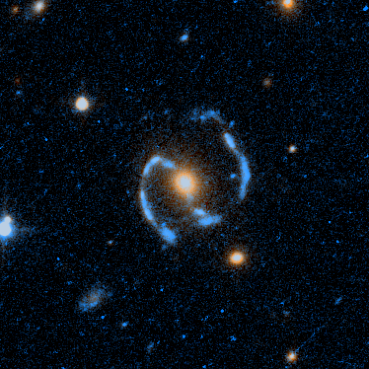
Credit: Tania Barone / AGEL DR2; HST program 16773 (PI Glazebrook); reduced data: Hannah Skobe. · Image source · Reuse information
Image details
Hubble Space Telescope / WFC3; F200LP, F140W
CC0 1.0
- Other names
- DCLS0854-0424 [2]
Name origin
AGEL HST mappingName variants and source provenance
Published spellings and paper abbreviations retained for matching and traceability.
AGEL085413-042409A [2]AGEL HST mapping
- Catalog source
- AGEL
- Right ascension
- 133.5530834°
08h 54m 12.74s [2] - Declination
- -4.40257156°
−04° 24′ 09.26″ - Coordinates
- Equatorial J2000 · adopted catalog position
- Lens → Source
- Galaxy → Galaxy [1]
- Appearance
- Not yet classified
- Lens redshift
- 0.856 [1]
Measurement details
No target-specific uncertainty or quality flag accompanies the deflector value in Figure 9/Section 4.1.
Method: Keck/KCWI integral-field spectroscopy
Source location: Figure 9 p.17; Section 4.1 p.18, AGEL085413-042409A deflector z=0.856; Table 1 deflector entry is blank.
- Discovery report
- Not available
- Explore
- External object viewer
Background sources
Background galaxy 1 of the spectroscopically identified pair [1]
- Source redshift
- 2.393 [1]
Measurement details
Reported uncertainty: −0.0005 / +0.0005
Formal ±0.0005; reliable multiple-feature measurement. Section 3.1 notes possible internal-rotation and interstellar-line offsets in applicable spectra; no target-specific cause is assumed. Common reported value for two physical galaxies; no independent per-galaxy uncertainty supplied.
Method: Spectroscopy; AGEL barycentric redshift
Source location: Table 1, PDF/printed p.7, row AGEL085413-042409A; columns 2–7; Section 3.1 pp.14–16. Figure 9 p.17; Section 4.1 p.18 establishes both galaxies.
- Einstein radius
- Not available
Background galaxy 2 of the spectroscopically identified pair [1]
- Source redshift
- 2.393 [1]
Measurement details
Reported uncertainty: −0.0005 / +0.0005
Formal ±0.0005; reliable multiple-feature measurement. Section 3.1 notes possible internal-rotation and interstellar-line offsets in applicable spectra; no target-specific cause is assumed. Common reported value for two physical galaxies; no independent per-galaxy uncertainty supplied.
Method: Spectroscopy; AGEL barycentric redshift
Source location: Table 1, PDF/printed p.7, row AGEL085413-042409A; columns 2–7; Section 3.1 pp.14–16. Figure 9 p.17; Section 4.1 p.18 establishes both galaxies.
- Einstein radius
- Not available
Evidence & coordinate notes
- Confirmation: Table 1, PDF/printed p.7, row AGEL085413-042409A; columns 2–7; Section 3.1 pp.14–16. Figure 9 p.17; Section 4.1 p.18 explicitly confirms multiply lensed galaxies. [1]
- Coordinates: AGEL_HST_objnames.tab line 36 (header line 1), columns AGEL objname, HST objnames, RAJ2000, DECJ2000 [2]
- Description: Table 1, PDF/printed p.7, row AGEL085413-042409A; columns 2–7; Section 3.1 pp.14–16. Figure 9 p.17; Section 4.1 p.18. [1]
- Source:source 1: Figure 9 caption p. 17 and Section 4.1 paragraph p. 18: two z=2.393 galaxies, both multiply lensed by z=0.856 deflector. [1]
- Source:source 2: Figure 9 caption p. 17 and Section 4.1 paragraph p. 18: two z=2.393 galaxies, both multiply lensed by z=0.856 deflector. [1]
- System class: Barone Figure 9 p.17 and Section 4.1 p.18, AGEL085413-042409A. [1]
References
- Barone et al. (2026), The AGEL Survey Data Release 2, AJ 171, 57. DOI: 10.3847/1538-3881/ae1f86
- AGEL HST object-name mapping, AGEL_HST_objnames.tab.