Catalog ID: GLC-36
AGEL025220-473238A
Published visual inspection identifies this system as a probable lens candidate. AGEL025220-473238A is included in the AGEL DR2 lens sample. The reported deflector redshift is 0.494. The primary source redshift is not reported in the inspected DR2 table. The newer DES Bright Arcs catalog reports an approximate Einstein radius of 2.94 ± 0.39 arcsec from image separation, not a precision mass model; lensing remains a candidate interpretation. [1] [3] [4]
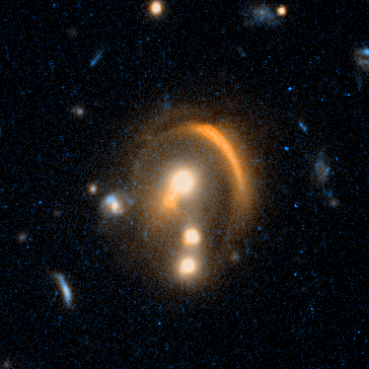
Credit: Tania Barone (Swinburne University of Technology), AGEL Survey DR2; HST program 16773 (PI Glazebrook). · Image source · Reuse information
Image details
Hubble Space Telescope / WFC3 (UVIS and IR); F200LP, F140W
CC0 1.0
- Other names
- DESJ0252-4732 [2]
Name origin
AGEL HST mappingName variants and source provenance
Published spellings and paper abbreviations retained for matching and traceability.
AGEL025220-473238A [1]AGEL DR2
- Catalog source
- AGEL
- Right ascension
- 43.082837°
02h 52m 19.88s [2] - Declination
- -47.543816°
−47° 32′ 37.74″ - Coordinates
- Equatorial J2000 · adopted catalog position
- Lens → Source
- Not yet classified
- Appearance
- Not yet classified
- Lens redshift
- 0.494 [1]
Measurement details
Reported uncertainty: −0.0005 / +0.0005
Reliable measurement from multiple well-detected spectral features; formal uncertainty does not include every systematic effect.
Method: VLT/X-shooter spectroscopy; AGEL spectral-feature/template fitting
Source location: Barone et al. 2026, Table 1, PDF p.6, row AGEL025220-473238A; Section 3.1, PDF pp.15–16.
- Discovery report
- Not available
- Explore
- External object viewer
Background sources
Background source A [1]
- Source redshift
- Not available
- Einstein radius
- 2.94 arcsec [4]
Measurement details
Reported uncertainty: −0.39 / +0.39
Approximate image-separation radius for candidate source. Section 4 uses separation scatter for multiple images or 10% for one image, added in quadrature with 0.263 arcsec pixel scale; single-image estimates can overestimate Einstein radius.
Method: DES mean separation of source images from primary lens; not a mass-model radius
Source location: O’Donnell et al. 2022, Table 3 p.11, DESJ0252-4732; Section 4 pp.15–16; Figure 13 p.18, row 3 column 1. Table 3 notes p.13 identify Diehl 2017 and Jacobs 2019b.
Evidence & coordinate notes
- Confirmation: Jacobs et al. 2019, Table 3 p.15, DESJ0252-4732, grade 2.3; Section 2.4 pp.5–6 defines mean visual grades: 2 probably a lens, 3 definitely a lens. Position matches DR2 Table 1 p.6. [3]
- Confirmation: Table 3 p.11 DESJ0252-4732 rank 7; Section 3 p.7: five judges each score 0–2, summed 0–10; ranks 3–10 span possible to definite. No target-specific definitive confirmation claimed. [4]
- Coordinates: Header line 1 (RAJ2000, DECJ2000); data line 21, AGEL025220-473238A / DESJ0252-4732 [2]
- Description: Barone et al. 2026, Table 1, PDF p.6, row AGEL025220-473238A; Section 3.1, PDF pp.15–16. [1]
- Description: Jacobs et al. 2019, Table 3 p.15, DESJ0252-4732, grade 2.3; Section 2.4 pp.5–6 defines mean visual grades: 2 probably a lens, 3 definitely a lens. Position matches DR2 Table 1 p.6. [3]
- Description: O’Donnell et al. 2022, Table 3 p.11, DESJ0252-4732; Section 4 pp.15–16; Figure 13 p.18, row 3 column 1. Table 3 notes p.13 identify Diehl 2017 and Jacobs 2019b. [4]
- RecordSource: Title, Section 1; Table 1 target row. AGEL is catalog provenance, not an assertion of original discovery credit. [1]
- Source:source a: Barone et al. 2026, Table 1, PDF p.6, row AGEL025220-473238A; Section 1 suffix convention; Section 3.1 quality definitions. [1]
References
- Barone et al. (2026), The AGEL Survey Data Release 2, AJ 171, 57. Final published article. DOI: 10.3847/1538-3881/ae1f86
- AGEL DR2 official AGEL_HST_objnames.tab; J2000 positions and HST cross-identifications.
- Jacobs et al. (2019), An Extended Catalog of Galaxy-Galaxy Strong Gravitational Lenses Discovered in DES Using Convolutional Neural Networks; accepted manuscript. DOI: 10.3847/1538-4365/ab26b6
- O’Donnell et al. (2022), The Dark Energy Survey Bright Arcs Survey, ApJS 259, 27; published institutional PDF. DOI: 10.3847/1538-4365/ac470b