Catalog ID: GLC-32
AGEL020613-011417A
Confirmed — published expert assessment [3]
AGEL020613-011417A is included in the AGEL DR2 lens sample. The adopted deflector redshift is the DR2 SDSS value 0.714, supported by the original SDSS catalog spectrum. Source A has reported redshift 1.303. A later environment compilation instead uses deflector redshift 0.632; the cause of the discrepancy is unknown. An approximate image-position Einstein radius of 1.5 ± 1.1 arcsec is reported from DECaLS imaging; this is not a precision mass-model radius. [1] [3] [4]
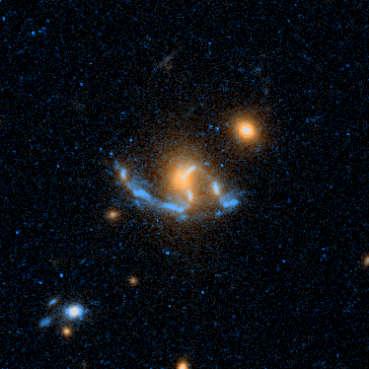
Credit: Tania Barone (Swinburne University of Technology), AGEL Survey DR2; HST program 16773 (PI Glazebrook). · Image source · Reuse information
Image details
Hubble Space Telescope / WFC3 (UVIS and IR); F200LP, F140W
CC0 1.0
- Other names
- DESJ0206-0114 [2]
Name origin
AGEL HST mappingName variants and source provenance
Published spellings and paper abbreviations retained for matching and traceability.
AGEL020613-011417A [1]AGEL DR2
- Catalog source
- AGEL
- Right ascension
- 31.55611°
02h 06m 13.47s [2] - Declination
- -1.23817°
−01° 14′ 17.41″ - Coordinates
- Equatorial J2000 · adopted catalog position
- Lens → Source
- Not yet classified
- Appearance
- Not yet classified
- Lens redshift
- 0.714 [1]
Measurement details
DR2 rounded SDSS literature value. Original DR17 spectrum reports z=0.7143014, zErr=0.000160705; retained separately without attaching excess precision to rounded DR2 value. Environment compilation gives 0.632; discrepancy cause unknown.
Method: SDSS spectroscopy as compiled by AGEL
Source location: Barone et al. 2026, Table 1, PDF p.6, row AGEL020613-011417A; Section 3.1, PDF pp.15–16. Table 1 footnote, p.10: caret denotes literature measurement; proposal column identifies SDSS.
- Discovery report
- Not available
- Explore
- External object viewer
Background sources
Background source A [1]
- Source redshift
- 1.303 [1]
Measurement details
Reported uncertainty: −0.0005 / +0.0005
Reliable measurement from multiple well-detected spectral features; formal uncertainty does not include every systematic effect.
Method: Keck/NIRES spectroscopy; AGEL spectral-feature/template fitting
Source location: Barone et al. 2026, Table 1, PDF p.6, row AGEL020613-011417A; Section 1 suffix convention; Section 3.1 quality definitions.
- Einstein radius
- 1.5 arcsec [3]
Measurement details
Reported uncertainty: −1.1 / +1.1
Approximate image-position/light estimate. Uncertainty includes half arc width and model-dependent systematic scatter against HST models. Target-specific ring/line subtype not established.
Method: DECaLS source-light MCMC ring/line family; not detailed HST mass modeling
Source location: Gottemoller et al. 2026, Table 4, PDF p.17, row AGEL020613-011417, column 4; Sections 3.3.1–3.3.3, PDF pp.6–8; Table 2 notes, p.15.
Evidence & coordinate notes
- Confirmation: Abstract and Section 2: sample of spectroscopically confirmed strong lenses; Table 4, p.17, row AGEL020613-011417. Source-redshift reliability remains separately qualified. [3]
- Coordinates: Header line 1 (RAJ2000, DECJ2000); data line 15, AGEL020613-011417A / DESJ0206-0114 [2]
- Description: Barone et al. 2026, Table 1, PDF p.6, row AGEL020613-011417A; Section 3.1, PDF pp.15–16. [1]
- Description: Gottemoller et al. 2026, Table 4, PDF p.17, row AGEL020613-011417, column 4; Sections 3.3.1–3.3.3, PDF pp.6–8; Table 2 notes, p.15. [3]
- Description: SpecObj result row 4768296422973134848: RA 31.556108, Dec -1.2381042, z 0.7143014, zErr 0.000160705, zWarning 0; within 0.24 arcsec of mapping position. [4]
- RecordSource: Title, Section 1; Table 1 target row. AGEL is catalog provenance, not an assertion of original discovery credit. [1]
- Source:source a: Barone et al. 2026, Table 1, PDF p.6, row AGEL020613-011417A; Section 1 suffix convention; Section 3.1 quality definitions. [1]
References
- Barone et al. (2026), The AGEL Survey Data Release 2, AJ 171, 57. Final published article. DOI: 10.3847/1538-3881/ae1f86
- AGEL DR2 official AGEL_HST_objnames.tab; J2000 positions and HST cross-identifications.
- Gottemoller et al. (2026), Most Strong Lensing Deflectors in the AGEL Survey Are in Group and Cluster Environments, AJ 171, 218; inspected arXiv v2 published-layout archive. DOI: 10.3847/1538-3881/ae4480
- SDSS DR17 SpecObj positional query; spectrum 4768296422973134848, plate 4235, MJD 55451, fiber 401.