Catalog ID: GLC-31
AGEL014253-183116A
Confirmed — spectroscopy [2]
AGEL014253-183116A (DESJ0142-1831; AGEL 0142) is a spectroscopically confirmed galaxy-scale gravitational lens. An early-type deflector at z = 0.63627 lenses a background galaxy at z = 2.46972. HST-based GLEE modeling gives a projected major-axis Einstein radius of 2.333 ± 0.044 arcsec. The deflector may be a brightest group or cluster galaxy; environmental halo contributions are possible, and membership is not established. [1]
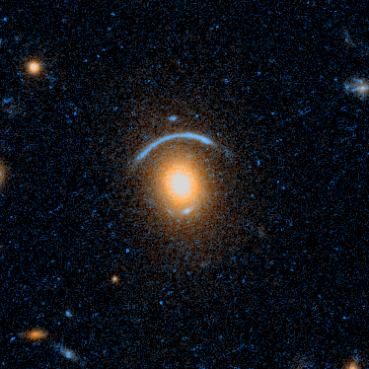
Credit: Tania Barone / AGEL Survey Data Release 2; Hubble Space Telescope program 16773 (PI Karl Glazebrook). Dataset: doi:10.7910/DVN/ATFVNA. · Image source · Reuse information
Image details
Hubble Space Telescope / WFC3; F200LP, F140W (mock RGB composite)
CC0 1.0 Universal (CC0-1.0)
- Other names
- DESJ0142-1831 [3]
Name origin
DES / AGEL DR2 cross-identificationName variants and source provenance
Published spellings and paper abbreviations retained for matching and traceability.
AGEL014253-183116A [3]AGEL DR2
AGEL 014253-183116 [1]AGEL pilot modeling (ASCII minus transcription)
AGEL014253-183116 [1]AGEL designation (whitespace-normalized transcription)
AGEL 0142 [1]AGEL pilot modeling short name
- Catalog source
- AGEL
- Right ascension
- 25.72030°
01h 42m 52.87s [3] [4] - Declination
- -18.52105°
−18° 31′ 15.78″ - Coordinates
- Equatorial J2000 · adopted catalog position
- Lens → Source
- Galaxy → Galaxy [1]
- Appearance
- Arc [3]
- Lens redshift
- 0.63627 [2]
Measurement details
Qz = 3 (robust). Tran Table 2 note e gives typical delta(z) < 0.00005; not a target-specific symmetric error. Sahu Table 1 gives typical uncertainty <= approximately 0.00005.
Method: Spectroscopy; multiple-line Gaussian fitting and median line redshift (Tran Section 2.5). VLT/X-shooter assigned in AGEL DR2 Table 4.
Source location: Table 2, p. 8, row AGEL 014253-183116, zdefl/Qzdefl and zsrc/Qzsrc columns; notes e-f p. 9; Section 2.5 pp. 5, 7.
- Discovery report
- Not available
- Explore
- External object viewer [5]
Background sources
Primary background galaxy associated with main arc A [1]
- Source redshift
- 2.46972 [2]
Measurement details
Qz = 3 (robust). Tran Table 2 note e gives typical delta(z) < 0.00005; not a target-specific symmetric error. Sahu Table 1 gives typical uncertainty <= approximately 0.00005.
Method: Spectroscopy; multiple-line Gaussian fitting and median line redshift (Tran Section 2.5). VLT/X-shooter assigned in AGEL DR2 Table 4.
Source location: Table 2, p. 8, row AGEL 014253-183116, zdefl/Qzdefl and zsrc/Qzsrc columns; notes e-f p. 9; Section 2.5 pp. 5, 7.
- Einstein radius
- 2.333 arcsec [1]
Measurement details
Reported uncertainty: −0.044 / +0.044
Projected major-axis R_Eins, not spherical-equivalent theta_Eins. Posterior median; 16th/84th percentiles give 68% bounds. Model-dependent statistical uncertainty; environmental systematics not included.
Method: GLEE lensing-only fit to HST/WFC3 F140W imaging: SPEMD power-law mass profile plus external shear; fixed core radius 0.0001 arcsec.
Source location: Appendix A, Table A1, R_Eins (arcsec) row, AGEL 0142 column; caption; Sections III.1 and IV.1.
Evidence & coordinate notes
- Confirmation: Table 2 p. 8, AGEL 014253-183116: deflector z=0.63627 and source z=2.46972, both Qz=3; notes e-f p. 9; Sections 2.5 and 3.2 p. 7. [2]
- Coordinates: Table 4, row AGEL014253-183116A, columns 10-11: 25.72030, -18.52105; Table A1 row 8 cross-identifies DESJ0142-1831, with alternative DEC -18.52110. [3]
- Coordinates: CDS table1.dat line 105, DESJ0142-1831 / objID 266036534; ReadMe byte descriptions RAdeg (26-34) and DEdeg (36-44): decimal degrees, J2000. [4]
- Description: Section II designation mapping; Table 1 AGEL 0142 redshifts; Appendix A Table A1 R_Eins row and caption; Figure 2 and Section IV.1; Section IV.2 paragraph beginning In the DESI survey viewer (possible BCG/BGG). [1]
- Lensing appearance: Table 4 AGEL014253-183116A; caption defines suffix A as main arc. Arc label does not assert a complete ring or image multiplicity. [3]
- Object url: Browser-visual field check at RA 25.7203 deg, Dec -18.5211 deg, zoom15; DR11 imagery loaded. Centre differs from adopted position by 0.18 arcsec in declination. Field link only, not a named-object database page or independent scientific confirmation. Checked 2026-10-29T00:35:27Z. [5]
- Record source: Table 4 AGEL014253-183116A and Table A1 row 8: AGEL survey target with DESJ0142-1831 cross-identification. [3]
- System class: Section II identifies seven galaxy-scale lenses; Section IV.1 and Figure 2 reconstruct the background source of AGEL 0142; Section VI describes the deflectors as early-type galaxies. Section IV.2 qualifies the possible group/cluster environment. [1]
References
- Sahu et al. (2024), AGEL: Is the Conflict Real? Investigating Galaxy Evolution Models using Strong Lensing at 0.3 < z < 0.9; arXiv:2405.15427v2.
- Tran et al. (2022), The AGEL Survey: Spectroscopic Confirmation of Strong Gravitational Lenses in the DES and DECaLS Fields Selected Using Convolutional Neural Networks, AJ 164, 148. DOI: 10.3847/1538-3881/ac7da2
- Barone et al. (2025), The AGEL Survey Data Release 2: A Gravitational Lens Sample for Galaxy Evolution and Cosmology; arXiv:2503.08041v1.
- Jacobs et al. (2019), An Extended Catalog of Galaxy-Galaxy Strong Gravitational Lenses Discovered in DES Using Convolutional Neural Networks, ApJS 243, 17; CDS J/ApJS/243/17, table1.dat and ReadMe.
- Legacy Surveys Sky Browser, DR11 coordinate-centred field for AGEL014253-183116A / DESJ0142-1831. Browser field inspected 28 October 2026 (New York); see object-viewer evidence note.