Catalog ID: GLC-30
AGEL014106-171324A
Confirmed — spectroscopy [1] [3]
AGEL014106-171324A (DESJ0141-1713) is a spectroscopically confirmed gravitational lens with a foreground deflector at redshift 0.609 and one represented background source at redshift 2.436. Both redshifts are supported by multiple well-detected spectral features. The source redshift is measured from interstellar absorption and may differ from the systemic velocity. An image-based estimate gives an Einstein radius of 3.9 ± 1.1 arcsec; this is an approximate light-position measurement rather than a detailed mass-model radius. Photometric environment analysis places the system in a cluster-like environment, which does not establish spectroscopic cluster membership. The deflector-scale classification is left unknown because the environment paper contains conflicting scale thresholds. [1] [3]
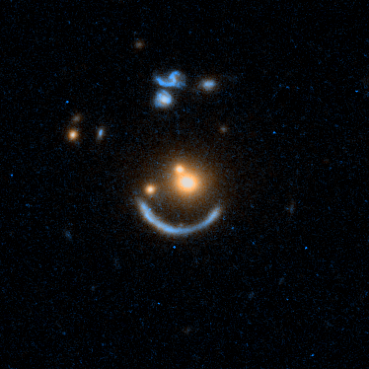
Credit: Tania Barone / AGEL Survey; HST program 16773 (PI Karl Glazebrook); image reduction: Hannah Skobe. · Image source · Reuse information
Image details
Hubble Space Telescope / WFC3 (UVIS and IR); F200LP, F140W
CC0 1.0
- Other names
- DESJ0141-1713 [2]
Name origin
AGEL HST cross-identificationName variants and source provenance
Published spellings and paper abbreviations retained for matching and traceability.
AGEL014106-171324A [1]AGEL DR2
- Catalog source
- AGEL
- Right ascension
- 25.27558°
01h 41m 06.14s [2] [1] - Declination
- -17.22326°
−17° 13′ 23.74″ - Coordinates
- Equatorial J2000 · adopted catalog position
- Lens → Source
- Not yet classified [3]
- Appearance
- Not yet classified
- Lens redshift
- 0.609 [1]
Measurement details
Reported uncertainty: −0.0005 / +0.0005
Formal uncertainty stated in Section 3.1. Multiple well-detected features support this redshift. Internal rotation can affect measured redshifts; for group/cluster deflectors the spectrum need not represent a systemic halo or brightest-member velocity. The environment compilation instead lists 0.608.
Method: Keck/ESI spectroscopy; program JONES_2019B_U058_ESI. Section 3.1 uses Gaussian feature fits and/or MARZ template fitting; object-specific fitting choice is not stated.
Source location: Table 1, PDF p.6, AGEL014106-171324A; Section 3.1, pp.14–16; Section 3.2, p.16.
- Discovery report
- Not available
- Explore
- External object viewer
Background sources
Primary background source A [1]
- Source redshift
- 2.436 [1]
Measurement details
Reported uncertainty: −0.0005 / +0.0005
Formal uncertainty only. Multiple well-detected features support the redshift. Figure 6 identifies interstellar absorption: Section 3.1 warns such features can be blueshifted from systemic velocity by outflows; internal rotation may also contribute. No target-specific offset is quantified.
Method: Keck/ESI interstellar absorption spectroscopy; program JONES_2019B_U058_ESI. Figure 6 top row identifies the source features.
Source location: Table 1, PDF p.6, AGEL014106-171324A; Section 3.1, pp.14–16; Section 3.2, p.16. Figure 6, p.15, top row.
- Einstein radius
- 3.9 arcsec [3]
Measurement details
Reported uncertainty: −1.1 / +1.1
Published approximate image-position uncertainty includes half arc width and model-dependent scatter against HST mass models. This is not a precision mass-model error; target-specific ring/line/blended-line choice is not tabulated. Blended-line estimates can be upper limits.
Method: DECaLS source-light MCMC ring or line-family fit (radius or half image separation); Sections 3.3.1–3.3.3. Preserve the published convention; no HST mass-model substitution.
Source location: Table 4, PDF p.17, AGEL014106-171324, cols.2–5; Table 2 notes p.15; Sections 3.3.1–3.3.3 pp.6–8 and Figure 7 p.8.
Evidence & coordinate notes
- Confirmation: Table 1 p.6 target source/deflector redshifts and flags; Figure 6 p.15 top row shows target source absorption spectrum; Section 3.1 pp.14–16 defines reliability. [1]
- Confirmation: Abstract p.1: sample of spectroscopically confirmed lenses; Table 4 p.17 target row. [3]
- Coordinates: AGEL_HST_objnames.tab, header RAJ2000/DECJ2000 and line 13: AGEL014106-171324A, DESJ0141-1713, 25.27558, -17.22326. [2]
- Coordinates: Table 1, PDF p.6, AGEL014106-171324A, R.A./Decl. columns: 25.27558, -17.22326 degrees. [1]
- Description: Table 1 p.6 target row; Figure 6 p.15 top row and caption; Sections 3.1–3.2 p.16: spectral reliability, formal uncertainty and interstellar absorption/systemic-velocity caveats. [1]
- Description: Table 4 p.17 target row; Table 2 notes p.15; Sections 3.3.1–3.3.4 pp.6–8 (approximate radius and scale); Table 1/Figure 9 p.9 (conflicting thresholds); Sections 4.1/5.1 pp.8–10 (photometric environment and confirmation limitations). [3]
- System class: Intentional null: Table 4 p.17 labels Group (log Einstein mass 12.6±0.2); Section 3.3.4 p.8 and Figure 9 p.9 use 12–13 for groups, but Table 1 p.9 prints <13 for galaxies and 13–14 for groups. Cluster in col.10 is photometric environment, not deflector scale. [3]
References
- Barone, T. M., et al. (2026), The AGEL Survey Data Release 2: A Gravitational Lens Sample for Galaxy Evolution and Cosmology, AJ 171, 57. Final published article. DOI: 10.3847/1538-3881/ae1f86
- AGEL HST object-name mapping, AGEL_HST_objnames.tab, Harvard Dataverse dataset doi:10.7910/DVN/ATFVNA, version 1.0; header and line 13. DOI: 10.7910/DVN/ATFVNA
- Gottemoller, W. J., et al. (2026), Most Strong Lensing Deflectors in the AGEL Survey Are in Group and Cluster Environments, AJ 171, 218; inspected arXiv:2602.11068v2 journal-layout PDF. DOI: 10.3847/1538-3881/ae4480