Catalog ID: GLC-29
AGEL013355-643413A
Confirmed — spectroscopy [1]
AGEL013355-643413A (DESJ0133-6434) is a spectroscopically confirmed strong lens with a curved blue arc around the foreground light. AGEL DR2 reports deflector redshift 0.326 and primary background-galaxy redshift 2.093, both supported by multiple well-detected spectral features. Gottemoller et al. classify the surrounding environment as group-like from photometric galaxy densities; this does not establish physical group membership or independently confirm lensing. Their visual classification encloses one apparent deflector. Their approximate image-position Einstein radius is 3.4 ± 1.2 arcsec. The same paper lists a different deflector redshift, 0.323; the direct DR2 spectroscopic value is adopted here, with the discrepancy retained in provenance. [6] [1] [2]
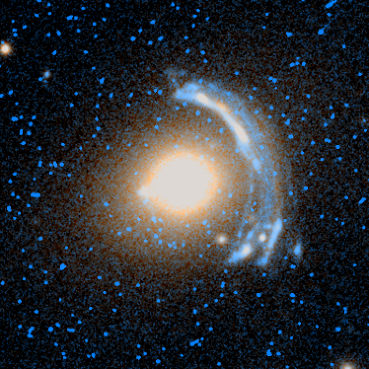
Credit: Tania Barone / AGEL Survey; Hubble Space Telescope program 16773 (PI Karl Glazebrook). Harvard Dataverse, doi:10.7910/DVN/ATFVNA, version 1.0. · Image source · Reuse information
Image details
Hubble Space Telescope / WFC3; F200LP, F140W
CC0 1.0
- Other names
- DESJ0133-6434 [3]
Name origin
AGEL HST official object-name mappingName variants and source provenance
Published spellings and paper abbreviations retained for matching and traceability.
AGEL013355-643413A [1]AGEL DR2
- Catalog source
- AGEL
- Right ascension
- 23.47773°
01h 33m 54.66s [3] [1] - Declination
- -64.57028°
−64° 34′ 13.01″ - Coordinates
- Equatorial J2000 · adopted catalog position
- Lens → Source
- Not yet classified [2]
- Appearance
- Arc [6]
- Lens redshift
- 0.326 [1]
Measurement details
Reported uncertainty: −0.0005 / +0.0005
DR2 formal ±0.0005, not a full systematic error budget. Survey flag 3 means reliable redshift from multiple well-detected features. Gottemoller v2 instead lists 0.323 without a new target-specific spectral derivation; discrepancy is not rounding.
Method: VLT/X-shooter spectroscopy, program LOPEZ_105.20KF.001. DR2 uses feature Gaussian fits and/or MARZ template fitting; target-specific fit choice and individual spectral lines are not specified.
Source location: Table 1, p. 5, AGEL013355-643413A row; Section 3.1, pp. 14–16 (flags, measurement methods and formal uncertainties); Section 3.3, p. 16 (X-shooter).
- Discovery report
- Not available
- Explore
- External object viewer [7]
Background sources
Primary background source A [1]
- Source redshift
- 2.093 [1]
Measurement details
Reported uncertainty: −0.0005 / +0.0005
DR2 formal ±0.0005, not a full systematic error budget. Survey flag 3 means reliable redshift from multiple well-detected features. Section 3.1 warns that ISM features can be blueshifted and galaxy rotation can affect redshifts; neither effect is established specifically here.
Method: VLT/X-shooter spectroscopy, program LOPEZ_105.20KF.001. DR2 uses feature Gaussian fits and/or MARZ template fitting; target-specific fit choice and individual spectral lines are not specified.
Source location: Table 1, p. 5, AGEL013355-643413A row; Section 3.1, pp. 14–16 (flags, measurement methods and formal uncertainties); Section 3.3, p. 16 (X-shooter).
- Einstein radius
- 3.4 arcsec [2]
Measurement details
Reported uncertainty: −1.2 / +1.2
Published approximate image-position radius; arc half-width plus model systematic scatter assessed against HST models. Target-specific ring/line/blended-line choice is not tabulated; blended-line estimates can be upper limits. Not a detailed mass-model or circularized radius. O’Donnell et al. report a different proxy, 4.44 ± 0.46 arcsec.
Method: MCMC fit to source light in DECaLS imaging using ring, line or blended-line geometry (target branch unspecified). Preserve published value; no conversion or refit. Paper uses lens/source redshifts 0.323/2.093.
Source location: Appendix B, Table 3, p. 16, AGEL013355-643413 row, column 4; Table 2 notes p. 15; Sections 3.3.1–3.3.3, pp. 6–7.
Evidence & coordinate notes
- Alternative einstein radius: Table 3 p. 10, DESJ0133-6434 row: 4.44 ± 0.46 arcsec. Section 4 pp. 15–16: mean lens–image separation, scatter or 10% single-image term plus 0.263 arcsec plate scale in quadrature; different proxy from Gottemoller MCMC geometry. [5]
- Alternative lens redshift: Table 3 p. 16 column 2: 0.323 versus adopted DR2 0.326. Table 2 notes p. 15 attributes spectroscopic redshifts to Barone et al.; no target-specific remeasurement or discrepancy explanation given. [2]
- Classification caveat: Unresolved source inconsistency: Table 1 p. 9 prints enclosed-mass thresholds <13/13–14/≥14 and counts 81/8/0; Section 3.3.4 p. 8 and Figure 9 p. 9 use 12/13 boundaries, and Section 4.2 p. 9 reports 22/59/8. Table 3 p. 16 target labels remain Group/Group/Galaxy (deflector/environment/visual); SystemClass=null, not a reconciled classification. [2]
- Confirmation: Table 1, p. 5, AGEL013355-643413A row; Section 3.1, pp. 14–16 (flags, measurement methods and formal uncertainties); Section 3.3, p. 16 (X-shooter). [1]
- Coordinates: AGEL_HST_objnames.tab header RAJ2000/DECJ2000 and line 12: AGEL013355-643413A / DESJ0133-6434, 23.47773, −64.57028. [3]
- Coordinates: Table 1, p. 5, AGEL013355-643413A row, columns 10–11: 23.47773, −64.57028 degrees; system/deflector catalog position. [1]
- Description: DESJ0133-6434.png full frame, mapped by official AGEL_HST_objnames.tab line 12: visibly curved blue arc around foreground light; morphology only, not an independent spectroscopic confirmation. [6]
- Description: Table 1 p. 5 target row, lens/source 0.326/2.093, both flags 3; Section 3.1 pp. 14–16 defines reliable multiple-feature spectroscopy; Section 3 p. 14 warns candidate catalog attribution is not necessarily first discovery. [1]
- Description: Table 3 p. 16 target row: radius 3.4 ± 1.2 arcsec, lens/source 0.323/2.093, Group/Group/Galaxy; methods Sections 3.3.1–3.3.4 pp. 6–8 and Table 2 notes p. 15. [2]
- Object url: Identity viewer-check.json verified survey_image_visual attempt; exact selected DR10 JPEG URL preserved. Saved viewer.jpg compared to official target PNG; association only. [7]
- Record source: Table 1 p. 5 and Section 3 p. 14: AGEL redshift sample; candidate catalog listed as C. Jacobs et al. (2019a, 2019b), explicitly not necessarily first discovery. Catalog source remains AGEL, local overview /surveys-and-discovery-programs/#AGEL. [1]
- Redshift quality: Table 1 p. 5: source and deflector flags 3; Section 3.1 pp. 15–16: survey-specific subjective flag 3 = reliable measurement from multiple well-detected features. Formal uncertainties ±0.0005 with possible line/rotation systematics; no universal catalog score. [1]
- System class: SystemClass intentionally unknown: Table 3 p. 16 target column 9 reports Group, but Section 3.3.4 p. 8/Figure 9 p. 9 use enclosed-mass boundaries 12/13 while Table 1 p. 9 prints 13/14. No categorical deflector scale adopted; separate photometric environment is not physical membership. [2]
- Version comparison: Table 4 row S5.T4.2.1.25 has unchanged target source/lens 2.093/0.326 and flags 3/3 versus final Table 1. Appendix A Table A1 row A0.T1.2.1.8 rounds coordinates; final publication is adopted. [4]
References
- Barone et al. (2026), The AGEL Survey Data Release 2: A Gravitational Lens Sample for Galaxy Evolution and Cosmology, AJ 171, 57. Final published version. DOI: 10.3847/1538-3881/ae1f86
- Gottemoller et al. (2026), Most Strong Lensing Deflectors in the AGEL Survey Are in Group and Cluster Environments, AJ 171, 218; arXiv v2. DOI: 10.3847/1538-3881/ae4480
- AGEL HST official object-name mapping, AGEL_HST_objnames.tab, dataset 10.7910/DVN/ATFVNA.
- Barone et al. (2025), AGEL DR2, arXiv:2503.08041v1; retained version comparison.
- O’Donnell et al. (2022), The Dark Energy Survey Bright Arcs Survey, ApJS 259, 27. DOI: 10.3847/1538-4365/ac470b
- AGEL official HST RGB image DESJ0133-6434.png, dataset 10.7910/DVN/ATFVNA.
- Legacy Surveys DR10 coordinate-centered JPEG; verified by identity worker.