Catalog ID: GLC-268
CSWA 10
Confirmed — combined [2]
CSWA 10 is a confirmed cluster lens with two distinct spectroscopically identified background galaxies, A at redshift 0.724 and B at 0.980. The foreground galaxy has an SDSS redshift of 0.412878. The five A slit positions trace one physical source; B is a separate source. C–F remain candidate sources without measured redshifts. Individual uncertainties for A and B are not tabulated. Wen and colleagues publicly reported the system on 10 December 2008. Their later paper acknowledges its prior listing as a CASSOWARY candidate, so this dated report does not establish sole discovery credit. [2] [6] [4] [5]
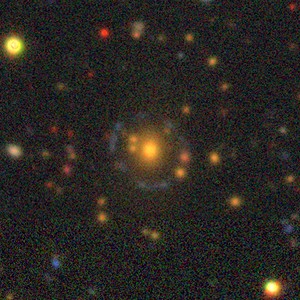
Credit: Legacy Surveys / D. Lang (Perimeter Institute) · Image source · Reuse information
Image details
/ ;
CC BY 4.0
- Other names
- SDSS J2238+1319 [3]
Name origin
Stark et al., published Table 4SDSS J223831.3+131955 [4]Name origin
Wen et al. v1, Table 1Name variants and source provenance
Published spellings and paper abbreviations retained for matching and traceability.
CSWA 10 [1]CASSOWARY
- Catalog source
- CASSOWARY
- Right ascension
- 339.63047433 deg
22h 38m 31.31s [1] [8] - Declination
- 13.33218384 deg
+13° 19′ 55.86″ - Coordinates
- Equatorial J2000 · adopted catalog position
- Lens → Source
- Cluster → Galaxy [2]
- Appearance
- Arc [2]
- Lens redshift
- 0.412878 [6]
Measurement details
Reported uncertainty: −0.00008277285 / +0.00008277285
Reported pipeline zErr, a formal fit error rather than a complete systematic error budget. The spectrum is centered on the foreground galaxy; this is not a background-source redshift.
Method: SDSS pipeline spectroscopic fit; sciencePrimary=1; use of the exact archive row, not a new fit.
Source location: Archived DR19 SpecObjAll Table1, specObjID=832104119987628032; plate 739, MJD 52520, fiber 233; z, zErr, zWarning, sciencePrimary columns; exact SQL in SqlQuery.
- Discovery report
- 2008-12-10 [4] [5]
- Explore
- External object viewer [9]
Background sources
A — primary lensed background galaxy [2]
- Source redshift
- 0.724 [2]
Measurement details
No individual error tabulated. Section 3.1 gives typical total errors for 2008A/R150 data of ±0.0007 at high S/N, rising to ±0.001 at lower S/N; neither is adopted as a measured error for this source. Table 4 A1–A4: 0.724; A5: 0.725. Adopt the Table 2 source summary, without averaging slit values.
Method: Gemini/GMOS-North 2008A R150 G5306 nod-and-shuffle spectroscopy; Gaussian line-center fits and mean line redshift (§3.1). Exact per-source line list is not tabulated.
Source location: arXiv v4 Table 2 p.8 SDSS J2238+1319 A; Table 4 p.27 A slit rows; Table 1 p.6 (2008A); section 2.3 pp.5–6 and 3.1 pp.7–9.
- Einstein radius
- Not available
B — distinct secondary lensed background galaxy [2]
- Source redshift
- 0.980 [2]
Measurement details
No individual error tabulated. Section 3.1 gives typical total errors for 2008A/R150 data of ±0.0007 at high S/N, rising to ±0.001 at lower S/N; neither is adopted as a measured error for this source. Table 4 B2 is secure; B1 is a low-confidence best-guess fit. Adopt the secure Table 2 source summary, not B1 alone.
Method: Gemini/GMOS-North 2008A R150 G5306 nod-and-shuffle spectroscopy; Gaussian line-center fits and mean line redshift (§3.1). Exact per-source line list is not tabulated.
Source location: arXiv v4 Table 2 p.8 SDSS J2238+1319 B; Table 4 p.27 B slit rows; Table 1 p.6 (2008A); section 2.3 pp.5–6 and 3.1 pp.7–9.
- Einstein radius
- Not available
C — tentative source; redshift and nature unknown [2]
- Source redshift
- Not available
- Einstein radius
- Not available
D — tentative source; redshift and nature unknown [2]
- Source redshift
- Not available
- Einstein radius
- Not available
E — tentative source; redshift and nature unknown [2]
- Source redshift
- Not available
- Einstein radius
- Not available
F — tentative source; redshift and nature unknown [2]
- Source redshift
- Not available
- Einstein radius
- Not available
Evidence & coordinate notes
- Appearance:arc: Table 2 p.8 identifies A as a primary giant arc; Figure 10(c) p.15 shows the labeled features. No exact image multiplicity or complete Einstein ring is inferred. [2]
- Confirmation: Table 2 p.8 A primary/B secondary lensed sources; Table 4 p.27 secure A1–A5 and B2 spectra; section 3.1 pp.7–9 definitions and Figure 10(c) p.15. Combined spectroscopic and published imaging assessment. [2]
- Coordinates: Catalogue dated 8 November 2019, CSWA 10 row, RA/Dec columns in degrees; adopted foreground galaxy anchor, not background-source coordinates. Printed digits are not an uncertainty. [1]
- Coordinates: Table metadata, RA/Dec columns: J2000 degrees; exact foreground ObjID recovered in identity GAVO cone row. No ICRS-to-FK5 transformation or observation epoch is asserted. [8]
- Description: Table 2 p.8 A/B; Table 4 p.27 A1–A5, B1–B2, C1–F1; section 3.1 pp.7–9 defines physical-source/slit labels, confidence and dataset-level uncertainties; Figure 10(c) p.15. Two confirmed background galaxies; C–F remain candidates; individual errors not tabulated. [2]
- Description: Archived DR19 SpecObjAll Table1, specObjID=832104119987628032; plate 739, MJD 52520, fiber 233; z, zErr, zWarning, sciencePrimary columns; exact SQL in SqlQuery. [6]
- Description: Version-specific arXiv submission history, 10 December 2008; v1 Table 1 p.2, SDSS J223831.3+131955, and Figure 1 fourth column. [4]
- Description: arXiv v8 Table 1 starred SDSS J223831.3+131955 row and section 3 final paragraph before Notes Added in Proof: CSWA 10 is one of five independent rediscoveries. [5]
- Discovery date: Version-specific arXiv submission history, 10 December 2008; v1 Table 1 p.2, SDSS J223831.3+131955, and Figure 1 fourth column. [4]
- Discovery date: Section 3 prior-CASSOWARY paragraph: earlier catalogue listing acknowledged without a target-specific date. Adopted date is a verified public report, not exclusive discovery priority. [5]
- Image:cswa-10-legacy-dr9.jpg: Native 300 x 300 ls-dr9 JPEG at Cambridge CSWA 10 foreground coordinates; visual match to official Cambridge row 10 image. Also matches Bayliss arXiv:1010.2714v4 Figure 10(c), p.15, SDSS J2238+1319. Unchanged bytes. Reuse: Legacy Surveys acknowledgments, Usage of images from the Sky Viewer. [9]
- Object url: Accepted identity attempt 2, viewer-check.json selected_url and survey_image_visual attempts, reinspection 2026-11-11T00:40:50.146826+00:00. Science preserves the exact URL; not an independent asset assessment. [9]
- Record source: CSWA 10 entry; source is the named CASSOWARY catalogue. Discovery priority is tracked separately. [1]
- Source:a: arXiv v4 Table 4 p.27 SDSS J2238+1319 A slit row(s), Figure 10(c) p.15, section 3.1 pp.7–9. One physical source, irrespective of slit/image count; Table 2 p.8 gives the secure source redshift. [2]
- Source:b: arXiv v4 Table 4 p.27 SDSS J2238+1319 B slit row(s), Figure 10(c) p.15, section 3.1 pp.7–9. One physical source, irrespective of slit/image count; Table 2 p.8 gives the secure source redshift. [2]
- Source:c: arXiv v4 Table 4 p.27 SDSS J2238+1319 C slit row(s), Figure 10(c) p.15, section 3.1 pp.7–9. Class 0 means redshift failure. This is a candidate label, not a confirmed additional source. [2]
- Source:d: arXiv v4 Table 4 p.27 SDSS J2238+1319 D slit row(s), Figure 10(c) p.15, section 3.1 pp.7–9. Class 0 means redshift failure. This is a candidate label, not a confirmed additional source. [2]
- Source:e: arXiv v4 Table 4 p.27 SDSS J2238+1319 E slit row(s), Figure 10(c) p.15, section 3.1 pp.7–9. Class 0 means redshift failure. This is a candidate label, not a confirmed additional source. [2]
- Source:f: arXiv v4 Table 4 p.27 SDSS J2238+1319 F slit row(s), Figure 10(c) p.15, section 3.1 pp.7–9. Class 0 means redshift failure. This is a candidate label, not a confirmed additional source. [2]
- System class: Table 3 p.17, SDSS J2238+1319 explicitly a galaxy-cluster lens; Table 2 p.8 and section 3.1 pp.7–9 identify two lensed background galaxies. This follows the authors’ cluster classification, not a new inference from angular size or velocity dispersion. [2]
References
- University of Cambridge, Institute of Astronomy. CASSOWARY catalogue, 8 November 2019 version.
- Bayliss et al. (2011), Gemini/GMOS Spectroscopy of 26 Strong Lensing Selected Galaxy Cluster Cores, ApJS 193, 8; inspected arXiv:1010.2714v4. DOI: 10.1088/0067-0049/193/1/8
- Stark et al. (2013), The CASSOWARY spectroscopy survey: a new sample of gravitationally lensed galaxies in SDSS, MNRAS 436, 1040–1056. DOI: 10.1093/mnras/stt1624
- Wen et al. (2008), Discovery of strong lensing clusters in the SDSS DR6, arXiv:0812.1860v1, submitted 10 December 2008.
- Wen et al. (2009), Discovery of four gravitational lensing systems by clusters in the SDSS DR6, RAA 9, 5–10; arXiv:0812.1860v8. DOI: 10.1088/1674-4527/9/1/002
- SDSS DR19 SkyServer, SpecObjAll public spectroscopy archive; exact target-specific query results retrieved 10 November 2026.
- SDSS DR17 documentation: Redshifts, Classifications and Velocity Dispersions; legacy SDSS/BOSS algorithm context.
- GAVO Data Center, SDSS DR7 sources: PhotoObjAll extraction provenance and J2000 coordinate column definitions.
- Legacy Surveys DR9 field viewer; exact URL visually verified in accepted identity attempt 2.