Catalog ID: GLC-267
CSWA 39
CSWA 39 is the J1527+0652 lens with primary source SGAS J152745.1+065219. HST modelling resolves three partial images of one galaxy. The local deflection is dominated by an elliptical galaxy in a group near redshift 0.43, with an additional contribution from the cluster near 0.39; these are not interchangeable lens planes. The adopted source redshift, 2.7627 ± 0.0007, comes from stellar spectral fitting. A separate line-of-sight emitter at 2.543 and candidate source families 2–6 are retained with their qualifications. The cluster mass model is weakly constrained, and no applicable primary-source Einstein radius is adopted. Hennawi et al. publicly reported the arc as a tentative lens in 2006, before spectroscopic confirmation. [8] [1] [6] [5]
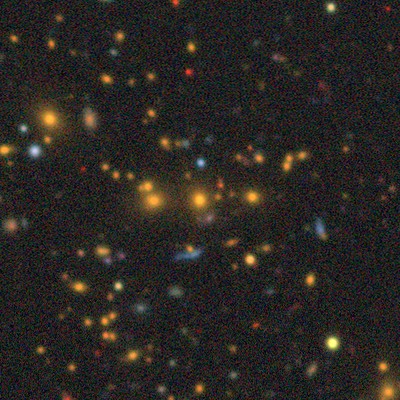
Credit: Legacy Surveys / D. Lang (Perimeter Institute) · Image source · Reuse information
Image details
/ ;
CC BY 4.0
- Other names
- SDSS J1527+0652 [1]
Name origin
foreground system; Koester Table1; Mainali §3.1 p4048; Sharon §4.3.30SGAS J152745.1+065219 [1]Name origin
primary background LBG, not foreground galaxy; Table1 pL74Name variants and source provenance
Published spellings and paper abbreviations retained for matching and traceability.
CSWA 39 [2]CASSOWARY system identifier, Stark Table 4
- Catalog source
- CASSOWARY
- Right ascension
- 231.93759592°
15h 27m 45.02s [3] [4] - Declination
- 6.87607048°
+06° 52′ 33.85″ - Coordinates
- Equatorial J2000 · adopted catalog position
- Lens → Source
- Galaxy → Galaxy [5]
- Appearance
- Arc [5]
- Lens redshift
- 0.43 [5]
Measurement details
Approximate group redshift, not a separately tabulated precise galaxy measurement; no error reported. The more foreground cluster is at about 0.39 (Koester §2.1), and the catalog coordinate is a cluster-field anchor, not the local galaxy position.
Method: KCWI spectroscopy of small local group including the locally dominant lens galaxy.
Source location: §4.3.30 printed p19 (PDF p20), right column: KCWI group near z≈0.43 includes galaxy nearest main arc.
- Discovery report
- 2006-10-03 [8]
- Explore
- External object viewer [3]
Background sources
SGAS J152745.1+065219 / Sharon source1 [5]
- Source redshift
- 2.7627 [6]
Measurement details
Reported uncertainty: −0.0007 / +0.0007
Table gives σ=0.0007 for stellar fit; does not include full range of stellar models (§2.6). Bright and faint-tail spectra are apertures of one galaxy; separate nebular values 2.762280±0.000080 and 2.762800±0.000100 are retained as alternatives.
Method: Starburst99 stellar-continuum and photospheric-feature fitting; likelihood over redshift shifts.
Source location: arXiv:1710.07294v2 Table 4 p24, SGAS J152745.1+065219 bright and faint-tail stellar columns; §2.6 p5.
- Einstein radius
- Not available
Line-of-sight emission/absorption galaxy [5]
- Source redshift
- 2.543 [5]
Measurement details
No numerical uncertainty stated. A line-of-sight interloper relative to the main galaxy, not a confirmed independent multiply imaged family.
Method: Reported KCWI emission-line and MagE absorption system.
Source location: §4.3.30 printed p19 (PDF p20), right column, KCWI emission and MagE intervening absorption.
- Einstein radius
- Not available
Candidate source family2 [5]
- Source redshift
- Not available
- Einstein radius
- Not available
Candidate source family3 [5]
- Source redshift
- Not available
- Einstein radius
- Not available
Candidate source family4 [5]
- Source redshift
- Not available
- Einstein radius
- Not available
Candidate source family5 [5]
- Source redshift
- Not available
- Einstein radius
- Not available
Candidate source family6 [5]
- Source redshift
- Not available
- Einstein radius
- Not available
Evidence & coordinate notes
- Appearance:arc: Figure 5 printed p20 bottom-right J1527 panel and §4.3.30 p19: arc comprises three partial images; not a four-image classification. [5]
- Confirmation: §2.3 ppL74–75 and Figure 2 pL75: MagE Lyα and UV metal-line confirmation of the lensed LBG. [1]
- Confirmation: §4.3.30 printed p19 and Figure 5 printed p20: three partial images; source spectroscopy traced to Koester (2010). [5]
- Coordinates: Cambridge row 39 SDSS ObjID 587736542562419006; decimal degrees; exact reported digits, no stated astrometric uncertainty. Foreground anchor, not source-plane coordinates. [3]
- Coordinates: DR7 glossary, coordinates entry: SDSS RA and Dec use J2000. No precession or averaging performed. [4]
- Description: Table 2 p5 row SDSS J1527+0652 (tentative lenses), §5.2 p9 target paragraph; arXiv submission history 3 October 2006. Candidate report precedes Koester spectroscopy. [8]
- Description: Table 1 pL74 identifies SGAS J152745.1+065219 and SDSS J1527+0652; §2.1 pL74 cluster0.39; §2.3 pL75 confirmation; §3 pL76 broad mass-model uncertainties. [1]
- Description: arXiv v2 Table 4 p24 SGAS J152745.1+065219 stellar z2.7627, σ0.0007; §2.6 p5 method and model-systematic limitation. Bright/faint tail are apertures, not separate sources. [6]
- Description: §4.3.30 printed p19: three partial images; local elliptical and cluster contributions; KCWI group ≈0.43; interloper2.543; unconfirmed families and weak cluster model. Table 8 pp36–37 lists IDs2–6 without spectroscopic redshifts. [5]
- Discovery date: arXiv:astro-ph/0610061v1 submission history 3 October 2006; Table 2 p5 and §5.2 p9 SDSS J1527+0652. Candidate-report date, not confirmation or the May 2005 observation. [8]
- Image:cswa-39-legacy-dr9.jpg: Native 400 x 400 ls-dr9 JPEG of J1527+0652. Visual match: Koester published Figure 1 right, pL75. Foreground group and blue SGAS J152745.1+065219 arc to south. Cambridge row 39 J1226 mislabel is not adopted. Not all images or knots resolved. Unchanged bytes; comparison-evidence.json. [9]
- Object url: Identity viewer-check.json / cswa-39: Legacy DR9 field visually matched to official Cambridge image and target-specific primary paper panel; preserve selected URL. Viewer is a field locator, not redshift evidence. [3]
- Record source: Catalogue rows 39. CASSOWARY membership is record provenance, not exclusive discovery credit; use existing CASSOWARY overview. [3]
- Source:candidate2: Table8 printed pp36–37 IDs2.x; §4.3.30 [5]
- Source:candidate3: Table8 printed pp36–37 IDs3.x; §4.3.30 [5]
- Source:candidate4: Table8 printed pp36–37 IDs4.x; §4.3.30 [5]
- Source:candidate5: Table8 printed pp36–37 IDs5.x; §4.3.30 [5]
- Source:candidate6: Table8 printed pp36–37 IDs6.x; §4.3.30 [5]
- Source:interloper: §4.3.30 printed p19 right column [5]
- Source:primary: Table 1 p4039 CSWA-39 gives spectroscopic2.762 without numerical error; §3.1 p4048 discusses C III] doublet detection. Retained alternative; stellar redshift adopted from Rigby. [7]
- Source:primary: §4.3.30 printed p19; Table 8 pp36–37: source 1 and its knots form one physical galaxy. [5]
- System class: §4.3.30 printed p19: locally dominant elliptical galaxy boosted by cluster potential. Galaxy–galaxy classification refers to local deflector, not absence of a cluster or a common lens plane. [5]
References
- Koester et al. (2010), Two Lensed z ≃ 3 Lyman Break Galaxies Discovered in the SDSS Giant Arcs Survey. ApJL 723, L73–L77. DOI: 10.1088/2041-8205/723/1/L73
- Stark et al. (2013), The CASSOWARY spectroscopy survey: a new sample of gravitationally lensed galaxies in SDSS. MNRAS 436, 1040–1056. DOI: 10.1093/mnras/stt1624
- University of Cambridge, Institute of Astronomy. CASSOWARY catalogue (8 November 2019).
- SDSS DR7 glossary: coordinates.
- Sharon et al. (2020), Strong Lens Models for 37 Clusters of Galaxies from the SDSS Giant Arcs Survey. ApJS 247, 12. DOI: 10.3847/1538-4365/ab5f13
- Rigby et al. (2018), The Magellan Evolution of Galaxies Spectroscopic and Ultraviolet Reference Atlas (MEGaSaURA). I. The Sample and the Spectra. AJ 155, 104; inspected author edition arXiv:1710.07294v2. DOI: 10.3847/1538-3881/aaa2ff
- Mainali et al. (2023), Spectroscopy of CASSOWARY gravitationally lensed galaxies in SDSS: characterization of an extremely bright reionization-era analogue at z = 1.42. MNRAS 520, 4037–4056. DOI: 10.1093/mnras/stad387
- Hennawi et al., A New Survey for Giant Arcs. arXiv:astro-ph/0610061v1 (3 October 2006); subsequently AJ 135, 664–681 (2008). DOI: 10.1088/0004-6256/135/2/664
- Legacy Surveys Sky Viewer, DR9 native color cutout for CSWA 39.