Catalog ID: GLC-266
CSWA 38
Confirmed — combined [1]
CSWA 38 is the northern SDSS J1226+2152 cluster lens, distinct from the southern J1226+2149 core. Its primary galaxy, SGAS J122651.3+215220 (galaxy A), and the separate southern giant-arc galaxy B have MUSE nebular redshifts 2.9257 ± 0.0001 and 2.9238 ± 0.0002. They are separate galaxies, not two images of one source; A itself has multiple images. The foreground cluster is near redshift 0.43. Earlier spectroscopy reported 2.9233 for the primary galaxy. Other background objects at 0.732 and 0.772 are retained without assuming counterimage families. Wen et al. reported the separate giant arc as a candidate in December 2008; Koester et al. later confirmed the high-redshift sources. No primary-source Einstein radius is adopted from a different core or a fiducial source plane. [1] [8] [5] [9] [10]
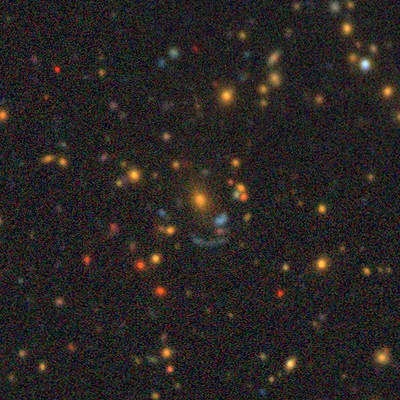
Credit: Legacy Surveys / D. Lang (Perimeter Institute) · Image source · Reuse information
Image details
/ ;
CC BY 4.0
- Other names
- SDSS J1226+2152 [1]
Name origin
foreground northern lens core/system; Table1 pL74 and §3SGAS J122651.3+215220 [1]Name origin
primary background LBG designation, not BCG; Table1, Figures1/2, abstractName variants and source provenance
Published spellings and paper abbreviations retained for matching and traceability.
CSWA 38 [2]CASSOWARY system identifier, Stark Table 4
- Catalog source
- CASSOWARY
- Right ascension
- 186.71535583°
12h 26m 51.69s [3] [4] - Declination
- 21.87373676°
+21° 52′ 25.45″ - Coordinates
- Equatorial J2000 · adopted catalog position
- Lens → Source
- Cluster → Galaxy [1]
- Appearance
- Arc [5]
- Lens redshift
- 0.43 [1]
Measurement details
Approximate cluster redshift as published; no numerical uncertainty. Not a new measurement of the individual BCG; Cambridge 0.42 is photometric.
Method: Cluster spectroscopy: SDSS objects and Gemini/GMOS confirmation of the earlier photometric estimate.
Source location: §2.1 pL74, SDSS J1226+2152 foreground cluster; abstract pL73.
- Discovery report
- 2008-12-23 [10]
- Explore
- External object viewer [3]
Background sources
Primary galaxy A: SGAS J122651.3+215220 [5]
- Source redshift
- 2.9257 [5]
Measurement details
Reported uncertainty: −0.0001 / +0.0001
Reported fit uncertainty; §3.1 tests common-width relaxation using 16th/50th/84th percentiles. Integrated spectra lose spatial velocity-gradient information; no additional systematic error invented.
Method: Simultaneous common-width Gaussian fit to Si II* λ1533 and C III] λλ1906,1908 in coadded MUSE spectra.
Source location: arXiv:2206.02949v2 §3.1 pp5–7; Table 2 p7, Redshift row, Galaxy A; Figure 2 p6.
- Einstein radius
- Not available
Separate southern giant-arc galaxy B [5]
- Source redshift
- 2.9238 [5]
Measurement details
Reported uncertainty: −0.0002 / +0.0002
Reported fit uncertainty; §3.1 tests common-width relaxation using 16th/50th/84th percentiles. Integrated spectra lose spatial velocity-gradient information; no additional systematic error invented.
Method: Simultaneous common-width Gaussian fit to Si II* λ1533 and C III] λλ1906,1908 in coadded MUSE spectra.
Source location: arXiv:2206.02949v2 §3.1 pp5–7; Table 2 p7, Redshift row, Galaxy B; Figure 2 p6.
- Einstein radius
- Not available
Additional background source at z0.732 [1]
- Source redshift
- 0.732 [1]
Measurement details
No numerical uncertainty supplied. Separate redshift objects; their counterimage grouping is not established in this paper.
Method: Spectroscopic follow-up of background objects.
Source location: §3 pL75, additional background sources; Figure 3 pL76 labels positions.
- Einstein radius
- Not available
Additional background source at z0.772 [1]
- Source redshift
- 0.772 [1]
Measurement details
No numerical uncertainty supplied. Separate redshift objects; their counterimage grouping is not established in this paper.
Method: Spectroscopic follow-up of background objects.
Source location: §3 pL75, additional background sources; Figure 3 pL76 labels positions.
- Einstein radius
- Not available
Evidence & coordinate notes
- Appearance:arc: arXiv v2 Figure 2 p6: primary arc A.1 and separate arc B, with counterimage A.2. [5]
- Confirmation: §2.3 ppL74–75, Figure 2 pL75: MagE Lyα and metal absorption spectroscopy; §3 ppL75–76 and Figure 3 lens interpretation. [1]
- Coordinates: Cambridge row 38 SDSS ObjID 587742013284679929; decimal degrees; exact reported digits, no stated astrometric uncertainty. Foreground anchor, not source-plane coordinates. [3]
- Coordinates: DR7 glossary, coordinates entry: SDSS RA and Dec use J2000. No precession or averaging performed. [4]
- Description: §2.1 pL74 cluster z0.43; §2.3 pL75 primary 2.9233; §3 ppL75–76 separate giant arc at 2.923, background 0.732/0.772, no identified counterimages in those data; Figure 3 pL76. [1]
- Description: arXiv v2 §3.1 pp4–5 and Table 2 p5: J1226+2149 and J1226+2152 separate cores; northern radius 10.0 +2.8/−6.4 arcsec at zarc2.923, 8.6 +2.4/−5.5 at fiducial z2. Neither transferred to primary A without matching constraints. [8]
- Description: arXiv v2 §2.3 and §3.1 pp5–7, Figure 2 p6 and Table 2 p7: A and B distinct, A.1/A.2 are images of A; integrated MUSE redshifts 2.9257±0.0001 and 2.9238±0.0002. [5]
- Description: Published Table 1 p7 NSCS J122648.0+215157, Figure 2 p8 last row, and proof note p9: separate giant arc added during proofs as probable; Koester §3 identifies that arc separately from primary LBG. [9]
- Description: Table1 PDF p2/printed p6 and Figure2 PDF p4/printed p8 last row; arXiv v5 submission history dates candidate report to 23 December 2008. [10]
- Discovery date: arXiv submission history: v5, 23 December 2008; Table 1 PDF p2/printed p6, NSCS J122648.0+215157; Figure 2 PDF p4/printed p8 last row. Target absent from v1–v4. Date is public candidate report of separate giant arc, not primary LBG spectroscopic confirmation. [10]
- Image:cswa-38-legacy-dr9.jpg: Native 400 x 400 ls-dr9 JPEG of northern J1226+2152. Visual match: Koester published Figure 1 left, pL75. Central galaxy, compact LBG southwest and separate giant arc farther south; southern J1226+2149 core excluded. Not all source families resolved. Unchanged bytes; comparison-evidence.json. [11]
- Object url: Identity viewer-check.json / cswa-38: Legacy DR9 field visually matched to official Cambridge image and target-specific primary paper panel; preserve selected URL. Viewer is a field locator, not redshift evidence. [3]
- Record source: Catalogue rows 38. CASSOWARY membership is record provenance, not exclusive discovery credit; use existing CASSOWARY overview. [3]
- Source:background0732: §3 pL75 and Figure3 pL76 [1]
- Source:background0772: §3 pL75 and Figure3 pL76 [1]
- Source:primary: Table 1 p4039 CSWA-38 gives spectroscopic2.925 without numerical error; §3.1 p4048 discusses C III]1909 detection. Retained alternative to the later source-specific MUSE analysis. [7]
- Source:primary: arXiv v2 Table 4 p24: stellar2.9252±0.0009; nebular2.926000±0.000200 (noisy C III]); ISM2.922900±0.0001. Method-specific alternatives; MUSE nebular value adopted without averaging. [6]
- Source:primary: §3.1 pp5–7, Figure 2 p6, Table 2 p7 (arXiv v2): galaxy A is primary; galaxy B is separate southern arc. [5]
- Source:southernarc: §3.1 pp5–7, Figure 2 p6, Table 2 p7 (arXiv v2): galaxy A is primary; galaxy B is separate southern arc. [5]
- System class: Abstract pL73 and §3 ppL75–76: cluster halo plus BCG, adjacent subcluster shear; lensed background LBGs. [1]
References
- Koester et al. (2010), Two Lensed z ≃ 3 Lyman Break Galaxies Discovered in the SDSS Giant Arcs Survey. ApJL 723, L73–L77. DOI: 10.1088/2041-8205/723/1/L73
- Stark et al. (2013), The CASSOWARY spectroscopy survey: a new sample of gravitationally lensed galaxies in SDSS. MNRAS 436, 1040–1056. DOI: 10.1093/mnras/stt1624
- University of Cambridge, Institute of Astronomy. CASSOWARY catalogue (8 November 2019).
- SDSS DR7 glossary: coordinates.
- Solimano et al. (2022), Revealing the Nature of a Lyα Halo in a Strongly Lensed Interacting System at z = 2.92. ApJ 935, 17; inspected author edition arXiv:2206.02949v2. DOI: 10.3847/1538-4357/ac7c1a
- Rigby et al. (2018), The Magellan Evolution of Galaxies Spectroscopic and Ultraviolet Reference Atlas (MEGaSaURA). I. The Sample and the Spectra. AJ 155, 104; inspected author edition arXiv:1710.07294v2. DOI: 10.3847/1538-3881/aaa2ff
- Mainali et al. (2023), Spectroscopy of CASSOWARY gravitationally lensed galaxies in SDSS: characterization of an extremely bright reionization-era analogue at z = 1.42. MNRAS 520, 4037–4056. DOI: 10.1093/mnras/stad387
- Oguri et al. (2012), Combined strong and weak lensing analysis of 28 clusters from the Sloan Giant Arcs Survey. MNRAS 420, 3213–3239; inspected author edition arXiv:1109.2594v2.
- Wen et al. (2009), Discovery of four gravitational lensing systems by clusters in the SDSS DR6. Research in Astronomy and Astrophysics 9, 5–10.
- Wen et al., Discovery of four gravitational lensing systems by clusters in the SDSS DR6. arXiv:0812.1860v5 (23 December 2008).
- Legacy Surveys Sky Viewer, DR9 native color cutout for CSWA 38.