Catalog ID: GLC-265
CSWA 16
Confirmed — spectroscopy [1]
CSWA 16 is a confirmed lens with a background galaxy at redshift 1.945. The measured foreground redshift 0.412 belongs to the southwestern member CSWA 16.2, which is the adopted position. The northeastern member CSWA 16.1 has only a provider photometric estimate; its spectroscopic redshift and individual mass contribution remain unknown. Mainali et al. retain the absorption-based source redshift and report no detected C III] emission in the discovery spectrum. Their two Gaussian light components describe one background source, not two galaxies. No supported Einstein radius is adopted. [2] [4] [1]
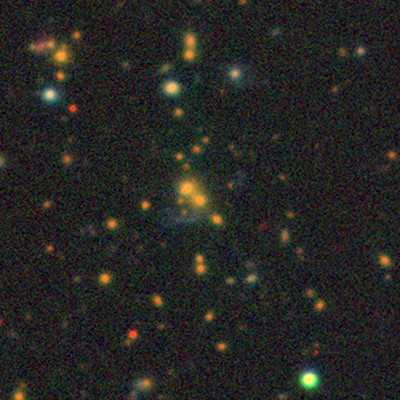
Credit: Legacy Surveys / D. Lang (Perimeter Institute) · Image source · Reuse information
Image details
/ ;
CC BY 4.0
- Other names
- CSWA 16.1 [2]
Name origin
northeast foreground component; row16.1CSWA 16.2 [2]Name origin
southwest foreground component; row16.2SDSS J1111+5308 [1]Name origin
system designation; Stark Tables2/4; Mainali §3.1 p4049Name variants and source provenance
Published spellings and paper abbreviations retained for matching and traceability.
CSWA 16 [1]CASSOWARY system identifier, Stark Table 4
- Catalog source
- CASSOWARY
- Right ascension
- 167.76378766°
11h 11m 03.31s [2] [3] - Declination
- 53.14774276°
+53° 08′ 51.87″ - Coordinates
- Equatorial J2000 · adopted catalog position
- Lens → Source
- Galaxy → Galaxy [1]
- Appearance
- Arc [1]
- Lens redshift
- 0.412 [1]
Measurement details
No numerical error stated. Table 4 and Mainali Table 1 use a system pointing near 16.1; that pointing does not relocate the 0.412 spectrum.
Method: Authors’ foreground spectroscopy, position matched to CSWA 16.2.
Source location: Table 2 p1044, CSWA 16, lens position 11:11:03.30 +53:08:51.8 and dagger; §3.1 p1045.
- Discovery report
- 2013-02-11 [5]
- Explore
- External object viewer [2]
Background sources
Primary lensed galaxy behind CSWA16 [1]
- Source redshift
- 1.945 [1]
Measurement details
No numerical error stated. The low-ionization gas mean in §3.2 is 1.946; adopted catalogue value is 1.945. Mainali §3.1 p4049 does not supply a new nebular redshift.
Method: MMT Blue Channel absorption-line spectroscopy; published adopted catalogue estimate.
Source location: Table 2 p1044 row CSWA 16; §3.1 p1044; §3.2 p1048 J1111+5308; Mainali Table 1 p4039 repeats 1.945.
- Einstein radius
- Not available
Evidence & coordinate notes
- Appearance:arc: Figure 1 p1046 J1111+5308 panel; Table 2 source coordinates are approximate slit/arc intersection. [1]
- Confirmation: Table 2 p1044 CSWA 16 and caption; §3.2 p1048 J1111+5308 and Figure 1 p1046. Galaxy lens with projected companion; no common-plane mass assignment implied. [1]
- Coordinates: Cambridge row 16.2 SDSS ObjID 587731868557115671; decimal degrees; exact reported digits, no stated astrometric uncertainty. Foreground anchor, not source-plane coordinates. [2]
- Coordinates: DR7 glossary, coordinates entry: SDSS RA and Dec use J2000. No precession or averaging performed. [3]
- Description: Rows 16.1 and 16.2: distinct NE/SW foreground positions; photometric 0.33/0.46 (reference −1), no provider spectra. Accepted positional mapping associates Stark spectrum with 16.2; no individual mass inference. [2]
- Description: Table 1 p4039 CSWA-16 retains 1.945; §3.1 p4049: metal absorption, no C III] detection, 3σ EW limit <2.3 Å; §2.4 p4045: two Gaussian source-light components, SIE lens model and magnification, no reported Einstein radius. [4]
- Description: Table 2 p1044 CSWA 16: source 1.945 and lens 0.412 at 11:11:03.30 +53:08:51.8; Table 4 p1051 gives no radius; §3.2 p1048 gives absorption mean 1.946. [1]
- Discovery date: arXiv history 11 February 2013; v1 Table 2 p6 CSWA 16 and §3.2 p9 J1111+5308. Earliest target-specific public report located; distinct from the 2012 observation. [5]
- Image:cswa-16-legacy-dr9.jpg: Native 400 x 400 ls-dr9 JPEG centered on 16.2. Visual match: Cambridge 16.2 cutout; Stark published Figure 1 p1046, J1111+5308 (row 4, column 2). 16.1 remains above-left; no individual spectrum inferred from appearance. Unchanged bytes; comparison-evidence.json. [6]
- Object url: Identity viewer-check.json / cswa-16: Legacy DR9 field visually matched to official Cambridge image and target-specific primary paper panel; preserve selected URL. Viewer is a field locator, not redshift evidence. [2]
- Record source: Catalogue rows 16.1/16.2. CASSOWARY membership is record provenance, not exclusive discovery credit; use existing CASSOWARY overview. [2]
- Source:primary: Stark Table2 row16, §3.2 p1048; Mainali §3.1 p4049 and Figure1 p4040 [1]
- System class: Table 2 p1044 CSWA 16 and caption; §3.2 p1048 J1111+5308 and Figure 1 p1046. Galaxy lens with projected companion; no common-plane mass assignment implied. [1]
References
- Stark et al. (2013), The CASSOWARY spectroscopy survey: a new sample of gravitationally lensed galaxies in SDSS. MNRAS 436, 1040–1056. DOI: 10.1093/mnras/stt1624
- University of Cambridge, Institute of Astronomy. CASSOWARY catalogue (8 November 2019).
- SDSS DR7 glossary: coordinates.
- Mainali et al. (2023), Spectroscopy of CASSOWARY gravitationally lensed galaxies in SDSS: characterization of an extremely bright reionization-era analogue at z = 1.42. MNRAS 520, 4037–4056. DOI: 10.1093/mnras/stad387
- Stark et al. (2013), The CASSOWARY spectroscopy survey: A new sample of gravitationally lensed galaxies in SDSS. arXiv:1302.2663v1 (11 February 2013).
- Legacy Surveys Sky Viewer, DR9 native color cutout for CSWA 16.