Catalog ID: GLC-263
CSWA 23
Confirmed — spectroscopy [1]
CSWA 23 lenses a post-starburst background galaxy into three spectroscopically associated images A, B and C. D is a possible fourth image, supported by color and modeling but not independently confirmed spectroscopy. The foreground elliptical G has a measured Subaru redshift of 0.3492; the nearby galaxy at 0.3347 is a different object. The adopted source redshift 0.7659 is the measurement of image B, not an average of the three spectra. The 2.23-arcsecond radius is the mass parameter of an SIE model with external shear, fitted assuming D is the fourth image; its quoted error is fitting-only. Shin’s public report dates to 9 April 2008. The surrounding cluster environment is distinct from the modeled galaxy deflector. [1] [2]
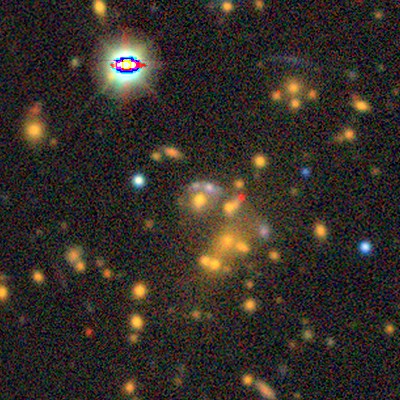
Credit: Legacy Surveys / D. Lang (Perimeter Institute) · Image source · Reuse information
Image details
/ ;
CC BY 4.0
- Other names
- SDSS J082728.70+223256.4 [1]
Name origin
system name based on lensed image B, not foreground GSDSS J0827+2232 [3]Name origin
published system cross-identificationSDSS J082728.83+223253.9 [1]Name origin
foreground galaxy GName variants and source provenance
Published spellings and paper abbreviations retained for matching and traceability.
CSWA 23 [4]survey system
- Catalog source
- Cited Paper
- Right ascension
- 126.87013375°
08h 27m 28.83s [4] [5] - Declination
- 22.54831707°
+22° 32′ 53.94″ - Coordinates
- Equatorial J2000 · adopted catalog position
- Lens → Source
- Galaxy → Galaxy [1]
- Appearance
- Not yet classified
- Lens redshift
- 0.3492 [1]
Measurement details
Reported uncertainty: −0.0007 / +0.0007
Reported spectral error; applies to G. Nearby SDSS z=0.3347 is a separate galaxy.
Method: Subaru/FOCAS Ca II H/K, G-band and Mg absorption
Source location: arXiv:0804.1487v1, section 3.2 p6, paragraph beginning The spectrum of the lensing galaxy G; Figure 2 p19.
- Discovery report
- 2008-04-09 [1] [2]
- Explore
- External object viewer
Background sources
Post-starburst background galaxy; A/B/C confirmed images, D candidate [1]
- Source redshift
- 0.7659 [1]
Measurement details
Reported uncertainty: −0.0003 / +0.0003
Reported error of image B, not an average. A=0.7654±0.0004 and C=0.7660±0.0007 retained separately; confidence convention not explicitly quantified.
Method: Subaru/FOCAS absorption lines H8, H7, H6, H and Hδ in image B
Source location: arXiv:0804.1487v1, section 3.2 p6, B and C spectral-redshift paragraph; Figure 2 p19.
- Einstein radius
- 2.23 arcsec [1]
Measurement details
Reported uncertainty: −0.01 / +0.01
Only fitting error of SIE mass parameter (footnote 2). Fit assumes candidate D is fourth image and includes external shear; not a full systematic error.
Method: SIE plus external shear fitted to A/B/C/D image positions with gravlens
Source location: arXiv:0804.1487v1, section 4 pp7–8, radius paragraph and footnote 2 p8; Figure 4 p21.
Evidence & coordinate notes
- Confirmation: Sections 3.1–3.2 pp5–7 and Figure 2 p19: A/B/C matching post-starburst spectra; D unconfirmed. [1]
- Coordinates: catalogue.info line 27; CSWA 23 foreground row. Decimal degrees retained; precision is not an error estimate. [4]
- Coordinates: SDSS DR7 Glossary, coordinates entry: standard RA and Dec are J2000; Cambridge SDSS foreground identifier. [5]
- Description: Sections 3.1–3.2 pp5–7: spectra A/B/C, candidate D, G and different neighbor; section 4 pp7–8 and footnote 2: SIE/shear radius and fitting-only error; section 5 pp8–9: environment; v1 p1 target/date. [1]
- Description: Submission history v1 9 April 2008, matched to target in author manuscript p1. [2]
- Discovery date: Author manuscript v1 date stamp p1, 9 April 2008; abstract identifies target and confirmed lens. [1]
- Discovery date: arXiv submission history: v1 9 April 2008 13:58:14 UTC. Observation dates and later journal publication are not discovery dates. [2]
- Image:cswa-23-legacy-dr9.jpg: Native 400 x 400 ls-dr9 JPEG centered on foreground G. Field match: Shin arXiv:0804.1487 Figure 1 (p18), Table 1 G/A/B/C rows (p17). G differs from system-name image B and the spectroscopic neighbor. Individual labeled features not all resolved. Unchanged bytes; comparison-evidence.json. [6]
- Source:primary: Sections 3.1–3.2 pp5–7; Figure 2 p19; one physical post-starburst galaxy represented by A/B/C, with D possible. [1]
- System class: Abstract p1; sections 4–5 pp7–9: elliptical G modeled as SIE with external shear; surrounding cluster distinct from galaxy deflector. [1]
References
- Shin et al. (2008), The Sloan Digital Sky Survey Discovery of a Strongly Lensed Post-Starburst Galaxy at z = 0.766, AJ 136, 44–50. Locators use arXiv:0804.1487v1, titled The SDSS Discovery of a Strongly Lensed Post-Starburst Galaxy at z=0.766. DOI: 10.1088/0004-6256/136/1/44
- arXiv:0804.1487 submission history, v1 submitted 9 April 2008.
- Stark et al. (2013), The CASSOWARY spectroscopy survey: a new sample of gravitationally lensed galaxies in SDSS, MNRAS 436, 1040–1056. Published edition. DOI: 10.1093/mnras/stt1624
- Cambridge Institute of Astronomy, CASSOWARY catalogue, release dated 8 November 2019.
- SDSS DR7 Glossary, coordinates entry: standard right ascension and declination are J2000.
- Legacy Surveys Sky Viewer, DR9 native color cutout for CSWA 23.