Catalog ID: GLC-262
CSWA 19
Confirmed — spectroscopy [1]
CSWA 19 is a confirmed lens with two bright central galaxies and a star-forming background galaxy. The measured foreground redshift 0.4890 applies to the northwest galaxy. Diehl’s matching bright-knot spectra established the primary source; Jones later measured its systemic redshift from C III]. Bian identifies A and B and the arc D with this source, excludes C by spectroscopy, and reports a weak arc A1 as a possible separate source requiring confirmation. A1 has no adopted measured redshift. The 7.0-arcsecond Einstein radius is Diehl’s approximate arc-curvature estimate; later models give different scales. Wen reported the lens morphology on 10 December 2008, before Diehl’s 2009 spectroscopic report. [2] [1] [3] [6] [4]
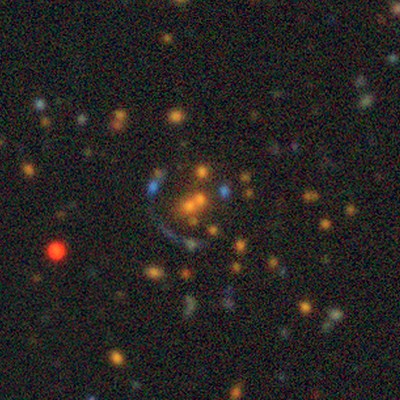
Credit: Legacy Surveys / D. Lang (Perimeter Institute) · Image source · Reuse information
Image details
/ ;
CC BY 4.0
- Other names
- SDSS J090002.79+223403.6 [1]
Name origin
paper system name and SE central galaxy; not the adopted NW anchorSDSS J0900+2234 [6]Name origin
published system cross-identificationSDSS J090002.6+223404 [4]Name origin
earlier system designationSDSS J090002.64+223404.8 [4]Name origin
explicit NW central galaxy cross-identificationName variants and source provenance
Published spellings and paper abbreviations retained for matching and traceability.
CSWA 19 [8]survey system
- Catalog source
- Cited Paper
- Right ascension
- 135.01101894°
09h 00m 02.64s [8] [9] - Declination
- 22.56801561°
+22° 34′ 04.86″ - Coordinates
- Equatorial J2000 · adopted catalog position
- Lens → Source
- Not yet classified
- Appearance
- Arc [2]
- Lens redshift
- 0.4890 [1]
Measurement details
Reported uncertainty: −0.0002 / +0.0002
SDSS spectroscopic error reported for the northwest central galaxy only; no independent redshift assigned to southeast member.
Method: SDSS spectroscopy of northwest central galaxy
Source location: arXiv:0910.4600v1, section 4.4, p7; Table 4 p16, SDSS J090002.79+223403.6 row.
- Discovery report
- 2008-12-10 [4] [5]
- Explore
- External object viewer
Background sources
Primary star-forming background galaxy (A, B and arc D) [2]
- Source redshift
- 2.03237 [3]
Measurement details
Reported uncertainty: −0.00011 / +0.00011
Formal 1σ Gaussian-centroid error. Different spectral features show larger scatter; section 2.1 discusses possible systematic errors. Vacuum reference wavelengths; no heliocentric convention asserted.
Method: Keck/ESI C III] doublet Gaussian fit; authors’ adopted systemic redshift
Source location: Published ApJ 863:191, Table 2 p4, CSWA 19 C III] row and footnote a; section 2.1 pp2–3; Appendix A p26 and A.3 p28.
- Einstein radius
- 7.0 arcsec [1]
Measurement details
Reported uncertainty: −0.8 / +0.8
Approximate manual arc-curvature estimate; not a precision two-deflector mass model or an A1 radius. Later model scales differ and are retained in dossier.
Method: Manual circular chord fit to arc; SIS used for enclosed-mass estimate
Source location: arXiv:0910.4600v1, section 4 p4 (method), section 4.4 p7 and Table 4 p16, target row.
A1: candidate separate background source; unconfirmed [2]
- Source redshift
- Not available
- Einstein radius
- Not available
Evidence & coordinate notes
- Appearance:arc: Figure 1 p8, arc D and weak A1; A1 source association remains candidate. [2]
- Confirmation: Section 4.4 p7 and Figure 6 p14: two bright-knot spectra agree, with Lyα and metal absorption. [1]
- Coordinates: catalogue.info line 23; CSWA 19 foreground row. Decimal degrees retained; precision is not an error estimate. [8]
- Coordinates: SDSS DR7 Glossary, coordinates entry: standard RA and Dec are J2000; Cambridge SDSS foreground identifier. [9]
- Description: Sections 3.1, 3.2 and 4 p3; Figure 1 p8; section 6 pp6–7: A/B/D, C exclusion, candidate A1, complex two-deflector model; section 5.1 p4 star-formation interpretation. [2]
- Description: Section 4.4 p7: two central galaxies, NW-only z=0.4890, matching bright-knot spectra and radius 7.0±0.8; section 4 p4: manual circle fit. [1]
- Description: Table 2 p4 CSWA 19 C III] adopted systemic row; section 2.1 pp2–3 and Appendix A.3 p28. [3]
- Description: Section 4.2 p1050 and Table 4 p1051 target row: later SIE radius 7.9 arcsec versus original circle-fit scale. [6]
- Description: Table 1 p2 target row and p3 central-pair paragraph: first verified morphology report, dated by v1 stamp on p1. [4]
- Discovery date: arXiv:0812.1860v1 Table 1 p2 SDSS J090002.6+223404 (reference 7, this work); p3 central-pair paragraph; morphology report, not source spectroscopy. [4]
- Discovery date: Submission history v1: 10 December 2008, 08:28:03 UTC; matched to target in archived v1, not later title. [5]
- Image:cswa-19-legacy-dr9.jpg: Native 400 x 400 ls-dr9 JPEG at the accepted NW foreground coordinates. Field match: Diehl arXiv:0910.4600v1 Figure 2 right (p10), Table 3 (p16); Bian arXiv:1004.4318v2 Figure 1 (p8), section 3.1 (p3). C excluded; A1 candidate, not individually resolved here. Unchanged bytes; comparison-evidence.json. [10]
- Source:a1: Section 3.1 p3, Figure 1 p8 and conclusions section 6 pp6–7: weak A1 may be another source; spectroscopy and deeper imaging needed. No measured redshift. [2]
- Source:primary: Sections 3.1–3.2 p3 and Figure 1 p8: A/B matching emission redshifts; A/B/D primary images; C excluded by MMT spectroscopy. [2]
References
- Diehl et al. (2009), The Sloan Bright Arcs Survey: Four Strongly Lensed Galaxies with Redshift >2, ApJ 707, 686–692. Scientific locators use arXiv:0910.4600v1 author manuscript, not journal PDF. DOI: 10.1088/0004-637X/707/1/686
- Bian et al. (2010), LBT/LUCIFER Observations of the z~2 Lensed Galaxy J0900+2234. Author manuscript arXiv:1004.4318v2, 15 November 2010. DOI: 10.1088/0004-637X/725/2/1877
- Jones, Stark & Ellis (2018), Dust in the Wind: Composition and Kinematics of Galaxy Outflows at the Peak Epoch of Star Formation, ApJ 863, 191. Published edition. DOI: 10.3847/1538-4357/aad37f
- Wen et al., Discovery of Strong Lensing Clusters in the SDSS DR6, arXiv:0812.1860v1 (10 December 2008). Original author edition; later journal title differs.
- arXiv:0812.1860 submission history, v1 submitted 10 December 2008.
- Stark et al. (2013), The CASSOWARY spectroscopy survey: a new sample of gravitationally lensed galaxies in SDSS, MNRAS 436, 1040–1056. Published edition. DOI: 10.1093/mnras/stt1624
- Mainali et al. (2023), Spectroscopy of CASSOWARY gravitationally lensed galaxies in SDSS: characterization of an extremely bright reionization-era analogue at z = 1.42, MNRAS 520, 4037–4056. DOI: 10.1093/mnras/stad387
- Cambridge Institute of Astronomy, CASSOWARY catalogue, release dated 8 November 2019.
- SDSS DR7 Glossary, coordinates entry: standard right ascension and declination are J2000.
- Legacy Surveys Sky Viewer, DR9 native color cutout for CSWA 19.