Catalog ID: GLC-261
MACS J1133.2+5008
Confirmed — combined [1]
MACS J1133.2+5008 (CSWA 12) is a confirmed cluster lens at redshift 0.394. Its tangential and radial arcs are multiple images of one background galaxy. The adopted source redshift is 1.544 from the original [O II] doublet spectroscopy; a later imaging study lists 1.550 for the same tangential arc, retained as an alternative. The quoted 10.9 ± 0.3 arcsec lensing scale is the tangential critical-line position inferred from the arc morphology, used as an approximate Einstein radius. It is distinct from the 3.2 ± 0.5 arcsec radial critical-line position. The record coordinates identify the foreground cluster galaxy, not the background arc. [5] [3] [1] [2]
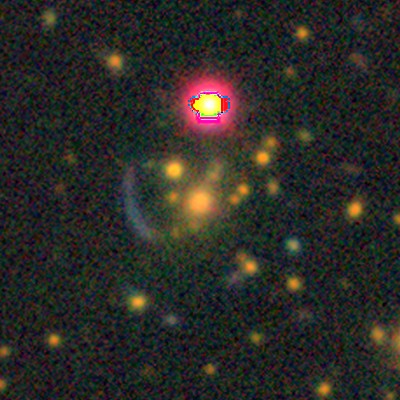
Credit: Legacy Surveys / D. Lang (Perimeter Institute) · Image source · Reuse information
Image details
/ ;
CC BY 4.0
- Other names
- CSWA 12 [5]
Name origin
CASSOWARY catalogueName variants and source provenance
Published spellings and paper abbreviations retained for matching and traceability.
MACS J1133.2+5008 [5]CASSOWARY explicit cross-identification
- Catalog source
- Cited Paper
- Right ascension
- 173.30488333 deg
11h 33m 13.17s [5] [6] - Declination
- 50.14447842 deg
+50° 08′ 40.12″ - Coordinates
- Equatorial J2000 · adopted catalog position
- Lens → Source
- Cluster → Galaxy [1]
- Appearance
- Arc [1]
- Lens redshift
- 0.394 [1]
Measurement details
No numerical redshift uncertainty stated; not the background arc redshift.
Method: New spectroscopic measurement of foreground BCG/cluster in Keck program.
Source location: Table 1 p.37 RXJ1133 row, note a; section 4.2 p.10.
- Discovery report
- 2003-09-17 [4]
- Explore
- External object viewer
Background sources
One background galaxy producing tangential A1 and radial A2 arcs [1]
- Source redshift
- 1.544 [1]
Measurement details
No numerical redshift error reported. Livermore Table 1 p.689 lists 1.550 at the same tangential arc without a replacement target-specific spectrum; retained as an alternative, not averaged.
Method: Keck spectroscopy detecting [O II] 3726,3729 doublet; radial and tangential arcs of one physical source.
Source location: Section 4.2 p.10; Table 3 p.39 RXJ1133 z_radial and z_tan, note a; section 6.1 p.19.
- Einstein radius
- 10.9 arcsec [1]
Measurement details
Reported uncertainty: −0.3 / +0.3
±0.3 arcsec is a conservative positional estimate; confidence level unspecified. Not a fitted area-equivalent Einstein radius. Radial critical line is a separate 3.2 ± 0.5 arcsec quantity.
Method: Tangential critical-line position inferred visually between merging images/near strongly distorted arcs; approximate Einstein scale at source z=1.544.
Source location: Section 3.4 pp.8–9; Table 3 p.39 RXJ1133 R_tan.
Evidence & coordinate notes
- Appearance:arc: Table 3 p.39; section 6.1 p.19, RXJ1133 radial and tangential arcs. [1]
- Confirmation: Section 4.2 p.10 and Table 3 p.39 (new arc spectroscopy); section 6.1 pp.19–20 (shared-source cluster lens model). [1]
- Coordinates: CSWA 12 RADec / a.k.a. MACS J1133.2+5008; SDSS DR7-linked foreground position; decimal degrees; reporting digits are not positional uncertainty. [5]
- Coordinates: Transformation from Great Circle Coordinates to J2000 Celestial Coordinates; frame convention only, not a new DR8 astrometric measurement. [6]
- Description: CSWA 12 RADec / MACS J1133.2+5008 explicit cross-identification. [5]
- Description: Journal p.689 Table 1 MACS J1133.2+5008, Arc position columns and z=1.550; section 2 (imaging sample); lens-model reference [6] Sand 2005. [3]
- Description: Table 1 p.37 (foreground); section 4.2 p.10 / Table 3 p.39 (source and arc scales); section 3.4 pp.8–9 (critical-line method); section 6.1 p.19 (one source). [1]
- Description: Table 3 p.41 RXJ1133 foreground position; Table 4 p.45 A1/A2 offsets, redshifts, reference 5 to Sand 2004. [2]
- Discovery date: v1 Table 4 p.7 RXJ1133 row and note a (new arc spectroscopy); Table 1 p.3; submission history 17 September 2003. Earliest target-specific public lens report verified here. [4]
- Image:cswa-12-legacy-dr9.jpg: Native 400 x 400 ls-dr9 JPEG centered on accepted CSWA-12 foreground coordinates. Field match: Livermore et al. (2012), MNRAS 427, Figure 1 MACS1133 bottom-right panel p.691; Table 1 MACS J1133.2+5008 arc row p.689. Unchanged bytes; full comparison in comparison-evidence.json. [7]
- Source:primary: Section 6.1 p.19 RXJ1133 paragraph: each arc comprises two images of the background source; Table 3 p.39. [1]
- System class: Section 6.1 pp.19–20: cluster-scale potential, BCG and additional galaxy mass components; background galaxy arcs. [1]
References
- Sand, Treu, Smith & Ellis (2004), The Dark Matter Distribution in the Central Regions of Galaxy Clusters: Implications for Cold Dark Matter, ApJ 604, 88–107; arXiv:astro-ph/0309465v2. DOI: 10.1086/382146
- Sand et al. (2005), A Systematic Search for Gravitationally-Lensed Arcs in the Hubble Space Telescope WFPC2 Archive, arXiv:astro-ph/0502528v1.
- Livermore et al. (2012), Hubble Space Telescope Hα imaging of star-forming galaxies at z ≃ 1–1.5: evolution in the size and luminosity of giant H II regions, MNRAS 427, 688–702. DOI: 10.1111/j.1365-2966.2012.21900.x
- Sand, Treu, Smith & Ellis, The Dark Matter Distribution in the Central Regions of Galaxy Clusters: Implications for CDM, arXiv:astro-ph/0309465v1, submitted 17 September 2003.
- University of Cambridge, Institute of Astronomy, CASSOWARY catalogue, dated 8 November 2019.
- SDSS-III DR8 documentation, Astrometry: Transformation from Great Circle Coordinates to J2000 Celestial Coordinates.
- Legacy Surveys Sky Viewer, DR9 native color cutout for CSWA 12.