Catalog ID: GLC-260
SDSS J120923.7+264047
Confirmed — combined [1]
SDSS J120923.7+264047 (CSWA 8) is a confirmed cluster lens. The historical giant arc A has an adopted source redshift of 1.018 and an approximate Einstein radius of 11 arcsec inferred from its distance from the brightest cluster galaxy. The adopted cluster-mean redshift is 0.5606 ± 0.0012; the original 0.558 measurement refers to the brightest cluster galaxy. Later work identifies distinct sources B, C and systems 4–7. B’s proposed redshift 0.879 is tentative, while C is measured at 3.948 with some line-identification uncertainty. Systems 4–7 have no adopted spectroscopic redshifts. A later model’s 22.7 arcsec effective Einstein radius is defined for a hypothetical source at redshift 2 and is not the radius of arc A. [3] [1] [2]
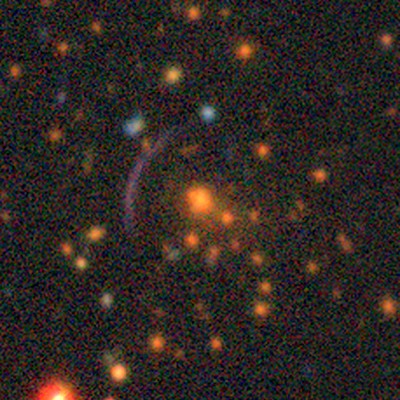
Credit: Legacy Surveys / D. Lang (Perimeter Institute) · Image source · Reuse information
Image details
/ ;
CC BY 4.0
- Other names
- CSWA 8 [5]
Name origin
CASSOWARY catalogueSDSS J1209+2640 [2]Name origin
SGAS cluster designationName variants and source provenance
Published spellings and paper abbreviations retained for matching and traceability.
SDSS J120923.7+264047 [1]Ofek et al., discovery designation
- Catalog source
- Cited Paper
- Right ascension
- 182.34869727 deg
12h 09m 23.69s [5] [6] - Declination
- 26.6796452 deg
+26° 40′ 46.72″ - Coordinates
- Equatorial J2000 · adopted catalog position
- Lens → Source
- Cluster → Galaxy [2]
- Appearance
- Arc [1]
- Lens redshift
- 0.5606 [2]
Measurement details
Reported uncertainty: −0.0012 / +0.0012
Reported ±0.0012 cluster-mean uncertainty; no confidence convention explicitly stated for this redshift error. Not the redshift of each member or the BCG.
Method: Mean of spectroscopically measured cluster-member redshifts; 25 members in dynamical sample, new GMOS plus Bayliss.
Source location: Table 2 row 22, printed p.5 (PDF p.6); section 3.2 printed pp.4–5.
- Discovery report
- 2008-08-05 [4]
- Explore
- External object viewer
Background sources
Historical giant arc A (primary source) [1]
- Source redshift
- 1.018 [1]
Measurement details
No object-specific numerical uncertainty quoted. Bayliss Table 4 gives A1=1.021, but its Table 2 gives A=1.018; adopt original arc spectroscopy retained by Sharon; preserve discrepancy.
Method: Keck/LRIS arc A spectrum: strong [O II] identification with supporting absorption/Balmer-break evidence.
Source location: Section 3 pp.2–3; Figure 3. Sharon Table 7 printed p.32 retains 1.0180.
- Einstein radius
- 11 arcsec [1]
Measurement details
No numerical error quoted; geometric approximation before counterimages were identified, not a detailed fitted critical-curve radius. Arc length 21 arcsec is a separate quantity. Stark Table 4 gives 8.4 arcsec from a distinct SDSS-only SIE model (section 4.2), retained as an alternative.
Method: Approximate arc A–BCG separation used by the authors to estimate Einstein radius at source z≈1 (arc A measured z=1.018).
Source location: Section 4 p.4 following equation (1); section 3 p.2.
Source B; redshift identification tentative [2]
- Source redshift
- Not available
- Einstein radius
- Not available
Source C; multiple images [2]
- Source redshift
- 3.948 [3]
Measurement details
No object-specific error given. Bayliss class 2: at least two significant lines and/or more weaker features, with small misidentification risk. Generic instrumental errors are not assigned to this object. Table 2 rounds/reports 3.949; Sharon Table 7 uses 3.9480.
Method: Gemini/GMOS spectroscopy of two images, C1/C2.
Source location: arXiv v4 Table 4 p.24, SDSS J1209+2640 rows C1 and C2; section 3.1 pp.7–9.
- Einstein radius
- Not available
System 4; candidate counterimage [2]
- Source redshift
- Not available
- Einstein radius
- Not available
System 5; radial pair and counterimage [2]
- Source redshift
- Not available
- Einstein radius
- Not available
System 6; six modeled images [2]
- Source redshift
- Not available
- Einstein radius
- Not available
Candidate system 7 [2]
- Source redshift
- Not available
- Einstein radius
- Not available
Evidence & coordinate notes
- Appearance:arc: Figures 1–3 and section 3 pp.2–3: giant arc A; other labels include arc candidates. [1]
- Confirmation: Section 3 pp.2–3 and Figure 3: background spectrum plus arc morphology confirm arc A as lensed galaxy; section 4 cluster evidence. [1]
- Coordinates: CSWA 8 RADec / SDSS cg1 BCG; SDSS DR7-linked foreground position; decimal degrees; reporting digits are not positional uncertainty. [5]
- Coordinates: Transformation from Great Circle Coordinates to J2000 Celestial Coordinates; frame convention only, not a new DR8 astrometric measurement. [6]
- Description: Figure 4 p.5 source B; section 3.1 pp.7–9 quality definitions; Table 4 p.24 C1/C2 and B1. [3]
- Description: Sections 3–4 pp.2–4 / Figure 3 (arc A, 1.018, BCG 0.558, approximate 11 arcsec separation-based radius). [1]
- Description: Table 2 row 22 and note printed p.5; section 3.2 pp.4–5; section 4.3.22 p.16; Table 7 target block pp.32–33. [2]
- Discovery date: Actual v1 abstract and sections 1–3 identify SDSS J120923.7+264047 / arc A; arXiv submission history 5 August 2008. [4]
- Einstein radius: Journal Table 4 p.1051, CSWA 8 row; section 4.2 p.1050: alternative SDSS DR8 gri single-source SIE model radius 8.4 arcsec, no numerical uncertainty. [7]
- Image:cswa-8-legacy-dr9.jpg: Native 400 x 400 ls-dr9 JPEG centered on accepted CSWA-8 foreground coordinates. Field match: Ofek et al., arXiv:0808.0721v1, Figure 1 and section 3 (PDF p.2). Unchanged bytes; full comparison in comparison-evidence.json. [8]
- Source:a: Ofek section 3 pp.2–3, Figures 1–3 and Table 1. [1]
- Source:b: Sharon section 4.3.22 printed p.16 (PDF p.17); Table 7 SDSS J1209+2640 block printed pp.32–33 (PDF pp.33–34). [2]
- Source:c: Sharon section 4.3.22 printed p.16 (PDF p.17); Table 7 SDSS J1209+2640 block printed pp.32–33 (PDF pp.33–34). [2]
- Source:source4: Sharon section 4.3.22 printed p.16 (PDF p.17); Table 7 SDSS J1209+2640 block printed pp.32–33 (PDF pp.33–34). [2]
- Source:source5: Sharon section 4.3.22 printed p.16 (PDF p.17); Table 7 SDSS J1209+2640 block printed pp.32–33 (PDF pp.33–34). [2]
- Source:source6: Sharon section 4.3.22 printed p.16 (PDF p.17); Table 7 SDSS J1209+2640 block printed pp.32–33 (PDF pp.33–34). [2]
- Source:source7: Sharon section 4.3.22 printed p.16 (PDF p.17); Table 7 SDSS J1209+2640 block printed pp.32–33 (PDF pp.33–34). [2]
- System class: Section 4.3.22 printed p.16: cluster halo plus galaxy halos and external shear; Table 2 row 22, 25 spectroscopic cluster members. [2]
References
- Ofek, Seitz & Klein (2008), SDSS J120923.7+264047: a new massive galaxy cluster with a bright giant arc; arXiv:0808.0721v1. DOI: 10.1111/j.1365-2966.2008.13563.x
- Sharon et al. (2020), Strong Lens Models for 37 Clusters of Galaxies from the SDSS Giant Arcs Survey, ApJS 247, 12. DOI: 10.3847/1538-4365/ab5f13
- Bayliss et al. (2011), Gemini/GMOS Spectroscopy of 26 Strong-lensing-selected Galaxy Cluster Cores, ApJS 193, 8; arXiv:1010.2714v4. DOI: 10.1088/0067-0049/193/1/8
- Ofek, Seitz & Klein, SDSS J120923.7+264047: A new massive galaxy cluster with a bright giant arc, arXiv:0808.0721v1, submitted 5 August 2008.
- University of Cambridge, Institute of Astronomy, CASSOWARY catalogue, dated 8 November 2019.
- SDSS-III DR8 documentation, Astrometry: Transformation from Great Circle Coordinates to J2000 Celestial Coordinates.
- Stark et al. (2013), The CASSOWARY spectroscopy survey: a new sample of gravitationally lensed galaxies in SDSS, MNRAS 436, 1040–1056. DOI: 10.1093/mnras/stt1624
- Legacy Surveys Sky Viewer, DR9 native color cutout for CSWA 8.