Catalog ID: GLC-26
AGEL010158-491738A
AGEL010158-491738A is an AGEL gravitational lens with one catalogued primary background source. The deflector has a photometric redshift estimate of 0.77; no spectroscopic deflector redshift is listed in DR2. A galaxy-to-galaxy interpretation is inferred from its CNN-selected sample context, not from a measured halo mass. The source redshift has limited precision. [1]
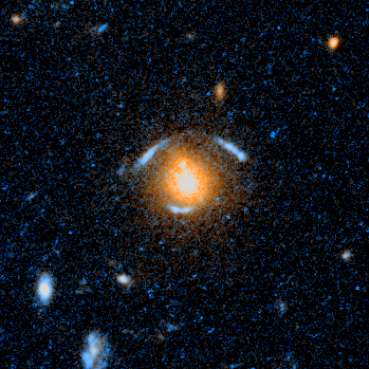
Credit: Tania Barone / AGEL Survey; HST program 16773 (PI Karl Glazebrook); reduced data: Hannah Skobe · Image source · Reuse information
Image details
Hubble Space Telescope / WFC3/UVIS; WFC3/IR; F200LP; F140W
CC0 1.0
- Other names
- DESJ0101-4917 [2]
Name origin
Official AGEL/HST mappingName variants and source provenance
Published spellings and paper abbreviations retained for matching and traceability.
AGEL010158-491738A [2]Official AGEL/HST mapping
- Catalog source
- AGEL
- Right ascension
- 15.491818°
01h 01m 58.04s [2] - Declination
- -49.293942°
−49° 17′ 38.19″ - Coordinates
- Equatorial J2000 · adopted catalog position
- Lens → Source
- Galaxy → Galaxy [1] [3]
- Appearance
- Not yet classified
- Lens redshift
- 0.77 [3]
Measurement details
Photometric estimate, not spectroscopy. Individual uncertainty not quoted in this table; do not apply AGEL spectroscopic formal errors.
Method: BPZ photometric redshift from DES Y3A1 catalog
Source location: Final Table 1 online full table, DESJ0101-4917, line 108; header note (1) BPZ, note (2) selection flags; PDF p.3
- Discovery report
- Not available
- Explore
- External object viewer
Background sources
AGEL010158-491738A background source A [1]
- Source redshift
- 2.632 [1]
Measurement details
Reported uncertainty: −0.0005 / +0.0005
Limited precision; alternative spectral limitations are described in section 3.1, without identifying which applies to this target. Formal uncertainty does not capture all uncertainty.
Method: VLT/X-shooter spectroscopy; Gaussian feature fits or MARZ templates (survey methods)
Source location: Table 1 p.5, AGEL010158-491738A; section 3.1 pp.14-16
- Einstein radius
- Not available
Evidence & coordinate notes
- Confirmation: Table 1 p.5, AGEL010158-491738A; Figure 3 p.11 includes the named HST-program lens; section 3.1 distinguishes spectral quality from lensing. [1]
- Confirmation: Final Table 1 online full table, DESJ0101-4917, line 108; header note (1) BPZ, note (2) selection flags; PDF p.3; section 2.4 pp.5-6 defines mean expert grades. [3]
- Coordinates: AGEL_HST_objnames.tab line 9 (AGEL010158-491738A / DESJ0101-4917); RAJ2000, DECJ2000 columns; catalog lens-system position, not source-plane astrometry. [2]
- Description: Table 1 p.5, AGEL010158-491738A; section 3.1 pp.14-16 (redshift methods and limitations). [1]
- Source:a: Table 1 p.5, AGEL010158-491738A; physical A/B naming explained p.4 and Table 1 note p.10. [1]
- System class: Table 1 p.5, AGEL010158-491738A; section 3.1 source-galaxy context [1]
- System class: Final Table 1 online full table, DESJ0101-4917, line 108; header note (1) BPZ, note (2) selection flags; PDF p.3; sections 2.1, 2.4 pp.3-6 and 3.5 p.8; sample-context inference, not measured halo mass. [3]
References
- Barone et al. (2026), The AGEL Survey Data Release 2, AJ 171, 57; final published article. DOI: 10.3847/1538-3881/ae1f86
- AGEL Survey, AGEL_HST_objnames.tab, Harvard Dataverse v1.0.
- Jacobs et al. (2019), An Extended Catalog of Galaxy-Galaxy Strong Gravitational Lenses Discovered in DES Using Convolutional Neural Networks, ApJS 243, 17; final article and online Table 1. DOI: 10.3847/1538-4365/ab26b6