Catalog ID: GLC-259
CSWA 5
Confirmed — combined [1]
CSWA 5 lenses one star-forming galaxy into three spectroscopically confirmed images, with a tentative fourth image. Its emission-line redshift is 1.06856 ± 0.00004 (1σ). Two foreground galaxies, L1 and L2, contribute to the lens: the record is centered on L1 (CSWA 5.1), while the measured foreground redshift 0.3877 belongs to L2 (CSWA 5.2). L1 has no measured spectroscopic redshift in these studies. The group interpretation is supported by modeling that assumes both galaxies share L2’s redshift and that im4 belongs to the same source. Individual model deflection scales and the 2.38 arcsec mean image distance are not adopted as one system-wide Einstein radius. The system was shown as a candidate in October 2008, before the 2010 spectroscopy report. [3] [4] [1] [2]
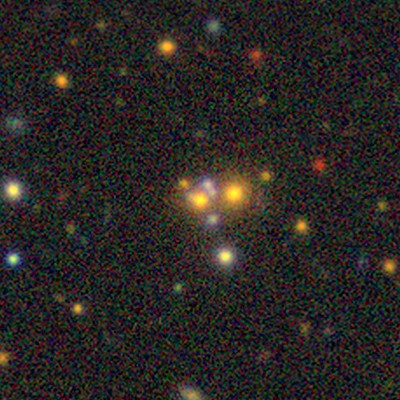
Credit: Legacy Surveys / D. Lang (Perimeter Institute) · Image source · Reuse information
Image details
/ ;
CC BY 4.0
- Other names
- CASSOWARY 5 [1]
Name origin
Christensen et al., full survey designationCSWA 5.1 [4]Name origin
CASSOWARY foreground component L1CSWA 5.2 [4]Name origin
CASSOWARY foreground component L2Name variants and source provenance
Published spellings and paper abbreviations retained for matching and traceability.
CSWA 5 [1]Christensen et al., system designation
- Catalog source
- Cited Paper
- Right ascension
- 191.21400615 deg
12h 44m 51.36s [4] [5] - Declination
- 1.11193257 deg
+01° 06′ 42.96″ - Coordinates
- Equatorial J2000 · adopted catalog position
- Lens → Source
- Group → Galaxy [2]
- Appearance
- Not yet classified
- Lens redshift
- 0.3877 [1]
Measurement details
No error quoted. Applies only to L2; the record coordinate anchor is L1, whose spectroscopic redshift is unknown. Common-redshift lens models assume L1 is at this redshift.
Method: SDSS absorption spectrum of L2 (western galaxy; Cambridge CSWA 5.2).
Source location: Section 3 p.4 and Figure 2 p.3: SDSS spectrum of L2, not L1.
- Discovery report
- 2008-10-14 [3]
- Explore
- External object viewer
Background sources
Star-forming galaxy; confirmed im1–im3; im4 tentative [1]
- Source redshift
- 1.06856 [1]
Measurement details
Reported uncertainty: −0.00004 / +0.00004
Reported 1σ uncertainty on mean emission redshift; source has distinct narrow/broad kinematic line components, not separate lensed galaxies.
Method: Flux-weighted mean nebular emission redshift from summed VLT/X-shooter im1–im3 spectra; vacuum heliocentric.
Source location: Section 4.2 p.5, emission-line mean; Table 3 p.7 footnote a.
- Einstein radius
- Not available
Evidence & coordinate notes
- Confirmation: Section 4 pp.4–5: im1–im3 spectra have indistinguishable profiles and matching emission-line redshifts; Figure 1 im4 is not spectroscopically established. [1]
- Coordinates: CSWA 5.1 RADec; separate CSWA 5.2 row is L2; SDSS DR7-linked foreground position; decimal degrees; reporting digits are not positional uncertainty. [4]
- Coordinates: Transformation from Great Circle Coordinates to J2000 Celestial Coordinates; frame convention only, not a new DR8 astrometric measurement. [5]
- Description: Figure 2 p.3 top-right CSWA 5 candidate; section 2.1 p.2; v2 metadata 14 October 2008. [3]
- Description: CSWA 5.1 and 5.2 separate provider rows; positions match Christensen Figure 1 / Table 1 L1/L2. [4]
- Description: Figure 1 / Table 1 p.2; Figure 2 p.3; sections 3–4.2 pp.4–5; Table 3 p.7 footnote a. [1]
- Description: Tables 1–2 p.2 notes (L1 and im4 assumptions); sections 2–3 / Tables 3–4 p.3 (group interpretation, separate model scales, mean image distance 2.38 arcsec). [2]
- Discovery date: Actual v2 Figure 2 p.3, top-right panel CSWA 5; section 2.1 p.2 calls these candidates. arXiv submission history v2: 14 October 2008. v1 inspected; this panel is not in v1. [3]
- Image:cswa-5-legacy-dr9.jpg: Native 400 x 400 ls-dr9 JPEG centered on accepted CSWA-5 foreground coordinates. Field match: Christensen et al., arXiv:1004.3546, Figure 1 and Table 1 (PDF p.2). Unchanged bytes; full comparison in comparison-evidence.json. [6]
- Source:primary: Figure 1 / Table 1 p.2; section 4 pp.4–5; spectra agree within Δz=5×10^-5. [1]
- System class: Abstract and sections 2–3 pp.2–3: two-galaxy thin lens and group interpretation; common redshift and fourth-image assumptions explicitly stated. [2]
References
- Christensen et al. (2010), X-shooter observations of the gravitational lens system CASSOWARY 5, MNRAS 406, 2616–2626; arXiv:1004.3546v2. DOI: 10.1111/j.1365-2966.2010.16860.x
- Grillo & Christensen (2011), Dark matter-rich early-type galaxies in the CASSOWARY 5 strong lensing system, MNRAS 418, 929–937; arXiv:1108.0678. DOI: 10.1111/j.1365-2966.2011.19544.x
- Belokurov et al., Two New Large Separation Gravitational Lenses from SDSS, arXiv:0806.4188v2, submitted 14 October 2008.
- University of Cambridge, Institute of Astronomy, CASSOWARY catalogue, dated 8 November 2019.
- SDSS-III DR8 documentation, Astrometry: Transformation from Great Circle Coordinates to J2000 Celestial Coordinates.
- Legacy Surveys Sky Viewer, DR9 native color cutout for CSWA 5.