Catalog ID: GLC-258
CSWA 3
Confirmed — combined [1]
CSWA 3 is a confirmed lens dominated by a massive early-type galaxy in a cluster environment. A star-forming background galaxy at redshift 0.725 produces three bright images along an arc; a fainter fourth image is predicted. The adopted foreground redshift, 0.278, follows the detailed spectroscopy and its figure caption, while the same paper reports 0.274 in its summary table and conclusion. The approximate 3.8 arcsec Einstein radius is an arc-curvature estimate, with no quoted numerical uncertainty. [1]
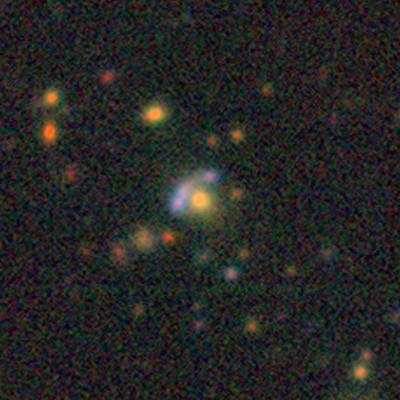
Credit: Legacy Surveys / D. Lang (Perimeter Institute) · Image source · Reuse information
Image details
/ ;
CC BY 4.0
- Other names
- CASSOWARY 3 [1]
Name origin
Belokurov et al., system designationName variants and source provenance
Published spellings and paper abbreviations retained for matching and traceability.
CSWA 3 [3]CASSOWARY catalogue
- Catalog source
- Cited Paper
- Right ascension
- 190.1345157 deg
12h 40m 32.28s [3] [4] - Declination
- 45.15079076 deg
+45° 09′ 02.85″ - Coordinates
- Equatorial J2000 · adopted catalog position
- Lens → Source
- Galaxy → Galaxy [1]
- Appearance
- Arc [1]
- Lens redshift
- 0.278 [1]
Measurement details
No numerical error reported. Adopt detailed measurement section; Table 1, abstract and conclusion instead report 0.274. Discrepancy remains in the published edition; neither averaged nor treated as a statistical error.
Method: BTA/SCORPIO long-slit absorption spectrum of foreground early-type galaxy (Ca H and K).
Source location: arXiv v2 section 4 p.7 and Figure 8 caption p.8; journal section 4 / Figure 8, pp.110–111.
- Discovery report
- 2008-06-25 [2]
- Explore
- External object viewer
Background sources
Star-forming galaxy; images A, B and C; predicted fourth image [1]
- Source redshift
- 0.725 [1]
Measurement details
No numerical redshift uncertainty supplied.
Method: BTA/SCORPIO prominent [O II] emission; authors exclude other viable line identifications.
Source location: arXiv v2 section 4 p.7 and Figure 8 p.8.
- Einstein radius
- 3.8 arcsec [1]
Measurement details
No quoted error; not an area-equivalent critical-curve radius. Conclusion rounds the arc radius to about 4 arcsec. Stark Table 4 gives 2.9 arcsec from a distinct SDSS-only SIE model (section 4.2), retained as an alternative.
Method: Approximate arc-curvature radius estimated from imaging; source at z=0.725.
Source location: arXiv v2 Table 1 p.4, CSWA 3 R_E; section 2.2 p.4 arc ellipse/curvature method.
Evidence & coordinate notes
- Appearance:arc: Figure 4 lower row; section 4 and Table 3: three bright images along arc; fourth image predicted, not observed. [1]
- Confirmation: arXiv v2 section 4, pp.7–8; Figure 8 spectroscopy and Figure 9 lens model; main lens is a single massive early-type galaxy within NSCS J124034+450923. [1]
- Coordinates: CSWA 3 RADec row; SDSS DR7-linked foreground position; decimal degrees; reporting digits are not positional uncertainty. [3]
- Coordinates: Transformation from Great Circle Coordinates to J2000 Celestial Coordinates; frame convention only, not a new DR8 astrometric measurement. [4]
- Description: arXiv v2 section 4 pp.7–8 / Figures 8–9 (class, spectra, three images and prediction); Table 1 / section 2.2 p.4 (3.8 arcsec); section 5 p.8 (0.274 alternative). [1]
- Discovery date: v1 submission history: 25 June 2008; actual v1 abstract p.1 and Table 1 p.3 identify CSWA 3. Public report date, not exposure date. [2]
- Einstein radius: Journal Table 4 p.1051, CSWA 3 row; section 4.2 p.1050: alternative SDSS DR8 gri single-source SIE model radius 2.9 arcsec, no numerical uncertainty. [5]
- Image:cswa-3-legacy-dr9.jpg: Native 400 x 400 ls-dr9 JPEG centered on accepted CSWA-3 foreground coordinates. Field match: Belokurov et al., arXiv:0806.4188v2, Figure 4 lower row (PDF p.5), Table 1 CSWA 3 column (PDF p.4). Unchanged bytes; full comparison in comparison-evidence.json. [6]
- Source:primary: arXiv v2 section 4, pp.7–8; Figures 8–9; Table 3. [1]
- System class: arXiv v2 section 4, pp.7–8; Figure 8 spectroscopy and Figure 9 lens model; main lens is a single massive early-type galaxy within NSCS J124034+450923. [1]
References
- Belokurov et al. (2009), Two new large-separation gravitational lenses from SDSS, MNRAS 392, 104–112; author manuscript arXiv:0806.4188v2. DOI: 10.1111/j.1365-2966.2008.14075.x
- Belokurov et al., Two New Large Separation Gravitational Lenses from SDSS, arXiv:0806.4188v1, submitted 25 June 2008.
- University of Cambridge, Institute of Astronomy, CASSOWARY catalogue, dated 8 November 2019.
- SDSS-III DR8 documentation, Astrometry: Transformation from Great Circle Coordinates to J2000 Celestial Coordinates.
- Stark et al. (2013), The CASSOWARY spectroscopy survey: a new sample of gravitationally lensed galaxies in SDSS, MNRAS 436, 1040–1056. DOI: 10.1093/mnras/stt1624
- Legacy Surveys Sky Viewer, DR9 native color cutout for CSWA 3.