Catalog ID: GLC-257
SDSS J0921+1810
Confirmed — combined [1]
CSWA 31 (SDSS J0921+1810) is a confirmed group-scale lens centered on a bright elliptical galaxy at redshift 0.6828. MUSE spectroscopy identifies five physical background galaxies: primary spiral S0 at 1.4869, S2 at 1.4874, S3 at 2.763, S4 at 3.4280 and S5 at 4.205. S1 is a star-forming clump within S0, not a sixth galaxy. S4 is identified through a single line interpreted as Ly-alpha in each of three images, supported by the lens model; the lower signal-to-noise S5(d) spectrum gives 4.203 and is fixed to 4.205 in the model. Grillo’s approximate 70 kpc primary-source Einstein radius corresponds to about 9.9 arcsec using that paper’s angular scale. This total-lens scale is distinct from individual galaxy and group-halo model parameters. S0 also acts as a secondary deflector for more distant sources. The verified public report is Brewer’s 26 October 2010 preprint, which preceded a measured primary-source redshift. [5] [4] [1] [3]
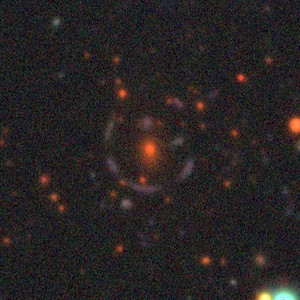
Credit: Legacy Surveys / D. Lang (Perimeter Institute) · Image source · Reuse information
Image details
/ ; g, r, z
CC BY 4.0
- Other names
- CSWA 31 [6]
Name origin
CASSOWARY catalogueName variants and source provenance
Published spellings and paper abbreviations retained for matching and traceability.
SDSS J0921+1810 [2]Stark et al. (2013), SDSS designation
- Catalog source
- Cited Paper
- Right ascension
- 140.3572627°
09h 21m 25.74s [6] [8] [7] - Declination
- 18.17148017°
+18° 10′ 17.33″ - Coordinates
- Equatorial J2000 · adopted catalog position
- Lens → Source
- Group → Galaxy [1]
- Appearance
- Arc [1]Quadruple image [1]
- Lens redshift
- 0.6828 [1]
Measurement details
No numerical redshift uncertainty stated in Table 1. Four decimals are reported precision, not an uncertainty. Older SDSS value 0.683 retained as an alternative.
Method: VLT/MUSE spectroscopy of the brightest group galaxy.
Source location: Table 1 p5 BGG row and note; section 2.4 p5.
- Discovery report
- 2010-10-26 [5]
- Explore
- External object viewer
Background sources
Spiral galaxy S0, including internal clump S1 [1]
- Source redshift
- 1.4869 [1]
Measurement details
No numerical redshift error in Table 1; secure spectroscopic identification per table note, not a universal quality grade.
Method: VLT/MUSE spectroscopy; source-family identification from spectra and multiple images.
Source location: Table 1 p5, S0 rows and note; sections 2.2–2.3 pp3–4.
- Einstein radius
- 9.9 arcsec [4]
Measurement details
Approximate derived angular scale, no numerical error adopted. Not Table 2 lens strength b, not a BGG-only radius, and not a z=infinity radius or S0 secondary-deflector parameter.
Method: Angular conversion of the reported approximate total-lens Einstein radius: 70 / 7.08 = 9.887 arcsec, rounded to 9.9.
Source location: Published HTML section 3 approximate R_Ein=70 kpc for primary source z=1.4870; section 1 final paragraph: 1 arcsec=7.08 kpc.
Source S2 [1]
- Source redshift
- 1.4874 [1]
Measurement details
No numerical redshift error in Table 1; secure spectroscopic identification per table note, not a universal quality grade.
Method: VLT/MUSE spectroscopy; source-family identification from spectra and multiple images.
Source location: Table 1 p5, S2 rows and note; sections 2.2–2.3 pp3–4.
- Einstein radius
- Not available
Source S3 [1]
- Source redshift
- 2.763 [1]
Measurement details
No numerical redshift error in Table 1; secure spectroscopic identification per table note, not a universal quality grade.
Method: VLT/MUSE spectroscopy; source-family identification from spectra and multiple images.
Source location: Table 1 p5, S3 rows and note; sections 2.2–2.3 pp3–4.
- Einstein radius
- Not available
Source S4 [1]
- Source redshift
- 3.4280 [1]
Measurement details
No numerical redshift error in Table 1; secure spectroscopic identification per table note, not a universal quality grade. No HST continuum counterpart; preserve the single-line identification basis.
Method: MUSE single emission line identified as Ly-alpha in three images; positions consistent with the lens model.
Source location: Table 1 p5, S4 rows and note; sections 2.2–2.3 pp3–4.
- Einstein radius
- Not available
Source S5 [1]
- Source redshift
- 4.205 [1]
Measurement details
No numerical redshift error in Table 1; secure spectroscopic identification per table note, not a universal quality grade. S5(a-c) give 4.205; S5(d) independently fits 4.203 at lower signal-to-noise and is fixed to 4.205 for modeling (section 2.3 p4).
Method: VLT/MUSE spectroscopy; source-family identification from spectra and multiple images.
Source location: Table 1 p5, S5 rows and note; sections 2.2–2.3 pp3–4.
- Einstein radius
- Not available
Evidence & coordinate notes
- Aliases: Catalogue row CSWA 31, exact original designation and SDSS foreground anchor; no normalized alias copies added. [6]
- Aliases: Table 4, p1051, SDSS J0921+1810 row: SDSS and CSWA identifiers. [2]
- Appearance:arc: Section 2.3 pp3–4 and Figure 1 p4: bright extended primary spiral arc. [1]
- Appearance:quadruple: Table 1 p5 S0(a)–S0(d), section 2.3 p3: four images of primary S0, not four physical sources. [1]
- Confirmation: Sections 2.2–2.3 pp3–4, Table 1 p5 and Figure 1 p4: MUSE redshifts and multiple-image families, with S4/S5 qualifications. [1]
- Coordinates: Catalogue 2019-11-08, CSWA 31 row: RA (deg), Dec (deg), SDSS ObjID; adopted central foreground anchor. Printed decimal digits are not an error estimate. [6]
- Coordinates: Algorithms: Astrometry, first paragraph: positions based on r-band centroids; no individual coordinate uncertainty adopted. [8]
- Coordinates: Survey Interface File for Calibrated Objects, TTYPE104 ra and TTYPE105 dec: J2000 equatorial degrees. [7]
- Description: Abstract p1 and section 5 pp6–8; v1 submission 26 October 2010. Section 5 explicitly lacks source redshifts; the assumed source plane is not a measurement. [5]
- Description: Published HTML section 3: approximate primary-source Einstein radius 70 kpc; section 1 last paragraph: 7.08 kpc per arcsec. Derived angular equivalent ≈9.9 arcsec. Table 2 footnote a distinguishes lens strength from an Einstein radius. [4]
- Description: Table 1 p5 BGG/S0/S2/S3/S4/S5; sections 2.2–2.4 pp3–5; Figure 1 p4: five physical sources, S1 inside S0, S4 line identification, S5(d) 4.203 fixed to 4.205, group scale. [1]
- Description: Section 2 p2: S0 is a secondary lens in addition to being a source behind the main group; section 3.2 p4 and Table 1 p5 describe component parameters for a source at infinite redshift, not the main S0 Einstein radius. [3]
- Discovery date: arXiv v1 submission history: 26 October 2010; abstract p1, section 5 pp6–8 and Figure 3 p7 identify CSWA 31; source redshift is explicitly unknown in section 5. [5]
- Image:cswa-31-legacy-dr9.jpg: Native 300 × 300 ls-dr9 JPEG at the accepted CSWA 31 foreground position. Compared with official Cambridge gri cutout and Stark Table 2 p1044 lens/arc coordinates. Also Wang et al. (2022), Figure 1 p4 (rotated) and Table 1 p5, BGG/S0 rows. No pixel edits; unresolved source families remain unlabeled. [9]
- ObjectURL: Official CSWA 31 gri field image and published lens/arc positions cross-checked against the selected Legacy Surveys viewer in accepted identity viewer-check.json, 2026-11-10. [6]
- Record source: Primary record-origin paper supplying the core adopted scientific information; first ordered reference is intentional. CASSOWARY membership is retained separately. [1]
- Source:s0: Sections 2.2–2.3 pp3–4 and Table 1 p5, S0 image rows; Figure 1 p4. S0/S1 belong to one physical spiral; S2 is distinct despite similar redshift. [1]
- Source:s2: Sections 2.2–2.3 pp3–4 and Table 1 p5, S2 image rows; Figure 1 p4. S0/S1 belong to one physical spiral; S2 is distinct despite similar redshift. [1]
- Source:s3: Sections 2.2–2.3 pp3–4 and Table 1 p5, S3 image rows; Figure 1 p4. S0/S1 belong to one physical spiral; S2 is distinct despite similar redshift. [1]
- Source:s4: Sections 2.2–2.3 pp3–4 and Table 1 p5, S4 image rows; Figure 1 p4. S0/S1 belong to one physical spiral; S2 is distinct despite similar redshift. [1]
- Source:s5: Sections 2.2–2.3 pp3–4 and Table 1 p5, S5 image rows; Figure 1 p4. S0/S1 belong to one physical spiral; S2 is distinct despite similar redshift. [1]
- System class: Abstract p1; section 2.4 p5: group-scale lens with 46 spectroscopically selected group members, BGG at 0.6828. Fossil status remains a candidate interpretation. [1]
References
- Wang et al. (2022), Constraining the multi-scale dark-matter distribution in CASSOWARY 31 with strong gravitational lensing and stellar dynamics. A&A 668, A162. DOI: 10.1051/0004-6361/202243600
- Stark et al. (2013), The CASSOWARY spectroscopy survey: a new sample of gravitationally lensed galaxies in SDSS. MNRAS 436, 1040–1056. DOI: 10.1093/mnras/stt1624
- Wang et al. (2024), Strong-lensing and kinematic analysis of CASSOWARY 31: Can strong lensing constrain the masses of multi-plane lenses? A&A 690, A1. DOI: 10.1051/0004-6361/202449910
- Grillo et al. (2013), Measuring the total and baryonic mass profiles of the very massive CASSOWARY 31 strong lens. A fossil system at z ≃ 0.7? MNRAS 433, 2604–2612. DOI: 10.1093/mnras/stt930
- Brewer et al., Modelling of the Complex CASSOWARY/SLUGS Gravitational Lenses. arXiv:1010.5298v1, submitted 26 October 2010; first-version public report. DOI: 10.1111/j.1365-2966.2010.18074.x
- Institute of Astronomy, University of Cambridge, CASSOWARY catalogue, version 8 November 2019.
- SDSS DR7, Survey Interface File for Calibrated Objects: spObj.
- SDSS DR7, Algorithms: Astrometry.
- Legacy Surveys Sky Viewer, DR9 native color cutout for CSWA 31.