Catalog ID: GLC-255
SDSS J0800+0812
CSWA 11 (SDSS J0800+0812) is a confirmed lens associated with a galaxy group whose central galaxy has a spectroscopic redshift of 0.314. Its primary background galaxy has an adopted nebular redshift of 1.408 from unresolved [O II] emission; Mainali et al. list 1.409 for the same source and report later near-infrared line detections. The explicitly described Stark measurement is retained rather than treating the table difference as a new source. A later lens model provides a magnification, but no numerical Einstein radius is adopted from the inspected papers. The date records the earliest target-specific public paper verified here, 11 February 2013, rather than an asserted original discovery date. [4] [3] [2] [1] [5]
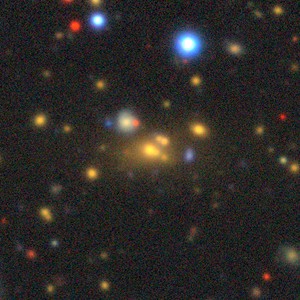
Credit: Legacy Surveys / D. Lang (Perimeter Institute) · Image source · Reuse information
Image details
/ ; g, r, z
CC BY 4.0
- Other names
- CSWA 11 [6]
Name origin
CASSOWARY catalogueName variants and source provenance
Published spellings and paper abbreviations retained for matching and traceability.
SDSS J0800+0812 [1]Stark et al. (2013), SDSS designation
- Catalog source
- Cited Paper
- Right ascension
- 120.05441848°
08h 00m 13.06s [6] [8] [7] - Declination
- 8.20232396°
+08° 12′ 08.37″ - Coordinates
- Equatorial J2000 · adopted catalog position
- Lens → Source
- Group → Galaxy [4] [3]
- Appearance
- Arc [1]
- Lens redshift
- 0.314 [1]
Measurement details
No numerical uncertainty is reported for this foreground value; Cambridge photometric 0.31 is not adopted.
Method: SDSS spectroscopy as reported by Stark; non-dagger lens entry.
Source location: Table 2, p1044, SDSS J0800+0812 row and caption.
- Discovery report
- 2013-02-11 [5]
- Explore
- External object viewer
Background sources
Primary background galaxy [1]
- Source redshift
- 1.408 [1]
Measurement details
No numerical error reported. Absorption gas gives 1.407; Mainali Table 1 p4039 lists 1.409 for the same MMT target. No cause or formal significance of the difference is established.
Method: MMT nebular [O II] centroid: observed 8983 Å, assumed unresolved rest centroid 3728.3 Å.
Source location: Section 3.2, p1047, SDSS J0800+0812 paragraph; Table 2 p1044.
- Einstein radius
- Not available
Evidence & coordinate notes
- Aliases: Catalogue row CSWA 11, exact original designation and SDSS foreground anchor; no normalized alias copies added. [6]
- Aliases: Table 4, p1051, SDSS J0800+0812 row: SDSS and CSWA identifiers. [1]
- Appearance:arc: Table 2 p1044 caption identifies the observed lensed arc; section 3.2 p1047 confirms its background spectrum. [1]
- Confirmation: Manuscript section 3 pp4–5 and Table 2 p5, cswa11: Light-Traces-Mass lens model from Gemini gri images. [3]
- Confirmation: Section 3.2 p1047, SDSS J0800+0812: metal absorption and [O II] spectroscopy; Table 2 p1044. [1]
- Coordinates: Catalogue 2019-11-08, CSWA 11 row: RA (deg), Dec (deg), SDSS ObjID; adopted central foreground anchor. Printed decimal digits are not an error estimate. [6]
- Coordinates: Algorithms: Astrometry, first paragraph: positions based on r-band centroids; no individual coordinate uncertainty adopted. [8]
- Coordinates: Survey Interface File for Calibrated Objects, TTYPE104 ra and TTYPE105 dec: J2000 equatorial degrees. [7]
- Description: Manuscript section 2.1 p2, Table 1 p3 CSWA 11 and Figure 4 p7: galaxy-group context; no inference that the BGG alone supplies all lensing mass. [4]
- Description: Manuscript Table 1 p4 cswa11 gives magnification 1.9; section 3 pp4–5 and Table 2 p5 give model method and data, not a target Einstein radius. [3]
- Description: Table 1 p4039, CSWA-11: 1.409, MMT/BCS and 2012 March 24 observation; section 3.1 p4049 target paragraph: later FIRE [O II], [O III] and H-alpha detections; section 2.4 p4045 cites the later lens model. [2]
- Description: Table 2 p1044 and section 3.2 p1047: foreground 0.314, nebular source 1.408 and absorption 1.407; Table 4 p1051 has no radius for this target. [1]
- Description: Submission history v1 11 February 2013 and Table 2 p6 establish a verified public report, not the date of the earlier SDSS discovery. [5]
- Discovery date: arXiv submission history: v1, 11 February 2013; v1 Table 2 p6, SDSS J0800+0812. Earliest verified target-specific public paper in the bounded search; earlier survey-wide catalogue launch is not target-specific. [5]
- Image:cswa-11-legacy-dr9.jpg: Native 300 × 300 ls-dr9 JPEG at the accepted CSWA 11 foreground position. Compared with official Cambridge gri cutout and Stark Table 2 p1044 lens/arc coordinates. No pixel edits; unresolved source families remain unlabeled. [9]
- ObjectURL: Official CSWA 11 gri field image and published lens/arc positions cross-checked against the selected Legacy Surveys viewer in accepted identity viewer-check.json, 2026-11-10. [6]
- Record source: Primary record-origin paper supplying the core adopted scientific information; first ordered reference is intentional. CASSOWARY membership is retained separately. [1]
- Source:primary: Table 2 p1044 and section 3.2 p1047, SDSS J0800+0812: one primary galaxy; arc/slit coordinates are not foreground coordinates. [1]
- System class: Manuscript section 2.1 p2 and Table 1 p3 CSWA 11: group selected as a fossil progenitor; Figure 4 p7 includes its extended X-ray emission. Group designation is distinct from a proven relaxed fossil state. [4]
- System class: Manuscript section 3 p5 and Table 2 cswa11: mass model includes lens galaxies and a smoothed dark-matter component. Used with the target-specific group study, not generic CASSOWARY membership. [3]
References
- Stark et al. (2013), The CASSOWARY spectroscopy survey: a new sample of gravitationally lensed galaxies in SDSS. MNRAS 436, 1040–1056. DOI: 10.1093/mnras/stt1624
- Mainali et al. (2023), Spectroscopy of CASSOWARY gravitationally lensed galaxies in SDSS: characterization of an extremely bright reionization-era analogue at z = 1.42. MNRAS 520, 4037–4056. DOI: 10.1093/mnras/stad387
- Leethochawalit et al. (2016), A Keck Survey of Gravitationally-Lensed Star-Forming Galaxies: High Spatial Resolution Studies of Kinematics and Metallicity Gradients. arXiv:1509.01279v2 (manuscript edition). DOI: 10.3847/0004-637X/820/2/84
- Johnson et al. (2018), Chandra and HST Snapshots of Fossil System Progenitors. arXiv:1806.06819 (manuscript edition; ApJ 869, 170). DOI: 10.3847/1538-4357/aaf00b
- Stark et al., The CASSOWARY spectroscopy survey: A new sample of gravitationally lensed galaxies in SDSS. arXiv:1302.2663v1, submitted 11 February 2013; first-version public report. DOI: 10.1093/mnras/stt1624
- Institute of Astronomy, University of Cambridge, CASSOWARY catalogue, version 8 November 2019.
- SDSS DR7, Survey Interface File for Calibrated Objects: spObj.
- SDSS DR7, Algorithms: Astrometry.
- Legacy Surveys Sky Viewer, DR9 native color cutout for CSWA 11.