Catalog ID: GLC-253
SDSS J0851+3558
Confirmed — spectroscopy [1]
CSWA 30 (SDSS J0851+3558) is a spectroscopically confirmed lens system with a central lensing galaxy at redshift 0.272 and a background galaxy at 0.919, confirmed through [O II] emission. Stark et al. provide no reliable lens model or Einstein radius for this system in Table 4, so the radius remains unavailable. The system has been studied as a galaxy group and fossil-group progenitor; this environmental description alone is not used to assign the scale of the dominant deflector. The report date marks its verified listing in the 11 February 2013 Stark preprint; an earlier CASSOWARY data release is credited there but its target-specific date remains unverified. [5] [1] [2]
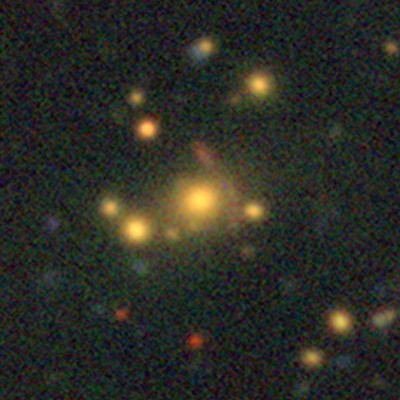
Credit: Legacy Surveys / D. Lang (Perimeter Institute) · Image source · Reuse information
Image details
/ ;
Creative Commons Attribution 4.0 International (CC BY 4.0)
- Other names
- CSWA 30 [3]
Name origin
Cambridge CASSOWARY target row; cross-identification in Stark Tables 2 and 4Name variants and source provenance
Published spellings and paper abbreviations retained for matching and traceability.
SDSS J0851+3558 [1]Stark journal Table 2, central lens/system designation
- Catalog source
- Cited Paper
- Right ascension
- 132.8604223°
08h 51m 26.50s [3] [4] - Declination
- 35.97049854°
+35° 58′ 13.79″ - Coordinates
- Equatorial J2000 · adopted catalog position
- Lens → Source
- Not yet classified
- Appearance
- Arc [1]
- Lens redshift
- 0.272 [1]
Measurement details
No numerical uncertainty quoted in Table 2. This is the central galaxy redshift, not a group mean. The row has no dagger marking a new non-SDSS lens redshift.
Method: SDSS spectroscopy of the central lensing galaxy, as compiled in Stark Table 2
Source location: Journal p.1044, Table 2 caption and SDSS J0851+3558 / CSWA 30 row
- Discovery report
- 2013-02-11 [2]
- Explore
- External object viewer [3]
Background sources
Primary background galaxy [1]
- Source redshift
- 0.919 [1]
Measurement details
No numerical uncertainty quoted. §3.1 states that average absorption/Ly-alpha kinematic corrections are included where possible; it does not identify a target-specific correction here. No target-specific vacuum/heliocentric convention or systemic accuracy is inferred.
Method: [O II] emission-line spectroscopy
Source location: Journal p.1044, Table 2 caption and SDSS J0851+3558 / CSWA 30 row; §3.1 pp.1044–1045
- Einstein radius
- Not available
Evidence & coordinate notes
- Appearance:arc: Journal p.1044, Table 2 caption and SDSS J0851+3558 / CSWA 30 row: source coordinates are explicitly rough slit intersections with arcs, not source-plane positions; no ring closure or image multiplicity inferred. [1]
- Confirmation: Journal p.1044, Table 2 caption and SDSS J0851+3558 / CSWA 30 row; p.1043 Table 1 target observing row; §§2.6–2.7 and 3.1 pp.1044–1045. Target is in the spectroscopically confirmed lensed-galaxy sample. [1]
- Coordinates: Catalogue CSWA 30 ObjID/RADec row; CSWA 30 ObjID/RADec row; immutable catalogue.info line 34. Decimal-degree foreground central-galaxy position, not an arc or intrinsic source-plane coordinate. Printed digits preserved; astrometric error and observation epoch not supplied. [3]
- Coordinates: DR7 Glossary, Coordinate system entry: standard RA and Dec are J2000. Cambridge identifies SDSS coordinates and links the DR7 viewer. No frame transformation performed. [4]
- Description: Actual arXiv:1711.06205v1 Table 2 (not Table 1), p.6 CSWA 30 row; Figure 6(d) and caption p.12: group/fossil-progenitor environment. No partition of galaxy and group lensing mass or numerical Einstein radius is supplied by these locators. [5]
- Description: Table 2 p.1044 SDSS J0851+3558 / CSWA 30 row: lens 0.272, source 0.919, [O II]; Table 4 p.1051 same target has blank radius/magnification and caption says model details are absent when data do not allow a reliable model; §4.2 p.1050. No target-specific limitation beyond this is inferred. [1]
- Description: Table 4 p.13 target row and caption reference [18] CASSOWARY data release; original v1 dated 11 February 2013 in submission history. Earlier target-specific release date not established; observations are not publication dates. [2]
- Discovery date: arXiv submission history 2013-02-11 22:59:20 UTC; actual v1 Table 4 p.13 target row. This is the earliest precisely dated public target listing verified in this bounded search, not a claim of original discovery credit. The row credits reference [18], CASSOWARY data release, whose earlier target-specific release date was not recovered. The June 2008 catalogue-start statement does not date every later row. [2]
- Image:cswa-30-legacy-dr9.jpg: Native 400 × 400 JPEG centered on accepted foreground position; URL specifies ls-dr9. Field check: Johnson v1 Figure 6(d), p12, explicitly identifies CSWA 30. The central galaxy, bright lower-left companion, smaller farther-left object, close right companion and two upper field objects match. No lensing confirmation or source multiplicity is inferred from this field image. [6]
- Object url: Identity attempt 2 viewer-check.json / cswa-30: native Legacy Surveys DR9 image field association verified 2026-11-10; exact selected URL retained. This reference supports the catalog center; the independent viewer verification is in the upstream report. [3]
- Source:primary: Journal p.1044, Table 2 caption and SDSS J0851+3558 / CSWA 30 row; caption identifies the lensed source and the central lens separately. One physical galaxy, not one source per arc knot. [1]
References
- Stark et al. (2013), The CASSOWARY spectroscopy survey: a new sample of gravitationally lensed galaxies in SDSS, MNRAS 436, 1040–1056. DOI: 10.1093/mnras/stt1624
- Stark et al. (2013), The CASSOWARY spectroscopy survey: A new sample of gravitationally lensed galaxies in SDSS, arXiv:1302.2663v1 (11 February 2013).
- Institute of Astronomy, University of Cambridge, CASSOWARY Gravitational Lenses, catalogue dated 8 November 2019 (accessed 10 November 2026).
- SDSS DR7 Glossary, Coordinate system entry (accessed 10 November 2026).
- Johnson et al. (2017), Using Strong Gravitational Lensing to Identify Fossil Group Progenitors, arXiv:1711.06205v1.
- Legacy Surveys Sky Viewer, DR9 native color cutout for CSWA 30.