Catalog ID: GLC-252
Hall's Arc
Hall's Arc (CSWA 22; SDSS J0146−0929) is a cluster lens with an incomplete Einstein ring formed by a background galaxy. The adopted foreground redshift is the central brightest cluster galaxy's 0.4469 ± 0.00006; the primary source is at 1.9436. HST imaging and spectroscopy establish a second lensed galaxy at 2.3660, distinct from the multiple images and knots of the primary source. The adopted primary-source Einstein radius is Auger et al.'s 11.94 arcsec SIE estimate, with their 5% uncertainty allowance for systematics. Stark et al. give 11.9 arcsec; Sharon et al.'s 12.4 arcsec effective critical-area radius is calculated at a fiducial source redshift of 2 and is not substituted for a measured source redshift. The discovery-report date records Hennawi et al.'s public 3 October 2006 preprint, separately from later spectroscopic confirmation. [3] [5] [4] [1] [2]
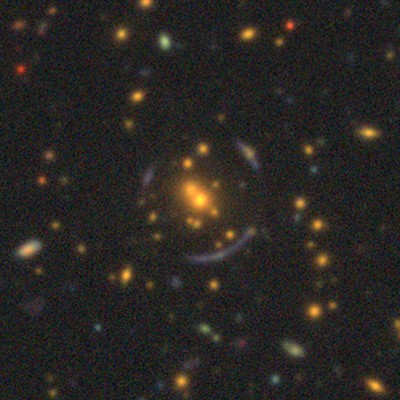
Credit: Legacy Surveys / D. Lang (Perimeter Institute) · Image source · Reuse information
Image details
/ ;
Creative Commons Attribution 4.0 International (CC BY 4.0)
- Other names
- SDSS J0146−0929 [2]
Name origin
Stark journal Table 2, central lens/system designationCSWA 22 [5]Name origin
Cambridge CASSOWARY target row; cross-identification in Stark Tables 2 and 4Name variants and source provenance
Published spellings and paper abbreviations retained for matching and traceability.
Hall's Arc [5]Cambridge CSWA 22 nickname; historical arc name used for this cluster lens system
- Catalog source
- Cited Paper
- Right ascension
- 26.73337065°
01h 46m 56.01s [5] [6] - Declination
- -9.49791496°
−09° 29′ 52.49″ - Coordinates
- Equatorial J2000 · adopted catalog position
- Lens → Source
- Cluster → Galaxy [1]
- Appearance
- Arc [1]Partial ring [1]
- Lens redshift
- 0.4469 [1]
Measurement details
Reported uncertainty: −0.00006 / +0.00006
Reported ±0.00006 is the BCG redshift uncertainty, not the cluster velocity dispersion. Confidence convention is not specified in this row. Nspec=1; the model fixes this redshift rather than propagating its error.
Method: SDSS DR12 BCG spectroscopy, as adopted in Sharon et al.
Source location: Published p.5 (institutional PDF p.6), Table 2, row 3 SDSS J0146−0929; §3.2 pp.4–5
- Discovery report
- 2006-10-03 [4]
- Explore
- External object viewer [5]
Background sources
Primary background galaxy (Sharon source 1) [1]
- Source redshift
- 1.9436 [1]
Measurement details
No numerical uncertainty is given for this source in Table 4. Preserve its instrument attribution; Stark §2.7 separately reports TripleSpec confirmation at 1.944. No heliocentric/vacuum convention assigned without target-specific evidence.
Method: Spectroscopy; Table 4 attributes this value to This work, FIRE; Stark+13
Source location: Published p.26 (PDF p.27), Table 4, SDSS J0146−0929 image 1.1 row; §4.3.3 p.10
- Einstein radius
- 11.94 arcsec [3]
Measurement details
Reported uncertainty: −0.597 / +0.597
Authors impose a 5% minimum uncertainty for systematics including line-of-sight structure; this undaggered row receives 5%, not 25%. Symmetric 0.597 arcsec is the explicit conversion 0.05 × 11.94, not an independently fitted error. Table uses z_l=0.4400 and z_s=1.9440; radius has not been recomputed at the separately adopted redshifts.
Method: Singular isothermal ellipsoid fit to SDSS gri imaging
Source location: Journal Table 1 p.504 SDSS J0146−0929 row and caption; §2.1. Matching arXiv:1308.6286v1 Table 1 p.3 and §2.1 p.2
Second background galaxy (Sharon source 2) [1]
- Source redshift
- 2.3660 [1]
Measurement details
Table 4 gives 2.3660; text gives 2.366. No numerical uncertainty specified. Images 2.1 and 2.2 are secure; candidate image 2.3 is not a model constraint.
Method: Magellan/IMACS spectroscopy of [C III] 1907 and C III] 1909 Angstrom emission
Source location: Published p.26 Table 4, SDSS J0146−0929 image 2.1 row; §4.3.3 p.10; Table 3 p.6
- Einstein radius
- Not available
Evidence & coordinate notes
- Appearance:arc: §4.3.3 p.10, first paragraph; Figure 1 p.9 SDSS J0146−0929 panel. Incomplete ring and multiple arcs, not a complete ring or four physical sources. [1]
- Appearance:partial ring: §4.3.3 p.10, first paragraph; Figure 1 p.9 SDSS J0146−0929 panel. Incomplete ring and multiple arcs, not a complete ring or four physical sources. [1]
- Confirmation: §4.3.3 p.10, Figure 1 p.9, Table 4 p.26: image associations, second spectroscopic source and central cluster halo lens model. [1]
- Confirmation: Journal p.1044, Table 2 caption and SDSS J0146−0929 / CSWA 22 row; p.1043 Table 1 target observing row; §§2.6–2.7 and 3.1 pp.1044–1045. Target is in the spectroscopically confirmed lensed-galaxy sample. [2]
- Coordinates: Catalogue CSWA 22 ObjID/RADec row; CSWA 22 ObjID/RADec row; immutable catalogue.info line 26. Decimal-degree foreground central-galaxy position, not an arc or intrinsic source-plane coordinate. Printed digits preserved; astrometric error and observation epoch not supplied. [5]
- Coordinates: DR7 Glossary, Coordinate system entry: standard RA and Dec are J2000. Cambridge identifies SDSS coordinates and links the DR7 viewer. No frame transformation performed. [6]
- Description: Table 1 p.504 SDSS J0146−0929 row: 11.94 arcsec, no dagger; caption and §2.1 supply 5% uncertainty floor for systematics and SIE method. This source-specific estimate is retained without recomputing for newer redshifts. [3]
- Description: CSWA 22 target row explicitly supplies the Hall’s Arc nickname and the CASSOWARY identifier. [5]
- Description: Actual v1 Table 1 p.5, §5.1 p.7, Figure 3 p.11 and arXiv submission history 3 October 2006: public target report, distinct from later spectroscopic work. [4]
- Description: §4.3.3 p.10 supports cluster lens, incomplete ring and two distinct physical sources; Table 2 p.5 row 3 supports BCG 0.4469 ±0.00006 and fiducial θE=12.4 arcsec at z_s=2, defined by sqrt(A/pi); Table 4 p.26 supports source 1=1.9436 and source 2=2.3660. [1]
- Description: Table 4 p.1051 SDSS J0146−0929 row gives 11.9 arcsec; §4.2 p.1050 defines SIE imaging fit. Table 2 p.1044 and §2.7 establish later TripleSpec spectroscopic confirmation. [2]
- Discovery date: arXiv:astro-ph/0610061v1 submission history: 2006-10-03 13:21:56 UTC; actual v1 Table 1 p.5, §5.1 p.7 SDSS J0146−0929 and Figure 3 p.11. Earliest dated public target report verified here; recognition in 2004 is not a public-report date. Title: A New Survey for Giant Arcs. [4]
- Image:cswa-22-legacy-dr9.jpg: Native 400 × 400 JPEG centered on accepted foreground position; URL specifies ls-dr9. Field check: The central bright galaxy complex, elongated upper-left feature, upper-right complex, and curved lower arc match Sharon Figure 1 middle-left and Hennawi Figure 3 top-left. The reference labels identify SDSS J0146−0929 / SDSSJ0146. No source numbering from the annotated HST image is assigned to unresolved features in the survey image. [7]
- Object url: Identity attempt 2 viewer-check.json / cswa-22: native Legacy Surveys DR9 image field association verified 2026-11-10; exact selected URL retained. This reference supports the catalog center; the independent viewer verification is in the upstream report. [5]
- Source:primary: §4.3.3 p.10 and Table 4 p.26: 1.1 complete image; 1.2–1.5 partial images of one galaxy; 11.*, 12.*, 13.*, 14.* are emission clumps in that source. [1]
- Source:secondary: §4.3.3 p.10 and Table 4 p.26: separately confirmed source 2, images 2.1/2.2; 2.3 candidate. E/D/G are not added as multiply imaged sources. Estrada local arc 2 is not this physical source 2. [1]
- System class: §4.3.3 p.10: central cluster-scale halo plus cluster-member galaxies; primary and second sources explicitly identified as lensed galaxies. [1]
References
- Sharon et al. (2020), Strong Lens Models for 37 Clusters of Galaxies from the SDSS Giant Arcs Survey, ApJS 247, 12. DOI: 10.3847/1538-4365/ab5f13
- Stark et al. (2013), The CASSOWARY spectroscopy survey: a new sample of gravitationally lensed galaxies in SDSS, MNRAS 436, 1040–1056. DOI: 10.1093/mnras/stt1624
- Auger et al. (2013), Are group- and cluster-scale dark matter haloes overconcentrated?, MNRAS 436, 503–510. DOI: 10.1093/mnras/stt1585
- Hennawi et al. (2006), A New Survey for Giant Arcs, arXiv:astro-ph/0610061v1 (3 October 2006).
- Institute of Astronomy, University of Cambridge, CASSOWARY Gravitational Lenses, catalogue dated 8 November 2019 (accessed 10 November 2026).
- SDSS DR7 Glossary, Coordinate system entry (accessed 10 November 2026).
- Legacy Surveys Sky Viewer, DR9 native color cutout for CSWA 22.