Catalog ID: GLC-25
AGEL004257-371858A
Confirmed — spectroscopy [1] [5]
AGEL004257-371858A (DESJ0042-3718) is a spectroscopically confirmed galaxy-galaxy gravitational lens imaged by Hubble. AGEL DR2 reports a foreground deflector at redshift 0.883 and a background source at 3.094. The source redshift is supported by multiple well-detected spectral features; the deflector redshift has limited precision, beyond the quoted formal uncertainty. An image-position estimate from DECaLS gives an approximate Einstein radius of 1.4 ± 0.8 arcsec. Gottemoller et al. classify both the deflector scale and its photometrically inferred environment as galaxy-scale; these are separate classifications, not spectroscopic proof of isolation. [1] [5] [2]
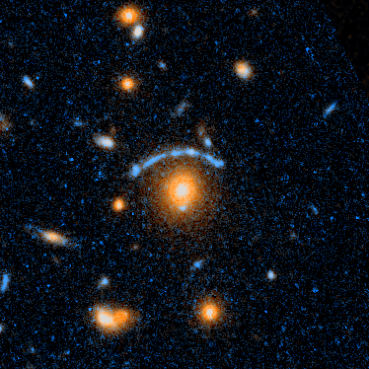
Credit: Tania Barone (Swinburne University of Technology), AGEL Survey; HST program 16773 (PI Glazebrook). · Image source · Reuse information
Image details
Hubble Space Telescope / WFC3; F200LP, F140W (mock RGB)
CC0 1.0 Universal
- Other names
- DESJ0042-3718 [1]
Name origin
AGEL DR2 Appendix A / HST object mappingName variants and source provenance
Published spellings and paper abbreviations retained for matching and traceability.
AGEL004257-371858A [1]AGEL DR2
- Catalog source
- AGEL
- Right ascension
- 10.73881°
00h 42m 57.31s [1] [5] [3] - Declination
- -37.31623°
−37° 18′ 58.43″ - Coordinates
- Equatorial J2000 · adopted catalog position
- Lens → Source
- Galaxy → Galaxy [1] [5] [2]
- Appearance
- Not yet classified
- Lens redshift
- 0.883 [5]
Measurement details
Reported uncertainty: −0.0005 / +0.0005
Formal ±0.0005 only. AGEL DR2 flag 2 means lower precision; its alternative spectral causes are not resolved for this target. Gottemoller v2 Table 2 instead lists 0.879 without explaining the difference. Adopt the direct DR2 spectroscopy; do not average or treat formal errors as total uncertainty.
Method: VLT/X-shooter, program LOPEZ_105.20KF.001. Survey uses Gaussian feature fits and/or MARZ templates; target-specific fit choice is not stated.
Source location: Final published Table 1, p.5, AGEL004257-371858A row, columns 5–7 (deflector); Figure 7 top panel p.15; Section 3.1 pp.14–16 (flags, formal errors, fitting); Section 3.3 p.16 (X-shooter).
- Discovery report
- Not available
- Explore
- External object viewer [4]
Background sources
Primary background source A [1]
- Source redshift
- 3.094 [5]
Measurement details
Reported uncertainty: −0.0005 / +0.0005
Formal ±0.0005. AGEL DR2 flag 3 denotes multiple well-detected features. Section III.1 cautions that ISM outflows and internal rotation can affect redshifts; no target-specific systemic correction or total uncertainty is established.
Method: VLT/X-shooter, program LOPEZ_105.20KF.001. Survey Gaussian feature fits and/or MARZ templates; specific target features are not identified in the table.
Source location: Final published Table 1, p.5, AGEL004257-371858A row, columns 2–4 (source); Section 3.1 pp.14–16 (flags, formal errors, fitting); Section 3.3 p.16 (X-shooter).
- Einstein radius
- 1.4 arcsec [2]
Measurement details
Reported uncertainty: −0.8 / +0.8
Published ±0.8 arcsec includes arc-width and model-comparison systematic uncertainty. Approximate image-position radius, not a detailed mass-model radius. Target ring/line/blended-line branch is unstated; blended-line estimates can be upper limits. Paper lists z_defl=0.879 and z_src=3.094; no refit using 0.883 is implied.
Method: MCMC maximization of source light in DECaLS images, using a ring radius or half an image-counterimage line separation (including a blended variant). Target-specific branch is not tabulated.
Source location: v2, Appendix B Table 2, p.15, AGEL004257-371858 row, column 4; Sections 3.3.1–3.3.3, pp.6–8.
Evidence & coordinate notes
- Confirmation: Table 4 target row S5.T4.2.1.15: distinct source/deflector redshifts, X-shooter program; Section III.1; Section II.1 and Figure 3 HST lens sample. [1]
- Confirmation: Final published Table 1 p.5 target row, columns 2–7: source 3.094 / flag 3 and deflector 0.883 / flag 2, X-shooter. Figure 7 top panel p.15 shows target deflector spectrum; Section 3.1 pp.14–16. [5]
- Coordinates: Table 4 row S5.T4.2.1.15: RA=10.73881 deg, Dec=-37.31623 deg; Appendix A Table A1 row A0.T1.2.1.6 supplies rounded cross-identification coordinates. [1]
- Coordinates: Final published Table 1 p.5, AGEL004257-371858A row, columns 10–11: 10.73881 / -37.31623 degrees. J2000 convention separately established by official object mapping. [5]
- Coordinates: AGEL_HST_objnames.tab, header RAJ2000/DECJ2000 and line 8, AGEL004257-371858A = DESJ0042-3718, 10.73881 / -37.31623 degrees. [3]
- Description: Table 4 target row; Section III.1: flag 3 source has multiple well-detected features; flag 2 deflector lower precision with alternative possible causes; Section II.1/Figure 3 HST program 16773. [1]
- Description: Final published Table 1 p.5 target row (redshifts, flags and HST F200LP/F140W program 16773); Section 3.1 pp.14–16 flag definitions/formal-error caveats; Figure 7 top panel p.15. [5]
- Description: v2 Appendix B Table 2 p.15 target row columns 4, 9–11; Sections 3.2.2 and 3.3.1–3.3.4: separate photometric environment and deflector-scale classification; approximate radius. [2]
- Object url: Identity snapshot viewer-check.json: verified survey_image_visual attempt at 2026-10-30T23:07:22.691246+00:00; exact selected JPEG URL preserved. Field association only, not lens confirmation. [4]
- Record source: AGEL DR2 Table 4 target row; provenance is AGEL. Named-source destination per assigned contract: /surveys-and-discovery-programs/#AGEL; original candidate citations Jacobs et al. 2019a,b are not a verified discovery date. [1]
- Record source: Final published AGEL DR2 Table 1 p.5 target row, candidate catalog Jacobs et al. 2019a,b. Section 3 p.14 warns candidate catalog is not necessarily first discovery. Named AGEL origin retained. [5]
- Source components: Section I.2 A/B/C source-letter naming convention and Table 4 sole target A row; Appendix A Table A1 maps AGEL004257-371858A to DESJ0042-3718. [1]
- Source components: Final published Section 1.2 p.4: letters A/B/C differentiate sources; Table 1 p.5 target A row. DESJ0042-3718 cross-identification remains supported by preprint Appendix A Table A1 and official HST mapping. [5]
- System class: Sections I and III.1 galaxy-galaxy survey context; Table 4 target source z=3.094 and deflector z=0.883; Appendix A Table A1 cross-identification. [1]
- System class: Final published Section 1.2 pp.3–4 and Table 1 p.5 target row: distinct deflector and background source; Gottemoller v2 Table 2 p.15 provides deflector-scale classification. [5]
- System class: v2 Appendix B Table 2 p.15 target row columns 9 and 11: galaxy-scale deflector and one visually enclosed deflector; Section 3.3.4. DR2 supplies distinct background galaxy source. [2]
References
- Barone et al. (2025), The AGEL Survey Data Release 2: A Gravitational Lens Sample for Galaxy Evolution and Cosmology, arXiv:2503.08041v1 DOI: 10.48550/arXiv.2503.08041
- Gottemoller et al. (2026), Most Strong Lensing Deflectors in the AGEL Survey Are in Group and Cluster Environments, AJ 171, 218; arXiv:2602.11068v2 DOI: 10.3847/1538-3881/ae4480
- AGEL official HST object-name mapping, AGEL_HST_objnames.tab
- Legacy Surveys DR10 coordinate-centered JPEG cutout; identity field verification 2026-10-30
- Barone et al. (2026), The AGEL Survey Data Release 2: A Gravitational Lens Sample for Galaxy Evolution and Cosmology, The Astronomical Journal 171, 57; final published article DOI: 10.3847/1538-3881/ae1f86