Catalog ID: GLC-248
SDSS J1207+5254
Confirmed — spectroscopy [1]
A foreground system with several central galaxies lenses an extended arc to the northeast. The quoted foreground redshift refers to the brightest SDSS detection, which may blend two galaxies. Hubble modeling identifies three images of the main source and a separate southwest source family with unknown redshift. [1] [6]
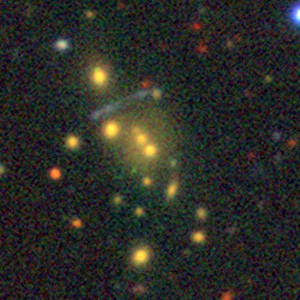
Credit: Legacy Surveys / D. Lang (Perimeter Institute) · Image source · Reuse information
Image details
/ ;
CC BY 4.0
- Other names
- CSWA 36 [2]
Name origin
Cambridge CASSOWARY cataloguemaxBCG J120735.9+525459 [2]Name origin
Cambridge CASSOWARY catalogueName variants and source provenance
Published spellings and paper abbreviations retained for matching and traceability.
SDSS J1207+5254 [1]Kubo et al. 2010
- Catalog source
- Cited Paper
- Right ascension
- 181.89964°
12h 07m 35.91s [1] [3] - Declination
- 52.91645°
+52° 54′ 59.22″ - Coordinates
- Equatorial J2000 · adopted catalog position
- Lens → Source
- Cluster → Galaxy [6]
- Appearance
- Arc [1]
- Lens redshift
- 0.2717 [1]
Measurement details
Reported uncertainty: −0.0002 / +0.0002
Reported uncertainty; confidence level not specified in Kubo. Applies to brightest SDSS detection, possibly a blend; not separately measured for each galaxy or the cluster mean.
Method: APO 3.5m DIS galaxy-template cross-correlation
Source location: Kubo journal Table 1, p. L140, row SDSS J1207+5254; §3.3, p. L140; note b; §2.2
- Discovery report
- 2008-12-10 [4]
- Explore
- External object viewer
Background sources
Primary arc source [1]
- Source redshift
- 1.9257 [1]
Measurement details
Reported uncertainty: −0.0002 / +0.0002
Reported cross-correlation uncertainty; confidence level not specified. No systemic stellar/nebular precision claim.
Method: APO DIS cross-correlation with Shapley composite Lyman-break galaxy template
Source location: Kubo journal Table 1, p. L140, row SDSS J1207+5254; §3.3, p. L140; §2.2; Fig. 2
- Einstein radius
- 9.4 arcsec [1]
Measurement details
Reported uncertainty: −0.3 / +0.3
Estimated manual-fit error from Table 1 note d; not a full lens-model systematic uncertainty or a confidence interval. Retained as the original approximate angular scale for this arc. Later model radii use different mass/source-plane definitions; see alternatives in the dossier.
Method: Manual angular fit in SDSS imaging, interpreted with a simple singular isothermal sphere
Source location: Kubo journal Table 1, p. L140, row SDSS J1207+5254; §3.3, p. L140; Table 1 note d; §3, pp. L138–L139
Sharon source 2 [6]
- Source redshift
- Not available
- Einstein radius
- Not available
Evidence & coordinate notes
- Appearance:arc: Kubo journal Table 1, p. L140, row SDSS J1207+5254; §3.3, p. L140; Fig. 1 p. L138 exact labelled panel [1]
- Confirmation: Kubo journal Table 1, p. L140, row SDSS J1207+5254; §3.3, p. L140; Fig. 2 p. L139 spectroscopy of the arc together with lensing morphology in Fig. 1 p. L138 [1]
- Coordinates: Kubo journal Table 1, p. L140, row SDSS J1207+5254; §3.3, p. L140; foreground position in decimal degrees, five decimal places are reporting precision, not error [1]
- Coordinates: PhotoObjAll ra and dec field definitions: J2000 equatorial convention; inherited verified identity survey-frame attribution [3]
- Description: Kubo journal Table 1, p. L140, row SDSS J1207+5254; §3.3, p. L140; Fig. 1 p. L138 supports arc direction and foreground association; exact target spectrum in Fig. 2 p. L139 [1]
- Description: §4.3.21 p. 16, three primary images and southwest secondary family; Table 7 p. 32. Secondary image 2.3 remains candidate/not a model constraint. [6]
- Discovery date: Table 1 p. 2 target-coordinate row, labelled probable giant arc, reference 7=this work; v1 title-page date 10 December 2008 and arXiv submission history. Candidate report, not confirmation date. [4]
- Image:cswa-36-legacy-dr9.jpg: Entire 300 × 300 JPEG, ls-dr9; Kubo et al. (2010) Figure 1 middle-left panel, p. L138, and §3.3. [7]
- Source:primary: §3.3, Fig1 and Fig2; Northeast extended arc: one physical background galaxy, several SDSS-deblended knots (Kubo §3.3). Sharon §4.3.21 resolves a naked-cusp configuration of three images (two partial); ten emission-knot constraints are not ten galaxies. [1]
- Source:source2: §4.3.21, Table7, Fig4; Distinct source 2 southwest of the cluster center, with two high-confidence arcs and a third predicted/visually confirmed image not used as a model constraint; Table7 marks 2.3 Candidate. Unknown measured redshift. Do not merge with primary northeast arc or SNcand. [6]
- System class: §4.3.21 p. 16, multi-galaxy core and secondary northeast halo [6]
References
- Kubo et al. 2010, The Sloan Bright Arcs Survey: Discovery of Seven New Strongly Lensed Galaxies from z = 0.66–2.94, ApJL 724 L137–L142 DOI: 10.1088/2041-8205/724/2/L137
- Cambridge CASSOWARY catalogue, 8 November 2019 edition
- SDSS DR7 SkyServer Query User Guide: PhotoObjAll coordinates
- Wen et al., Discovery of strong lensing clusters in the SDSS DR6, arXiv:0812.1860v1 (10 December 2008)
- Stark et al. 2013, The CASSOWARY spectroscopy survey: a new sample of gravitationally lensed galaxies in SDSS, MNRAS 436, 1040–1056 DOI: 10.1093/mnras/stt1624
- Sharon et al. 2020, Strong Lens Models for 37 Clusters of Galaxies from the SDSS Giant Arcs Survey, ApJS 247, 12 DOI: 10.3847/1538-4365/ab5f13
- Legacy Surveys Sky Viewer, DR9 color cutout of CSWA 36 (SDSS J1207+5254); downloaded 10 November 2026.