Catalog ID: GLC-247
SDSS J0957+0509
Confirmed — spectroscopy [1]
A blue arc southwest of the central galaxy contains multiple images of one background galaxy. Later Hubble modeling identifies two additional source families without spectroscopic redshifts. The foreground was originally described as a small group; later spectroscopy and modeling treat it as a cluster. [1] [6]
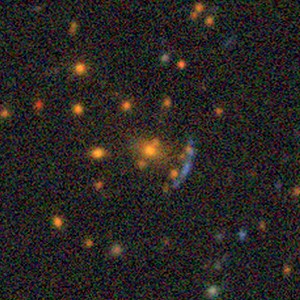
Credit: Legacy Surveys / D. Lang (Perimeter Institute) · Image source · Reuse information
Image details
/ ;
CC BY 4.0
- Other names
- CSWA 35 [2]
Name origin
Cambridge CASSOWARY catalogueSDSS J095739.1+05093 [2]Name origin
Cambridge CASSOWARY catalogueName variants and source provenance
Published spellings and paper abbreviations retained for matching and traceability.
SDSS J0957+0509 [1]Kubo et al. 2010
- Catalog source
- Cited Paper
- Right ascension
- 149.41330°
09h 57m 39.19s [1] [3] - Declination
- 5.15887°
+05° 09′ 31.93″ - Coordinates
- Equatorial J2000 · adopted catalog position
- Lens → Source
- Cluster → Galaxy [6]
- Appearance
- Arc [1]
- Lens redshift
- 0.4469 [1]
Measurement details
Reported uncertainty: −0.0002 / +0.0002
Reported uncertainty; confidence level not specified in Kubo. Central foreground LRG/BCG, not cluster-mean redshift.
Method: APO 3.5m DIS galaxy-template cross-correlation
Source location: Kubo journal Table 1, p. L140, row SDSS J0957+0509; §3.2, p. L140; note b; §2.2
- Discovery report
- 2008-12-10 [4]
- Explore
- External object viewer
Background sources
Primary arc source [1]
- Source redshift
- 1.8230 [1]
Measurement details
Reported uncertainty: −0.0003 / +0.0003
Reported cross-correlation uncertainty; confidence level not specified. No systemic stellar/nebular precision claim. Alternative Bayliss arXiv v4 Table 2 gives 1.8198; Sharon quotes 1.8210 and Oguri 1.820. Retain Kubo as the directly published measurement with explicit object error, not an adjudication that alternatives are wrong; systematic/source-feature offsets remain unquantified.
Method: APO DIS cross-correlation with Shapley composite Lyman-break galaxy template
Source location: Kubo journal Table 1, p. L140, row SDSS J0957+0509; §3.2, p. L140; §2.2; Fig. 2
- Einstein radius
- 8.0 arcsec [1]
Measurement details
Reported uncertainty: −0.3 / +0.3
Estimated manual-fit error from Table 1 note d; not a full lens-model systematic uncertainty or a confidence interval. Retained as the original approximate angular scale for this arc. Later model radii use different mass/source-plane definitions; see alternatives in the dossier.
Method: Manual angular fit in SDSS imaging, interpreted with a simple singular isothermal sphere
Source location: Kubo journal Table 1, p. L140, row SDSS J0957+0509; §3.2, p. L140; Table 1 note d; §3, pp. L138–L139
Sharon source 2 [6]
- Source redshift
- Not available
- Einstein radius
- Not available
Sharon source 3 [6]
- Source redshift
- Not available
- Einstein radius
- Not available
Evidence & coordinate notes
- Appearance:arc: Kubo journal Table 1, p. L140, row SDSS J0957+0509; §3.2, p. L140; Fig. 1 p. L138 exact labelled panel [1]
- Confirmation: Kubo journal Table 1, p. L140, row SDSS J0957+0509; §3.2, p. L140; Fig. 2 p. L139 spectroscopy of the arc together with lensing morphology in Fig. 1 p. L138 [1]
- Coordinates: Kubo journal Table 1, p. L140, row SDSS J0957+0509; §3.2, p. L140; foreground position in decimal degrees, five decimal places are reporting precision, not error [1]
- Coordinates: PhotoObjAll ra and dec field definitions: J2000 equatorial convention; inherited verified identity survey-frame attribution [3]
- Description: Kubo journal Table 1, p. L140, row SDSS J0957+0509; §3.2, p. L140; Fig. 1 p. L138 supports arc direction and foreground association; exact target spectrum in Fig. 2 p. L139 [1]
- Description: §4.3.10 p. 11, sources 1–3; Table 5 pp. 28–29; Table 2 p. 5 cluster properties. Six images belong to source 1. Sources 2 and 3 lack spectroscopic redshifts. [6]
- Discovery date: Table 1 p. 2 target-coordinate row, labelled probable giant arc, reference 7=this work; v1 title-page date 10 December 2008 and arXiv submission history. Candidate report, not confirmation date. [4]
- Image:cswa-35-legacy-dr9.jpg: Entire 300 × 300 JPEG, ls-dr9; Kubo et al. (2010) Figure 1 top-right panel, p. L138, and §3.2. [10]
- Source:primary: §3.2, Fig1 and Fig2; Southwest blue arc: one physical galaxy, three SDSS-deblended knots in Kubo §3.2. Sharon §4.3.10 identifies five bright images in the arc and one faint demagnified image: all source 1, not six physical sources. [1]
- Source:source2: §4.3.10, Table5, Fig2; Distinct physical source family, separate from primary; multiple images share this single source key. Spectroscopic redshift unavailable in this paper. [6]
- Source:source3: §4.3.10, Table5, Fig2; Distinct physical source family, separate from primary; multiple images share this single source key. Spectroscopic redshift unavailable in this paper. [6]
- System class: §4.3.10 p. 11 and Table 2 p. 5, 25 cluster members, multi-galaxy lens [6]
References
- Kubo et al. 2010, The Sloan Bright Arcs Survey: Discovery of Seven New Strongly Lensed Galaxies from z = 0.66–2.94, ApJL 724 L137–L142 DOI: 10.1088/2041-8205/724/2/L137
- Cambridge CASSOWARY catalogue, 8 November 2019 edition
- SDSS DR7 SkyServer Query User Guide: PhotoObjAll coordinates
- Wen et al., Discovery of strong lensing clusters in the SDSS DR6, arXiv:0812.1860v1 (10 December 2008)
- Stark et al. 2013, The CASSOWARY spectroscopy survey: a new sample of gravitationally lensed galaxies in SDSS, MNRAS 436, 1040–1056 DOI: 10.1093/mnras/stt1624
- Sharon et al. 2020, Strong Lens Models for 37 Clusters of Galaxies from the SDSS Giant Arcs Survey, ApJS 247, 12 DOI: 10.3847/1538-4365/ab5f13
- Bayliss et al., Gemini/GMOS Spectroscopy of 26 Strong Lensing Selected Galaxy Cluster Cores; arXiv:1010.2714v4 (19 February 2011) DOI: 10.1088/0067-0049/193/1/8
- Oguri et al., Combined strong and weak lensing analysis of 28 clusters from the Sloan Giant Arcs Survey; accepted manuscript arXiv:1109.2594v2
- Wiesner et al., The Sloan Bright Arcs Survey: Ten Strong Gravitational Lensing Clusters and Evidence of Overconcentration
- Legacy Surveys Sky Viewer, DR9 color cutout of CSWA 35 (SDSS J0957+0509); downloaded 10 November 2026.