Catalog ID: GLC-243
SDSS J1511+4713
Confirmed — spectroscopy [1]
A luminous red galaxy lenses an extended blue arc to its south. Spectroscopy of the brightest arc segment gives redshift 0.985 from [O II] emission; its three bright knots are not three established source galaxies. The group-scale classification follows Kubo’s preliminary SIS approximation. Its 5.4 arcsec Einstein-radius estimate uses the lens–arc separation. A later circle fit also gives 5.4 arcsec but reports a broader ±1.8 arcsec uncertainty including a sample-based systematic term. [1] [6]
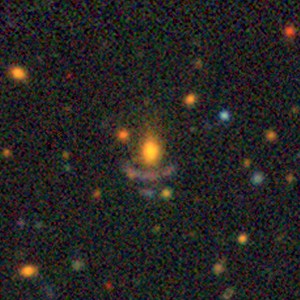
Credit: Legacy Surveys / D. Lang (Perimeter Institute) · Image source · Reuse information
Image details
/ ;
CC BY 4.0
- Other names
- CSWA 24 [2]
Name origin
Cambridge CASSOWARYSDSS J151118.73+471340.3 [2]Name origin
Cambridge CASSOWARYName variants and source provenance
Published spellings and paper abbreviations retained for matching and traceability.
SDSS J1511+4713 [1]Kubo et al. (2009), system designation
- Catalog source
- Cited Paper
- Right ascension
- 227.8281°
15h 11m 18.74s [1] [3] - Declination
- 47.2279°
+47° 13′ 40.44″ - Coordinates
- Equatorial J2000 · adopted catalog position
- Lens → Source
- Group → Galaxy [1]
- Appearance
- Arc [1]
- Lens redshift
- 0.4517 [1]
Measurement details
Reported uncertainty: −0.0003 / +0.0003
Quoted symmetric uncertainty; confidence convention not stated.
Method: SDSS spectroscopic redshift quoted by Kubo.
Source location: Table 1, p. L64, SDSS J1511+4713 row; §3.5, pp. L64
- Discovery report
- 2008-12-20 [5]
- Explore
- External object viewer
Background sources
Primary lensed galaxy [1]
- Source redshift
- 0.985 [1]
Measurement details
No numerical uncertainty reported; no vacuum/air or heliocentric convention specified in the cited source.
Method: APO/DIS [O II] 3727 emission; observed on brightest arc segment.
Source location: Table 1, p. L64, SDSS J1511+4713 row; §3.5, pp. L64
- Einstein radius
- 5.4 arcsec [1]
Measurement details
Reported uncertainty: −0.3 / +0.3
Estimated error on manual fit (Table 1 note d); confidence level and full model-systematic uncertainty not specified. Not a precision mass-model radius. Wiesner (2012), manuscript §4/Table 8, gives 5.4 ±1.8 arcsec with a sample-based systematic term; retained separately.
Method: Lens–arc separation used as Einstein-radius estimate under a singular isothermal sphere approximation.
Source location: Table 1 p. L64, SDSS J1511+4713 row, theta_E column and note d; §3 p. L62; §3.5.
Evidence & coordinate notes
- Appearance:arc: Figure 2 middle, p. L63; §3.5. [1]
- Confirmation: §3.5 pp. L64; Figure 2 middle, p. L63; Table 1: foreground and background spectroscopy. See §3 p. L62 for single-line identification checks. [1]
- Coordinates: Table 1 p. L64, SDSS J1511+4713 row, R.A./Decl. in degrees: foreground LRG position; four decimal places, uncertainty unreported. [1]
- Coordinates: Coordinates glossary entry: SDSS RA/Dec convention is J2000. Applied as survey-provenance inference; Kubo table itself only labels degrees. [3]
- Description: §3.5 p. L64; Figure 2 middle p. L63.; §3 p. L62; §3.5 and Table 1 p. L64. [1]
- Description: FERMILAB-PUB-12-569-AE §4 pp. 17–19; Table 8 p. 39, SDSS J1511+4713 row. [6]
- Discovery date: arXiv v1 submission 2008-12-20; Table 2 p. 13, SDSS J1511+4713 row; §3.5 pp. 6–7. Earliest target-specific public report located in bounded search, not observation date. [5]
- Image:cswa-24-legacy-dr9.jpg: Entire native 300 × 300 JPEG at the specified cutout URL, layer=ls-dr9, pixscale=0.2, size=300. Field matched to Kubo et al. (2009), ApJL 696, L61–L65, p. L63, Figure 2 middle image panel. [7]
- Source:primary: §3.5 pp. L64; Figure 2 middle, p. L63: sampled arc is the primary physical source, not each image-plane knot. [1]
- System class: §3 p. L62 and §4 p. L64: preliminary SIS lensing scale; §3.5 pp. L64. Group_galaxy is qualified model interpretation, not dynamical confirmation of a bound group. [1]
References
- Kubo, J. M., et al. (2009). The Sloan Bright Arcs Survey: Six Strongly Lensed Galaxies at z = 0.4–1.4. ApJ 696, L61–L65. DOI: 10.1088/0004-637X/696/1/L61
- Cambridge CASSOWARY catalogue, 8 November 2019 edition.
- SDSS DR18 Glossary, Coordinates entry.
- Stark, D. P., et al. (2013). The CASSOWARY spectroscopy survey: a new sample of gravitationally lensed galaxies in SDSS. MNRAS 436, 1040–1056. DOI: 10.1093/mnras/stt1624
- Kubo, J. M., et al. (2008). The Sloan Bright Arcs Survey: Six Strongly Lensed Galaxies at z=0.4–1.4. arXiv:0812.3934v1, submitted 20 December 2008.
- Wiesner, M. P., et al. (2012). The Sloan Bright Arcs Survey: Ten Strong Gravitational Lensing Clusters and Evidence of Overconcentration. FERMILAB-PUB-12-569-AE author manuscript; published as ApJ 761, 1. DOI: 10.1088/0004-637X/761/1/1
- Legacy Surveys Sky Viewer, DR9 color cutout of CSWA 24, centered at RA 227.8281 deg, Dec 47.2279 deg; original archived 10 November 2026.