Catalog ID: GLC-242
SDSS J1137+4936
Confirmed — spectroscopy [1]
A foreground luminous red galaxy lenses an eastern arc whose dominant spectroscopic features give a source redshift of 1.411. Absorption near redshift 1.38 suggests a second source; later HST modeling associates a fainter arc with it, without a new spatially resolved redshift measurement. The adopted 3.7 arcsec radius is Kubo’s approximate lens–arc separation under an SIS model, not a detailed mass fit. The lens scale remains unclassified here: Kubo’s preliminary group-scale interpretation differs from the later galaxy-scale HST treatment. [6] [1]
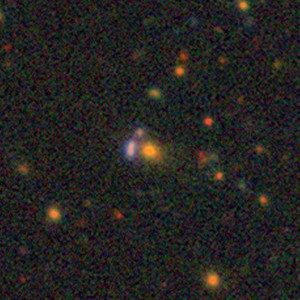
Credit: Legacy Surveys / D. Lang (Perimeter Institute) · Image source · Reuse information
Image details
/ ;
CC BY 4.0
- Other names
- CSWA 7 [2]
Name origin
Cambridge CASSOWARYName variants and source provenance
Published spellings and paper abbreviations retained for matching and traceability.
SDSS J1137+4936 [1]Kubo et al. (2009), system designation
- Catalog source
- Cited Paper
- Right ascension
- 174.4169°
11h 37m 40.06s [1] [3] - Declination
- 49.6099°
+49° 36′ 35.64″ - Coordinates
- Equatorial J2000 · adopted catalog position
- Lens → Source
- Not yet classified
- Appearance
- Arc [1]
- Lens redshift
- 0.4483 [1]
Measurement details
Reported uncertainty: −0.0002 / +0.0002
Quoted symmetric uncertainty; confidence convention not stated.
Method: SDSS spectroscopic redshift quoted by Kubo.
Source location: Table 1, p. L64, SDSS J1137+4936 row; §3.4, pp. L62–L64
- Discovery report
- 2008-12-10 [5]
- Explore
- External object viewer
Background sources
Primary lensed galaxy [1]
- Source redshift
- 1.411 [1]
Measurement details
No numerical uncertainty reported; no vacuum/air or heliocentric convention specified in the cited source.
Method: APO/DIS [O II] 3727 emission; corroborating Mg and Fe absorption.
Source location: Table 1, p. L64, SDSS J1137+4936 row; §3.4, pp. L62–L64
- Einstein radius
- 3.7 arcsec [1]
Measurement details
Reported uncertainty: −0.3 / +0.3
Estimated error on manual fit (Table 1 note d); confidence level and full model-systematic uncertainty not specified. Not a precision mass-model radius.
Method: Lens–arc separation used as Einstein-radius estimate under a singular isothermal sphere approximation.
Source location: Table 1 p. L64, SDSS J1137+4936 row, theta_E column and note d; §3 p. L62; §3.4.
Possible second lensed galaxy (absorption system near z = 1.38) [1]
- Source redshift
- 1.38 [1]
Measurement details
Approximate absorption-system redshift, no reported numerical uncertainty. Its interpretation as a second lensed galaxy is qualified; not a new spatially resolved spectrum.
Method: APO/DIS Mg II and Fe II absorption in blended arc spectrum.
Source location: §3.4 pp. L63–L64 and Figure 3 p. L64.
- Einstein radius
- Not available
Evidence & coordinate notes
- Appearance:arc: Figure 2 left, p. L63; Figure 3, p. L64; §3.4. [1]
- Confirmation: §3.4 pp. L62–L64; Figure 2 left, p. L63; Figure 3, p. L64; Table 1: foreground and background spectroscopy. See §3 p. L62 for single-line identification checks. [1]
- Coordinates: Table 1 p. L64, SDSS J1137+4936 row, R.A./Decl. in degrees: foreground LRG position; four decimal places, uncertainty unreported. [1]
- Coordinates: Coordinates glossary entry: SDSS RA/Dec convention is J2000. Applied as survey-provenance inference; Kubo table itself only labels degrees. [3]
- Description: Appendix A, pp. 140–145, especially p. 141 and Figures A.2–A.4; spectroscopy attributed to Kubo.; Appendix A p. 140; compare Kubo §3 p. L62 and §4 p. L64. [6]
- Description: §3.4, pp. L62–L64; Figures 2–3.; §3 p. L62, §3.4 p. L64 and Table 1 p. L64. [1]
- Discovery date: arXiv v1 submission 2008-12-10; Table 1 p. 2, SDSS J113740.0+493635, probable arc near galaxy; §2 p. 4. Earlier imaging report, not Kubo spectroscopic confirmation. [5]
- Image:cswa-7-legacy-dr9.jpg: Entire native 300 × 300 JPEG at the specified cutout URL, layer=ls-dr9, pixscale=0.2, size=300. Field matched to Kubo et al. (2009), ApJL 696, L61–L65, p. L63, Figure 2 left image panel. [7]
- Source:primary: §3.4 pp. L62–L64; Figure 2 left, p. L63; Figure 3, p. L64: sampled arc is the primary physical source, not each image-plane knot. [1]
- Source:secondary: Appendix A pp. 141–145; Figures A.2–A.4: HST modeling assigns A/B/C to likely z=1.38 source, E to z=1.41 source; D extraneous. Model assignment, not new spectroscopy. [6]
- Source:secondary: §3.4 pp. L63–L64; Figure 3 p. L64: apparent second source at z=1.38, spatially unresolved in DIS seeing of 2 arcsec. [1]
References
- Kubo, J. M., et al. (2009). The Sloan Bright Arcs Survey: Six Strongly Lensed Galaxies at z = 0.4–1.4. ApJ 696, L61–L65. DOI: 10.1088/0004-637X/696/1/L61
- Cambridge CASSOWARY catalogue, 8 November 2019 edition.
- SDSS DR18 Glossary, Coordinates entry.
- Stark, D. P., et al. (2013). The CASSOWARY spectroscopy survey: a new sample of gravitationally lensed galaxies in SDSS. MNRAS 436, 1040–1056. DOI: 10.1093/mnras/stt1624
- Wen, Z. L., et al. (2008). Discovery of Strong Lensing Clusters in the SDSS DR6. arXiv:0812.1860v1, submitted 10 December 2008.
- Bandara, H. M. Kaushala T. (2012). Applications of Strong Gravitational Lensing: Utilizing Nature’s Telescope for the Study of Intermediate to High Redshift Galaxies. PhD dissertation, University of Victoria, Appendix A.
- Legacy Surveys Sky Viewer, DR9 color cutout of CSWA 7, centered at RA 174.4169 deg, Dec 49.6099 deg; original archived 10 November 2026.