Catalog ID: GLC-241
8 O’Clock Arc
Confirmed — combined [1]
A foreground luminous red galaxy lenses a distant Lyman-break galaxy into three bright images along an arc and a fainter counterimage. Stellar and emission-line spectroscopy gives an adopted systemic redshift of 2.7350 on the vacuum-heliocentric scale. [1] [5]
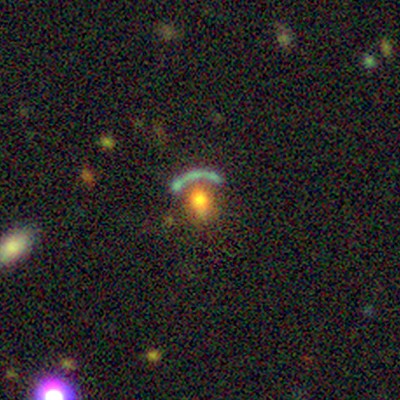
Credit: Legacy Surveys / D. Lang (Perimeter Institute) · Image source · Reuse information
Image details
/ ;
CC BY 4.0
- Other names
- CSWA 21 [3]
Name origin
system; Cambridge CSWA 21 row explicitly a.k.a. 8 O’Clock ArcSDSS J002240.91+143110.4 [1]Name origin
foreground LRG; Allam §2 p.2SDSS J0022+1431 [2]Name origin
system shorthand explicitly mapped in source; Stark arXiv Table 4 p.13, matching CSWA rowName variants and source provenance
Published spellings and paper abbreviations retained for matching and traceability.
8 O’Clock Arc [1]Published title/target designation; 8 O’Clock Arc
- Catalog source
- Cited Paper
- Right ascension
- 5.67049154 deg
00h 22m 40.92s [3] [4] - Declination
- 14.51956525 deg
+14° 31′ 10.43″ - Coordinates
- Equatorial J2000 · adopted catalog position
- Lens → Source
- Galaxy → Galaxy [1]
- Appearance
- Arc [1]Quadruple image [1]
- Lens redshift
- 0.3805 [1]
Measurement details
Reported uncertainty: −0.0002 / +0.0002
Numerical redshift and symmetric error read from Fig.2 spectrum annotation; confidence convention not specified. Prose 0.38 and catalogue 0.380 are rounded presentations.
Method: SDSS 3-arcsec fiber spectrum of foreground LRG
Source location: arXiv v1 Fig.2 p.2, spectrum annotation; §2 prose rounds to 0.38
- Discovery report
- 2006-11-04 [1]
- Explore
- External object viewer [3]
Background sources
Lyman-break galaxy imaged as A1–A4 [1]
- Source redshift
- 2.7350 [5]
Measurement details
Reported uncertainty: −0.0003 / +0.0003
Authors’ adopted symmetric uncertainty; confidence level for this systemic estimate is not specified. Vacuum-heliocentric scale. Derived from stellar 2.7347 ± 0.0003 and emission 2.7351 ± 0.0002 in the extracted arc spectra; not a new average of literature values. Aperture/component differences and total systematic uncertainty are not absorbed into this error.
Method: VLT/X-shooter stellar N IV 1718 centroid and emission-line Gaussian fits; authors’ adopted systemic estimate from co-added arc extractions
Source location: arXiv:0912.4384v1 §3.1 p.4, adoption paragraph and footnote 3; Table 2 p.5; §2 pp.3–4 for A2+A3 and A2-only extractions
- Einstein radius
- 2.91 arcsec [1]
Measurement details
Reported uncertainty: −0.14 / +0.14
Published symmetric model uncertainty; positional errors of 0.1 arcsec assumed, chi-square 2.1 for 7 degrees of freedom. Confidence level not specified; model dependent.
Method: Singular isothermal ellipsoid lens model using image positions
Source location: arXiv v1 §4 p.3 and Fig.5
Evidence & coordinate notes
- Appearance:arc: Abstract and Fig.3 p.2: elongated three-image arc. [1]
- Appearance:quadruple: Abstract, Fig.3 p.2: A1–A3 and A4 counterimage. [1]
- Confirmation: Abstract; §3.2 p.3 and Fig.4: arc spectroscopy with morphology and §4 lens model. [1]
- Coordinates: Catalogue row CSWA 21, RADec cells: central foreground galaxy; provider digits retained, not an uncertainty estimate. [3]
- Coordinates: IAU designations, J2000 naming convention and truncated coordinate digits; coordinate epoch/frame distinct from observation date. [4]
- Description: Sentence 1: abstract and Fig.3 p.2, foreground LRG, background Lyman-break galaxy, three bright images and faint counterimage. [1]
- Description: Sentence 2: arXiv:0912.4384v1 §3.1 p.4, final adoption paragraph and footnote 3; stellar and emission estimates yield authors’ adopted systemic 2.7350; all redshifts vacuum heliocentric. [5]
- Discovery date: arXiv:astro-ph/0611138v1 submission history, 4 November 2006. Public report; PDF draft typesetting date October 2018 is not discovery chronology. [1]
- Einstein radius history: Published Table 4 p.1051 and §4.2 p.1050: SIE model radius 3.3 arcsec from SDSS multiband fits, no target uncertainty given. Prefer Allam 2.91 ± 0.14 arcsec with explicit image-position fit assumptions. [2]
- Image:cswa-21-legacy-dr9-400-00da174a3dbc.jpg: Exact JPEG product: layer=ls-dr9; ra=5.67049154; dec=14.51956525; pixscale=0.15; size=400. Central lens and adjacent arc; identity crossmatch: Allam Figs. 1 and 3, arXiv p. 2. Reuse: official Acknowledgments, “Usage of images from the Sky Viewer”, Legacy Surveys layers license and credit paragraphs. [8]
- Object url: Identity viewer-check.json / cswa-21: official Legacy DR9 cutout visually matched to primary figure by identity; selected_url preserved exactly. Target association from this catalogue row. [3]
- Record source: Paper-based synthesis; first ordered reference is the intended Cited Paper destination. CASSOWARY membership retained separately as an alias, not discovery credit. [1]
- Source:primary: Abstract, §3 and Fig.3 p.2: A1–A4 images of one LBG. Fig.1 B1 is not included as a second lensed galaxy. [1]
- Source redshift history: arXiv v1 §3.2 p.3 and Fig.4: original APO/DIS-III absorption-line estimate 2.73, no numerical uncertainty. Retained as rounded acquisition-era measurement; replaced by explicitly defined X-shooter systemic estimate. [1]
- Source redshift history: arXiv v1 §3.1 p.4, footnote 3/Table 2 p.5: adopted vacuum-heliocentric systemic 2.7350 ± 0.0003 from stellar 2.7347 ± 0.0003 and emission 2.7351 ± 0.0002. Authors prefer their wavelength accuracy over Finkelstein. Adopted here for its explicit systemic definition, not as an average or conversion of other literature estimates; §2 pp.3–4 defines arc extractions. [5]
- Source redshift history: §3.1 and Table 2 p.6: weighted nebular mean 2.7333 ± 0.0001. Difference discussed but not explained by Dessauges-Zavadsky §3.1. [6]
- Source redshift history: Published §3.3: spatially resolved main H-beta component systemic 2.7363 ± 0.0004 using rest air wavelength 4861.325 Angstrom; additional blueshifted components. No conversion or claim that this equals an integrated systemic redshift made here. [7]
- System class: Abstract and §2 p.2: foreground luminous red galaxy lenses a Lyman-break galaxy; §4 p.3 treats lens as an elliptical galaxy. [1]
References
- Allam et al. (2007), The 8 o'clock Arc: A Serendipitous Discovery of a Strongly Lensed Lyman Break Galaxy in the SDSS DR4 Imaging Data, ApJ 662, L51–L54; inspected arXiv:astro-ph/0611138v1 (2006). DOI: 10.1086/519520
- Stark et al. (2013), The CASSOWARY spectroscopy survey: a new sample of gravitationally lensed galaxies in SDSS, MNRAS 436, 1040–1056; published edition. DOI: 10.1093/mnras/stt1624
- University of Cambridge, Institute of Astronomy, CASSOWARY catalogue (dated 8 November 2019), target rows; accessed 5 November 2026.
- SDSS DR6, IAU designations: J2000 coordinate and truncation conventions.
- Dessauges-Zavadsky et al., Rest-frame ultraviolet spectrum of the gravitationally lensed galaxy “the 8 o’clock arc”: stellar and interstellar medium properties; inspected arXiv:0912.4384v1 (2009), §3.1.
- Finkelstein et al. (2009), Turning Back the Clock: Inferring the History of the Eight O’clock Arc; inspected arXiv:0905.1122.
- Shirazi et al. (2014), The physical nature of the 8 o’clock arc based on near-IR IFU spectroscopy with SINFONI, MNRAS 440, 2201–2221. DOI: 10.1093/mnras/stu316
- Legacy Surveys Sky Viewer — DR9 JPEG cutout of CSWA 21 (8 O’Clock Arc)