Catalog ID: GLC-240
SDSS J1723+3411
A foreground galaxy system, described as a small group by Kubo et al. (2010) and as a cluster in later lens models, lenses a star-forming galaxy into five images. Two merging images form the bright southeastern arc. H-alpha spectroscopy places this source at redshift 1.3293. [3] [1] [2]
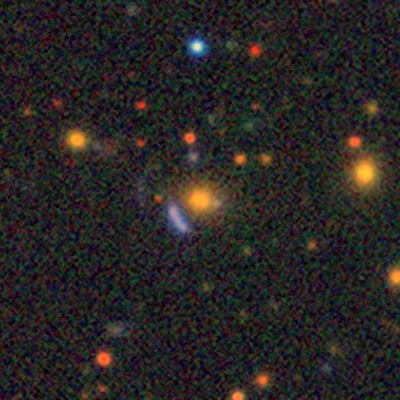
Credit: Legacy Surveys / D. Lang (Perimeter Institute) · Image source · Reuse information
Image details
/ ;
CC BY 4.0
- Other names
- CSWA 14 [5]
Name origin
system; Stark arXiv Table 4 p.13 explicitly maps SDSS J1723+3411 to CSWA 14; Cambridge position matches Kubo Table 1.Name variants and source provenance
Published spellings and paper abbreviations retained for matching and traceability.
SDSS J1723+3411 [1]Published title/target designation; SDSS J1723+3411
- Catalog source
- Cited Paper
- Right ascension
- 260.90067032 deg
17h 23m 36.16s [5] [6] - Declination
- 34.19946453 deg
+34° 11′ 58.07″ - Coordinates
- Equatorial J2000 · adopted catalog position
- Lens → Source
- Cluster → Galaxy [3] [2]
- Appearance
- Arc [2]
- Lens redshift
- 0.44227 [2]
Measurement details
Reported uncertainty: −0.00009 / +0.00009
Reported symmetric error for one BCG spectrum, not a cluster velocity dispersion. Adopt updated value also identified by Rigby §2.1. Earlier Kubo 0.4435 ± 0.0002 retained as discordant alternative; cause not established.
Method: SDSS DR12 BCG spectroscopy as tabulated by Sharon
Source location: Table 2 p.5, row 35 SDSS J1723+3411; §3.2
- Discovery report
- 2008-12-10 [7]
- Explore
- External object viewer [5]
Background sources
Main arc galaxy (Sharon source 1; images 1.1–1.5) [2]
- Source redshift
- 1.3293 [1]
Measurement details
Reported uncertainty: −0.0002 / +0.0002
Six clean difference images: median H-alpha wavelength 15290.8 Å, standard deviation 0.6 Å. Published ±0.0002; author identifies best systemic nebular redshift. Slit covers part of arc; grating drift mitigated as described.
Method: Gemini/GNIRS H-alpha; skyline-referenced vacuum wavelength and barycentric correction
Source location: §3.3 p.10; Fig.2 p.3 GNIRS slit on giant arc
- Einstein radius
- 4.7 arcsec [3]
Measurement details
Reported uncertainty: −0.3 / +0.3
Table note d estimates manual-fit errors as 0.3 arcsec; no confidence level specified. Approximate main-arc radius from SDSS imaging, not the later effective radius for a hypothetical z=2 source.
Method: Manual arc-radius fit; simple SIS approximation
Source location: Fermilab preprint Table 1 p.14, target row and note d; §§3,3.7
Additional galaxy (Sharon source 2; measured redshift) [2]
- Source redshift
- 2.1650 [2]
Measurement details
No numerical uncertainty reported at these locators. Table gives 2.1650, prose 2.165. Does not measure source 3 redshift.
Method: HST GO-14230 grism; [O III] 4959,5007 emission
Source location: Table 9 p.39, SDSS J1723+3411 source 2.1; §4.3.35 p.22
- Einstein radius
- Not available
Likely companion galaxy (Sharon source 3; redshift unknown) [2]
- Source redshift
- Not available
- Einstein radius
- Not available
Evidence & coordinate notes
- Appearance:arc: §4.3.35 p.22, Fig.6 p.20 target panel: source 1.1+1.2 form main bright arc. [2]
- Confirmation: §3.7 p.7 and Fig.4 p.13: southeastern arc C III] and [O II] spectra, independently cross-correlated; morphology in Fig.1. [3]
- Confirmation: §4.3.35 p.22: HST multiple-image constraints and lens model; source 2 grism confirmation, source 3 redshift unmeasured. [2]
- Coordinates: Catalogue row CSWA 14, RADec cells: central foreground galaxy; provider digits retained, not an uncertainty estimate. [5]
- Coordinates: IAU designations, J2000 naming convention and truncated coordinate digits; coordinate epoch/frame distinct from observation date. [6]
- Description: Sentence 1 foreground qualification: §3.7 p.7, central LRG in small group; southeastern arc. [3]
- Description: Sentence 1 star-forming galaxy and five-image geometry, sentence 2 merging southeastern arc: §§2.1–2.2 p.3. Sentence 3 H-alpha redshift: §3.3 p.10. [1]
- Description: Sentence 1 later cluster model and five images; sentence 2 two merging images: §4.3.35 p.22. [2]
- Discovery date: arXiv:0812.1860v1 Table 1 p.2, SDSS J172336.1+341158 row: J2000 260.90071, +34.19945, possible:multiple images?; §2 p.4 target paragraph retains foreground alternative. Submission history [v1]: 10 Dec 2008 08:28:03 UTC. Earliest verified public candidate report; Kubo 2010 is later spectroscopic confirmation. [7]
- Discovery history: arXiv:1010.3037v1 submission 14 October 2010; §3.7 p.7, Fig.4 p.13/Table 1 p.14 spectroscopically confirm the southeastern arc. Later confirmation, not earliest verified public candidate report. [3]
- Einstein radius history: Table 2 p.5 row 35 gives effective radius 6.8 arcsec for a hypothetical source at z=2, sqrt(A/pi) of tangential critical-curve area. Not the main source at z=1.3293 and not serialized as its radius. [2]
- Image:cswa-14-legacy-dr9-400-2e1a8ebe52d2.jpg: Exact JPEG product: layer=ls-dr9; ra=260.90067032; dec=34.19946453; pixscale=0.15; size=400. Central lens and adjacent arc; identity crossmatch: Kubo Fig. 1, p. 10, bottom-right SDSS J1723+3411 panel. Reuse: official Acknowledgments, “Usage of images from the Sky Viewer”, Legacy Surveys layers license and credit paragraphs. [8]
- Lens redshift history: §3.7 p.7/Table 1 p.14: LRG 0.4435 ± 0.0002. Prefer updated SDSS DR12 BCG value in Sharon Table 2, explicitly described as updated by Rigby §2.1. Difference is not silently averaged or explained. [3]
- Object url: Identity viewer-check.json / cswa-14: official Legacy DR9 cutout visually matched to primary figure by identity; selected_url preserved exactly. Target association from this catalogue row. [5]
- Record source: Paper-based synthesis; first ordered reference is the intended Cited Paper destination. CASSOWARY membership retained separately as an alias, not discovery credit. [1]
- Source:primary: §4.3.35 p.22; Table 9 p.39: source 1 has images 1.1–1.5; 1a labels are subfeatures, not separate galaxies. [2]
- Source:secondary: §4.3.35 p.22; Table 9 p.39 rows 2.1–2.4: source 2 is one galaxy with four images and grism redshift. [2]
- Source:tertiary: §4.3.35 p.22; Table 9 p.39 rows 3.1–3.4: likely galaxy pair member, redshift unmeasured; equal-to-source-2 redshift is a model assumption only. [2]
- Source redshift history: CSWA 14 Z_S cell gives 0.995; retained as discordant history, not an extra source or preferred measurement. No demonstrated cause for the earlier number. [5]
- Source redshift history: Fig.4 p.13: blue spectrum 1.3295 ± 0.0002 and red 1.3294 ± 0.0002; §3.7 p.7/Table 1 p.14 combined 1.3294 ± 0.0002. Consistent with preferred Rigby H-alpha redshift. [3]
- Source redshift history: Published Table 2 p.1044 and Table 4 p.1051, CSWA 14: 1.328; Table 2 C III] and absorption; Table 4 attributes to this paper. Earlier arXiv Table 4 p.13 has 0.995 attributed to CASSOWARY release [18]; not adopted. [4]
- System class: §3.7 p.7: central LRG in a small gmBCG group, richness 8. Earlier group-scale terminology retained; not silently equated with a measured massive-cluster scale. [3]
- System class: §4.3.35 p.22 and Table 2 p.5: cluster lens model, BCG and multiple-source constraints. Class follows later model terminology; no dynamical cluster mass measured for this target. [2]
References
- Rigby et al. (2021), A Comparison of Rest-frame Ultraviolet and Optical Emission-line Diagnostics in the Lensed Galaxy SDSS J1723+3411 at Redshift z = 1.3293, ApJ 908, 154. DOI: 10.3847/1538-4357/abcfc9
- Sharon et al. (2020), Strong Lens Models for 37 Clusters of Galaxies from the SDSS Giant Arcs Survey, ApJS 247, 12. DOI: 10.3847/1538-4365/ab5f13
- Kubo et al. (2010), The Sloan Bright Arcs Survey: Discovery of Seven New Strongly Lensed Galaxies from z = 0.66–2.94, ApJ 724, L137–L142; inspected Fermilab-PUB-10-416-AE preprint. DOI: 10.1088/2041-8205/724/2/L137
- Stark et al. (2013), The CASSOWARY spectroscopy survey: a new sample of gravitationally lensed galaxies in SDSS, MNRAS 436, 1040–1056; published edition. DOI: 10.1093/mnras/stt1624
- University of Cambridge, Institute of Astronomy, CASSOWARY catalogue (dated 8 November 2019), target rows; accessed 5 November 2026.
- SDSS DR6, IAU designations: J2000 coordinate and truncation conventions.
- Wen et al. (2008), Discovery of Strong Lensing Clusters in the SDSS DR6, arXiv:0812.1860v1; exact v1 title and candidate report (10 December 2008).
- Legacy Surveys Sky Viewer — DR9 JPEG cutout of CSWA 14 (SDSS J1723+3411)