Catalog ID: GLC-239
The Clone
Confirmed — combined [1]
A luminous red galaxy and its surrounding group lens a distant star-forming galaxy into a bright arc and a counterimage. The simple ellipsoidal lens model reproduces the image positions, but does not fully reproduce their brightnesses. [1]
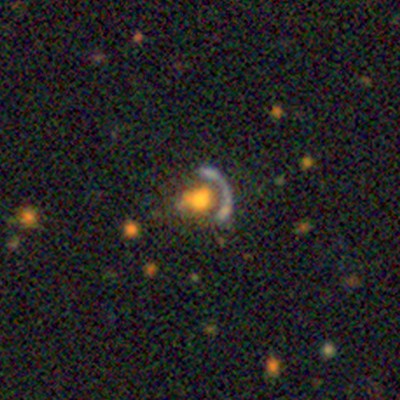
Credit: Legacy Surveys / D. Lang (Perimeter Institute) · Image source · Reuse information
Image details
/ ;
CC BY 4.0
- Other names
- CSWA 6 [3]
Name origin
system; Cambridge row CSWA 6, a.k.a. The CloneSDSS J120602.09+514229.5 [1]Name origin
main deflector; Lin §2 pp.3–4SDSS J1206+5142 [2]Name origin
system shorthand explicitly mapped in source; Stark arXiv Table 4 p.13, matching CSWA rowName variants and source provenance
Published spellings and paper abbreviations retained for matching and traceability.
The Clone [1]Published title/target designation; The Clone
- Catalog source
- Cited Paper
- Right ascension
- 181.50871224 deg
12h 06m 02.09s [3] [4] - Declination
- 51.70820438 deg
+51° 42′ 29.54″ - Coordinates
- Equatorial J2000 · adopted catalog position
- Lens → Source
- Group → Galaxy [1]
- Appearance
- Arc [1]Quadruple image [1]
- Lens redshift
- 0.4224 [1]
Measurement details
Reported uncertainty: −0.0002 / +0.0002
Quoted symmetric spectroscopic uncertainty; confidence convention unspecified in caption. Prefer direct spectrum over discordant catalogue 0.433; cause unknown.
Method: SDSS spectrum of central LRG
Source location: arXiv v1 Fig. 2, p.18; §2 pp.3–4
- Discovery report
- 2008-09-25 [1]
- Explore
- External object viewer [3]
Background sources
Background galaxy imaged as A1–A4 [1]
- Source redshift
- 2.0026 [5]
Measurement details
No numerical redshift uncertainty is tabulated. Separate image apertures agree within delta-z/(1+z)=0.0001; this is not an uncertainty on the tabulated value. Prefer nebular line over UV absorption for source redshift.
Method: Keck II/NIRSPEC Gaussian fit to H-alpha
Source location: arXiv Table 1 p.3, Clone row; §2.3 p.6; Fig.1 p.3 aperture map
- Einstein radius
- 3.82 arcsec [1]
Measurement details
Reported uncertainty: −0.03 / +0.03
Statistical model error, not total accuracy. Smooth SIE does not fit image fluxes fully; group and substructure contributions discussed. Kormann SIE convention; not a directly observed circle.
Method: SIE lens model; LENSVIEW fit with statistical errors from lensmodel image-position fit
Source location: arXiv:0809.4475v1 §4.2 p.7 (SIE radius), p.8 (statistical error and fit limitations), p.9 (group contribution and SIE convention).
Evidence & coordinate notes
- Appearance:arc: Fig.3 p.19: bright arc A1–A3 and A4 counterimage. [1]
- Appearance:quadruple: Fig.3 p.19; §4.2 four-image lens model, A1–A4. [1]
- Confirmation: §3.1 p.5: redshift of knots plus Subaru arc morphology; §4.2 model and counterimage. [1]
- Coordinates: Catalogue row CSWA 6, RADec cells: central foreground galaxy; provider digits retained, not an uncertainty estimate. [3]
- Coordinates: IAU designations, J2000 naming convention and truncated coordinate digits; coordinate epoch/frame distinct from observation date. [4]
- Description: Sentence 1: abstract, §§3.1–3.2, Fig.3 p.19, §4.2 p.9 (group contribution). Sentence 2: §4.2 pp.8–9, image-position fit versus A3 flux discrepancy. [1]
- Discovery date: arXiv:0809.4475v1 submission history, 25 September 2008: dated public report of this system; not an observation date or claim that no earlier thesis/catalogue mention exists. [1]
- Image:cswa-6-legacy-dr9-400-866c2b00e506.jpg: Exact JPEG product: layer=ls-dr9; ra=181.50871224; dec=51.70820438; pixscale=0.15; size=400. Central lens and adjacent arc; identity crossmatch: Lin Fig. 1, arXiv p. 17. Reuse: official Acknowledgments, “Usage of images from the Sky Viewer”, Legacy Surveys layers license and credit paragraphs. [6]
- Lens redshift history: CSWA 6 Z_L cell gives 0.433. Not adopted: direct Lin Fig.2 spectrum gives 0.4224 ± 0.0002. No cause assigned to catalogue discrepancy. [3]
- Lens redshift history: Published Table 4 p.1051, CSWA 6 row: 0.433, source 2.000, SIE radius 3.9 arcsec. These are retained alternatives; preferred direct measurements and model uncertainties are from Lin. [2]
- Object url: Identity viewer-check.json / cswa-6: official Legacy DR9 cutout visually matched to primary figure by identity; selected_url preserved exactly. Target association from this catalogue row. [3]
- Record source: Paper-based synthesis; first ordered reference is the intended Cited Paper destination. CASSOWARY membership retained separately as an alias, not discovery credit. [1]
- Source:primary: §§3.1–3.2, Fig.3 p.19 and Fig.5 p.21; A1–A4 are images of one physical galaxy, not four sources. [1]
- Source redshift history: §3.1 p.5/Table 2 p.29: Subaru A2+A3 absorption mean 2.0010 ± 0.0009; APO A1+A2 2.0001 ± 0.0006. Distinct from adopted H-alpha redshift; no cause of offset assigned. [1]
- System class: §4.2 pp.8–9: lensing partly due to group environment around central LRG; interpretation supported by large model dispersion and neighbouring red galaxies, not a measured group virial mass. [1]
References
- Lin et al. (2009), Discovery of a Very Bright, Strongly Lensed z = 2 Galaxy in the SDSS DR5, ApJ 699, 1242–1251; inspected arXiv:0809.4475v1 (2008). DOI: 10.1088/0004-637X/699/2/1242
- Stark et al. (2013), The CASSOWARY spectroscopy survey: a new sample of gravitationally lensed galaxies in SDSS, MNRAS 436, 1040–1056; published edition. DOI: 10.1093/mnras/stt1624
- University of Cambridge, Institute of Astronomy, CASSOWARY catalogue (dated 8 November 2019), target rows; accessed 5 November 2026.
- SDSS DR6, IAU designations: J2000 coordinate and truncation conventions.
- Hainline et al. (2009), Rest-Frame Optical Spectra of Three Strongly Lensed Galaxies at z ~ 2; inspected arXiv:0906.2197, Table 1 and §2.3.
- Legacy Surveys Sky Viewer — DR9 JPEG cutout of CSWA 6 (The Clone)