Catalog ID: GLC-238
SDSS J090122.37+181432.3
Confirmed — combined [3] [1] [2]
A foreground cluster, including central luminous galaxies, lenses a more distant galaxy into western, southeastern and northeastern arcs. These arcs are multiple images of one background galaxy. A separate reddish background object has four images; its redshift has not been measured. [3]
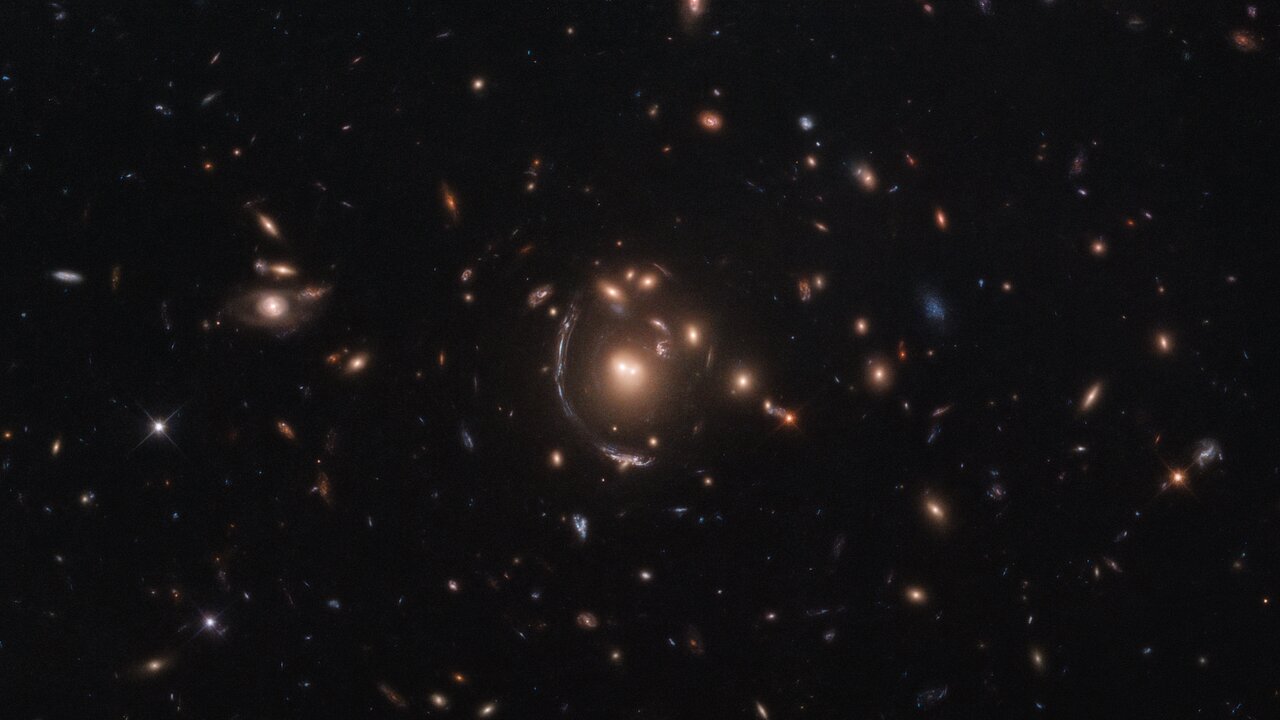
Credit: ESA/Hubble & NASA, S. Allam et al. · Image source · Reuse information
Image details
Hubble Space Telescope / WFC3; g (475 nm), V (606 nm), I (814 nm), YJ (1.1 μm), H (1.6 μm)
Field of view: 2.03 x 1.14 arcminutes
Orientation: North is 25.7° left of vertical
CC BY 4.0
- Other names
- CSWA 4 [4]
Name origin
CASSOWARY catalogueSDSS J0901+1814 [2]Name origin
Published shorthand for the lensed galaxy/system fieldLRG-3-817 [5]Name origin
ESA/Hubble designation for the background galaxyName variants and source provenance
Published spellings and paper abbreviations retained for matching and traceability.
SDSS J090122.37+181432.3 [1]SDSS designation; foreground/system reference
- Catalog source
- Cited Paper
- Right ascension
- 135.3432°
09h 01m 22.37s [1] - Declination
- 18.2423°
+18° 14′ 32.28″ - Coordinates
- Equatorial J2000 · adopted catalog position
- Lens → Source
- Cluster → Galaxy [3]
- Appearance
- Arc [3]
- Lens redshift
- 0.3459 [1]
Measurement details
Reported uncertainty: −0.0003 / +0.0003
Reported ±0.0003 for the central LRG; confidence level not specified in the cited passage. This is the central galaxy spectrum, not a cluster-averaged velocity measurement.
Method: SDSS DR7 spectroscopy of the central luminous red galaxy
Source location: arXiv:0910.4600v1, section 4.1, p.5; Table 4, p.16, SDSS J090122.37+181432.3 row.
- Discovery report
- 2009-06-11 [2]
- Explore
- External object viewer
Background sources
Primary lensed galaxy (western, southeastern and northeastern arcs) [3]
- Source redshift
- 2.2586 [2]
Measurement details
No individual redshift uncertainty is tabulated. Section 2.3 reports image-pair agreement within Δz/(1+z)=0.0001 for all three targets; this is not a formal ± error. Adopted nebular H-alpha value; distinct Ly-alpha result retained in dossier.
Method: Keck II/NIRSPEC; Gaussian fit to H-alpha emission
Source location: arXiv:0906.2197v1, Table 1, p.3, SDSS J0901+1814 row (z_Hα column); section 2.3, p.6.
- Einstein radius
- 7.7 arcsec [1]
Measurement details
Reported uncertainty: −1.1 / +1.1
Reported ±1.1 arcsec reflects changing arc curvature along its length; not a formal lens-model posterior interval or complete systematic error. Retained as the discovery-paper estimate.
Method: Manual circle-chord fit to the visible arc; geometric Einstein-radius estimate
Source location: arXiv:0910.4600v1, section 4, pp.4–5; section 4.1, p.5; Table 4, p.16, SDSS J090122.37+181432.3 row.
Secondary reddish lensed object (paper nickname: Sith; measured redshift unknown) [3]
- Source redshift
- Not available
- Einstein radius
- Not available
Evidence & coordinate notes
- Appearance:arc: Figure 16 and Appendix A.1, printed p.24/PDF p.25: W, SE and NE arcs of primary source. Four-image secondary does not define primary appearance. [3]
- Confirmation: Appendix A.1, printed pp.24–25/PDF pp.25–26, Figures 16–17: multiple-image reconstruction with cluster and galaxy potentials. Combined with spectroscopic evidence for primary source. [3]
- Confirmation: Section 4.1, p.5 and Figure 3, p.11: concordant arc-knot Ly-alpha spectra; low-redshift [O II] interpretation rejected; independent rest-optical lines confirm identification. [1]
- Confirmation: Section 2.1, p.2; Figure 2, p.4; Table 1 p.3 and section 2.3 p.6: near-infrared emission-line spectroscopy of two lensed images, H-alpha z=2.2586. [2]
- Coordinates: Table 1, p.15, first system row: RA/DEC in degrees, J2000. Section 4.1, p.5 associates designation with foreground central LRG. Table 3 p.16 arc-knot positions are different image-plane locations. [1]
- Description: Appendix A.1, printed pp.24–25/PDF pp.25–26, Figures 16–17 and Table 5: cluster plus central galaxies; W/SE/NE are images of one galaxy; distinct reddish Sith object has four images and unknown measured redshift (z≈3.1 is a model estimate). [3]
- Discovery date: arXiv:0906.2197 submission history: v1 11 June 2009 21:45:11 UTC; abstract and introduction p.2 name this exact target. Earliest target-specific public report verified in bounded search, not observing date or proof of absolute discovery priority. [2]
- Image:cswa-4-hst-wfc3-potw2045a.jpg: Contorting Giants (potw2045a), image Credit, Image Formats, Coordinates and Colours & filters. Native Screensize JPEG. [5]
- Source:primary: Appendix A.1, printed p.24/PDF p.25, Figure 16: W, SE and NE images; NE images part of source twice. Figure 17 describes further knot multiplicity, not additional physical sources. [3]
- Source:sith: Appendix A.1 and Figure 16, printed p.24/PDF p.25: four images S1–S4 of a second reddish lensed object; measured redshift unknown. Model redshift about 3.1 not adopted as spectroscopy. [3]
- System class: Appendix A.1, printed pp.24–25/PDF pp.25–26, Table 5: primary galaxy lensed by a poor cluster; explicitly modelled cluster potential plus central and member galaxies. Cluster-galaxy class is based on the deflecting model, not environment alone. [3]
References
- Diehl et al. (2009), The Sloan Bright Arcs Survey: Four Strongly Lensed Galaxies with Redshift > 2, ApJ 707, 686–692. Inspected arXiv:0910.4600v1. DOI: 10.1088/0004-637X/707/1/686
- Hainline et al. (2009), Rest-Frame Optical Spectra of Three Strongly Lensed Galaxies at z ~ 2, ApJ 701, 52–65. Inspected arXiv:0906.2197v1. DOI: 10.1088/0004-637X/701/1/52
- Davies et al. (2020), From Nuclear to Circumgalactic: Zooming in on AGN-driven Outflows at z ~ 2.2 with SINFONI, ApJ 894, 28. Bath peer-reviewed manuscript with one cover sheet. DOI: 10.3847/1538-4357/ab86ad
- University of Cambridge, CASSOWARY catalogue, edition 8 November 2019, CSWA 4.
- ESA/Hubble, Contorting Giants, potw2045a, 9 November 2020.