Catalog ID: GLC-237
PG1115+080
Confirmed — published expert assessment [2]
PG1115+080 contains four images (A1, A2, B and C) of one background quasar. The main lens is an elliptical galaxy in a foreground group. HST/NICMOS observations reveal a nearly complete ring from the quasar host galaxy. The catalog coordinates identify the system, not a verified absolute deflector centroid. [3] [2]
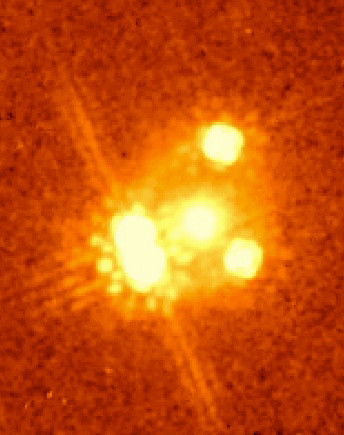
Credit: Christopher D. Impey (University of Arizona) · Image source · Reuse information
Image details
Hubble Space Telescope / NICMOS;
CC BY 4.0
- Other names
- No additional distinct designations
Name variants and source provenance
Published spellings and paper abbreviations retained for matching and traceability.
PG1115+080 [3]CASTLES
- Catalog source
- CASTLES
- Right ascension
- 11h 18m 17.00s
11h 18m 17.00s [3] - Declination
- +07° 45′ 57.7″
+07° 45′ 57.70″ - Coordinates
- Equatorial J2000 · adopted catalog position
- Lens → Source
- Galaxy → Quasar [2]
- Appearance
- Partial ring [2]Quadruple image [2]
- Lens redshift
- 0.3100 [1]
Measurement details
Reported uncertainty: −0.0005 / +0.0005
Table 2 errors combine cross-correlation peak width and estimated wavelength-calibration systematic error (Section 2). This is galaxy G, not the group mean 0.311.
Method: Keck/LRIS absorption-line spectroscopy; cross-correlation with G/K giant stellar templates.
Source location: arXiv v2, printed/PDF p. 6, Table 2, G row, Redshift column; Section 2 pp. 2-3.
- Discovery report
- Not available
- Explore
- External object viewer [4]
Background sources
Background quasar and its host galaxy [2]
- Source redshift
- 1.7225 [5]
Measurement details
Reported uncertainty: −0.0005 / +0.0005
Reported Table 2 error for image A (unresolved A1/A2), no confidence level assigned here. C III] line-based value, not a unique systemic redshift. Al III 1858 in the asymmetric blue wing can bias line position; 33-Angstrom weighting reduces its influence. Table wavelengths are in air. B=1.7230 +/-0.0011 and C=1.7220 +/-0.0009 are alternatives for the same source; inherited 1.722 retained in dossier.
Method: Hale 5.08-m/PFUEI CCD spectroscopy; continuum-normalized C III] 1909 profile, Gaussian-weighted line-position estimator (equation 2), width parameter 33 Angstrom. Adopt A, the smallest reported redshift error, without averaging images or inferring a systemic correction.
Source location: Printed p.728 / PDF p.6, Table 2, Redshift z_s row, A column; printed p.725 / PDF p.3, Section II(d), equation 2; instrumentation Section II(a), pp.723-724.
- Einstein radius
- 1.04 arcsec [2]
Measurement details
Reported uncertainty: −0.01 / +0.01
Galaxy critical-radius parameter b for SIE galaxy + SIS group only; Table 3 footnote d gives Delta chi-squared=1 errors. Model-family uncertainty is not included. Not the 1.15 arcsec observed ring-radius convention or group b. Historical model uses source z=1.722 and lens z=0.310 (Abstract/Section 1); retained as published, not refitted to the adopted line-based source redshift 1.7225.
Method: Model fit to quasar and galaxy positions (3 mas adopted errors) and quasar fluxes (20% errors), SIE galaxy plus SIS group. Ring brightness was not fitted for these parameters.
Source location: Section 2.3; Table 3 Lens Model Results, Galaxy b (arcsec) row, SIE/SIS column, footnotes a and d.
Additional images
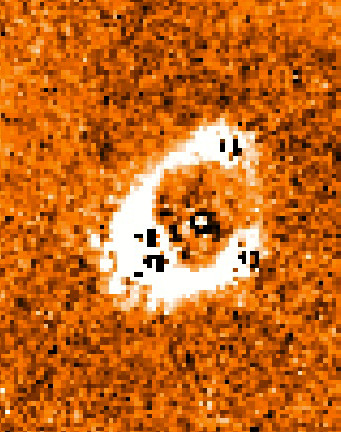
Credit: Christopher D. Impey (University of Arizona) · Image source · Reuse information
Image details
Hubble Space Telescope / NICMOS;
CC BY 4.0
Evidence & coordinate notes
- Confirmation: Abstract; Section 2.3 lens model fits and Section 2.5 host-galaxy ring detection and modeling; Figure 1c. Published primary research assessment of gravitational lensing, not a new spectral verification by this worker. [2]
- Coordinates: Summary table row 47, RA/Dec (J2000): 11:18:17.00, +07:45:57.7. Converted to decimal degrees; system position, not certified G centroid. [3]
- Description: Summary row 47 supplies system coordinates without certifying an absolute deflector centroid. [3]
- Description: Abstract; Section 1 four image labels; Sections 2.3 and 2.5; Figure 1c caption describes a nearly complete observed ring. [2]
- Object url: Identity attempt 2 viewer-check.json: exact selected_url verified by survey_image_visual at 2026-10-29T14:28:30.546612+00:00; interactive endpoint separately blocked. [4]
- Record source: Summary row 47 PG1115+080 and linked Individual/PG1115.html. [3]
- System class: Abstract and Section 1: main elliptical lens G and background quasar; Section 2.5 identifies the ring as its host. [2]
References
- Kundić, T., Cohen, J. G., Blandford, R. D. & Lubin, L. M. (1997), Keck Spectroscopy of the Gravitational Lens System PG 1115+080: Redshifts of the Lensing Galaxies, arXiv:astro-ph/9704109v2.
- Impey, C. et al. (1998), An Infrared Einstein Ring in the Gravitational Lens PG 1115+080, ApJ 509, 551; arXiv:astro-ph/9803207v1. DOI: 10.1086/306521
- CASTLES Survey, Summary of Multiply Imaged Systems, row 47: PG1115+080.
- Legacy Surveys DR10 survey-image cutout at the CASTLES PG1115+080 system position; verified in identity attempt 2.
- Young, P., Deverill, R. S., Gunn, J. E., Westphal, J. A. & Kristian, J. (1981), The Triple Quasar Q1115+080A,B,C: A Quintuple Gravitational Lens Image?, ApJ 244, 723-735. DOI: 10.1086/158750