Catalog ID: GLC-236
Cosmic Snake
Confirmed — combined [1]
The galaxy cluster MACS J1206.2−0847 stretches a star-forming background galaxy into the Cosmic Snake, a long arc containing multiple images of parts of the same galaxy. The natural magnification allows astronomers to study small star-forming structures in the distant source. [1]
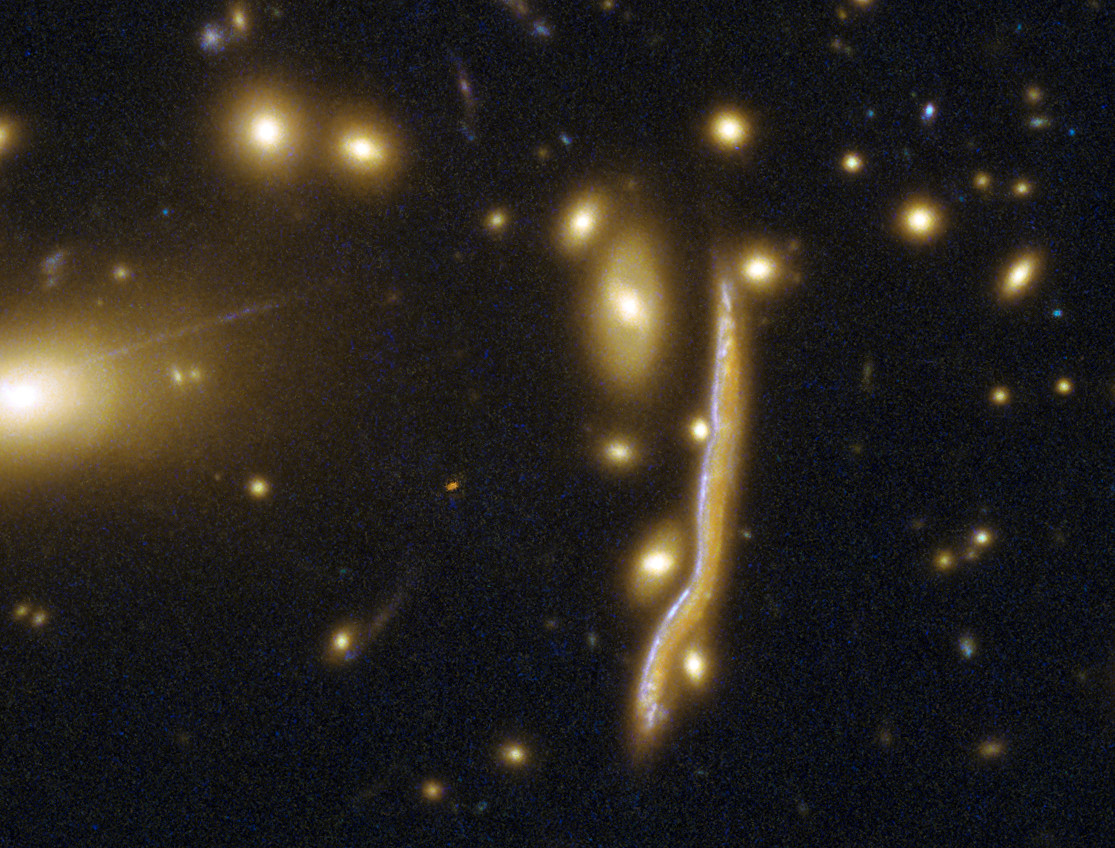
Credit: ESA/Hubble, NASA · Image source · Reuse information
Image details
Hubble Space Telescope / ;
CC BY 4.0; retain the full image credit; publisher JPEG unchanged
- Other names
- MACS J1206.2-0847 [1]
Name origin
Dessauges-Zavadsky et al. (2019), Molecular clouds in the Cosmic Snake normal star-forming galaxy 8 billion years ago.Name variants and source provenance
Published spellings and paper abbreviations retained for matching and traceability.
Cosmic Snake [4]ESA/Hubble (2017), Anatomy of a cosmic snake, potw1747a.
- Catalog source
- Cited Paper
- Right ascension
- 181.55062500°
12h 06m 12.15s [2] - Declination
- -8.80094444°
−08° 48′ 03.40″ - Coordinates
- Equatorial J2000 · adopted catalog position
- Lens → Source
- Cluster → Galaxy [1]
- Appearance
- Arc [1]
- Lens redshift
- 0.4398 [2]
Measurement details
Method: Published adopted spectroscopic redshift
Source location: Section 2.1: BCG redshift adopted as cluster centre; not a new precision measurement
- Discovery report
- Not available
Background sources
One star-forming background galaxy, multiple arc images [1]
- Source redshift
- 1.036 [1]
Measurement details
Method: Published adopted spectroscopic redshift
Source location: Opening paragraph and Figure 1: source spectroscopic redshift
- Einstein radius
- Not available
Evidence & coordinate notes
- Confirmation: Published spectroscopy and gravitational lens interpretation; see cited paper. [1]
- Coordinates: Biviano et al. Section 2.1: adopted cluster centre at the brightest cluster galaxy, J2000 12h06m12.15s −08°48′03.4″. This is the lens cluster position, not the arc position. Converted to decimal degrees; conversion digits do not imply additional astrometric accuracy. [2]
- Description: Opening text and Figure 1: one star-forming galaxy and its four-fold arc imaging. [1]
- System class: Foreground deflector and background source types described in the cited work. [1]
References
- Dessauges-Zavadsky et al. (2019), Molecular clouds in the Cosmic Snake normal star-forming galaxy 8 billion years ago. DOI: 10.1038/s41550-019-0874-0
- Biviano et al. (2023), CLASH-VLT: The inner slope of the MACS J1206.2−0847 dark matter density profile, ApJ 958, 148. DOI: 10.3847/1538-4357/acf832
- Cava et al. (2018), The nature of giant clumps in distant galaxies probed by the anatomy of the cosmic snake, Nature Astronomy 2, 76–82. DOI: 10.1038/s41550-017-0295-x
- ESA/Hubble (2017), Anatomy of a cosmic snake, potw1747a.