Catalog ID: GLC-235
Abell 2218
Confirmed — combined [1]
The mass of this rich galaxy cluster magnifies and stretches distant background galaxies into numerous arcs and arclets. One spectroscopically confirmed source is represented by arc images 384 and 468. This entry lists that selected source, not every known lensed galaxy in the field. [3]
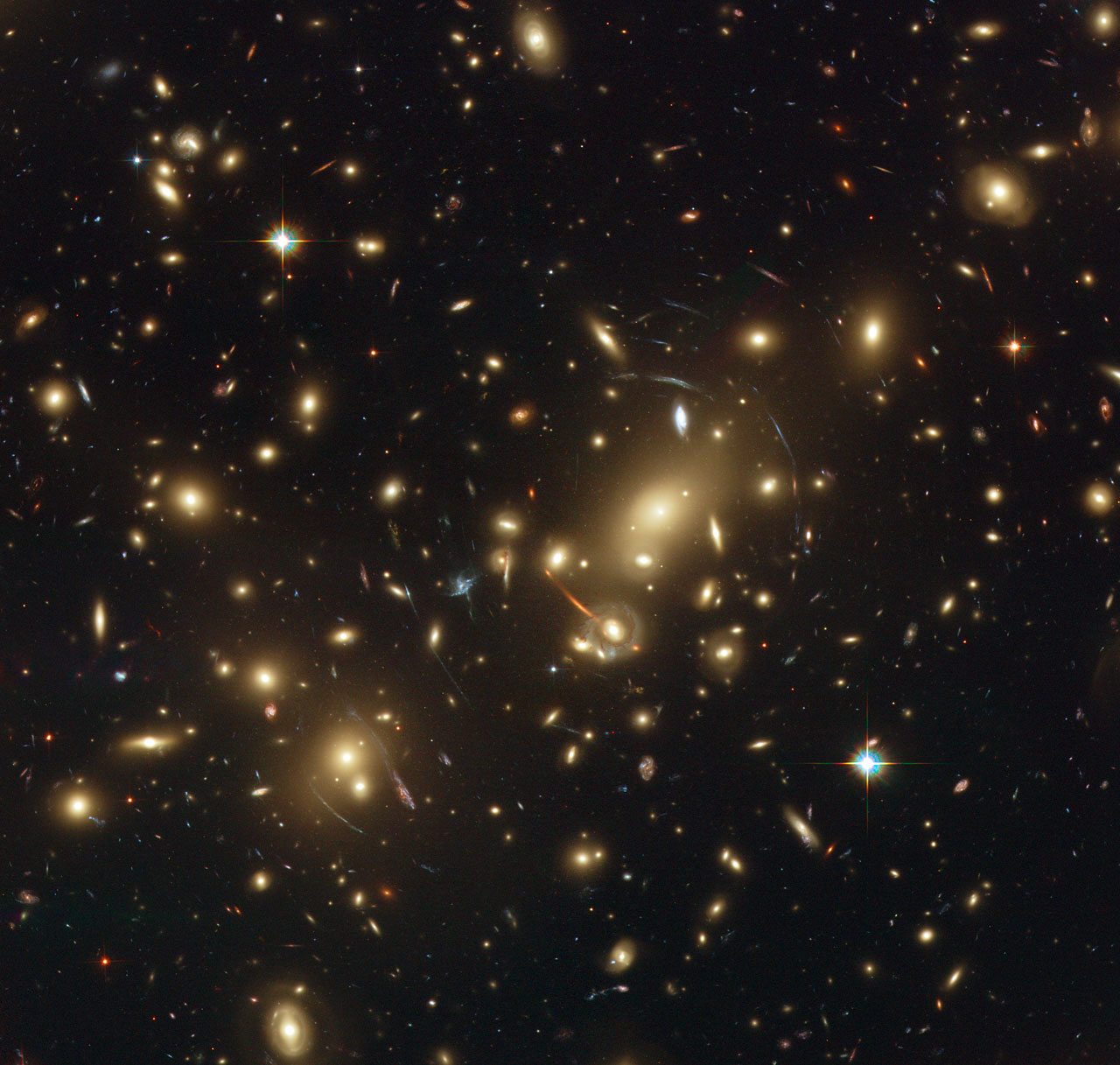
Credit: NASA, ESA, and Johan Richard (Caltech, USA). Acknowledgement: Davide de Martin & James Long (ESA/Hubble) · Image source · Reuse information
Image details
Hubble Space Telescope / ; B, V, R (publisher labels)
Field of view: 3.16 × 3.00 arcmin
Orientation: North 8.8° right of vertical
CC BY 4.0; retain the full image credit; publisher JPEG unchanged
- Other names
- A2218 [1]
Name origin
Ebbels et al. (1996), Identification of a gravitationally lensed z=2.515 star-forming galaxy, MNRAS 281, L75–L81.Name variants and source provenance
Published spellings and paper abbreviations retained for matching and traceability.
Abell 2218 [3]ESA/Hubble (2008), Abell 2218, heic0814a.
- Catalog source
- Cited Paper
- Right ascension
- 248.97500000°
16h 35m 54.00s [2] - Declination
- 66.21666667°
+66° 13′ 00.00″ - Coordinates
- Equatorial J2000 · adopted catalog position
- Lens → Source
- Cluster → Galaxy [1]
- Appearance
- Arc [3]
- Lens redshift
- 0.175 [1]
Measurement details
Method: Published adopted spectroscopic redshift
Source location: Abstract: adopted cluster redshift
- Discovery report
- Not available
Background sources
Star-forming galaxy seen as arcs 384 and 468 (selected source) [1]
- Source redshift
- 2.515 [1]
Measurement details
Reported uncertainty: −0.001 / +0.001
Method: Published adopted spectroscopic redshift
Source location: Figure 2 caption: spectroscopic absorption-line redshift
- Einstein radius
- Not available
Evidence & coordinate notes
- Confirmation: Published spectroscopy and gravitational lens interpretation; see cited paper. [1]
- Coordinates: SIMBAD cluster position ICRS epoch J2000 16 35 54.0 +66 13 00; quality E, approximate cluster centre. Converted to decimal degrees; conversion digits do not imply additional astrometric accuracy. [2]
- Description: Publisher description of the observed gravitational lens. [3]
- System class: Foreground deflector and background source types described in the cited work. [1]