Catalog ID: GLC-234
Abell 370
Confirmed — combined [1]
A massive galaxy cluster bends light from many more distant galaxies into arcs. Its prominent giant arc, often called the Dragon, is one physical background galaxy seen in multiple distorted images. The source listed here is a selected example, not a complete inventory of the cluster’s lensed galaxies. [4]
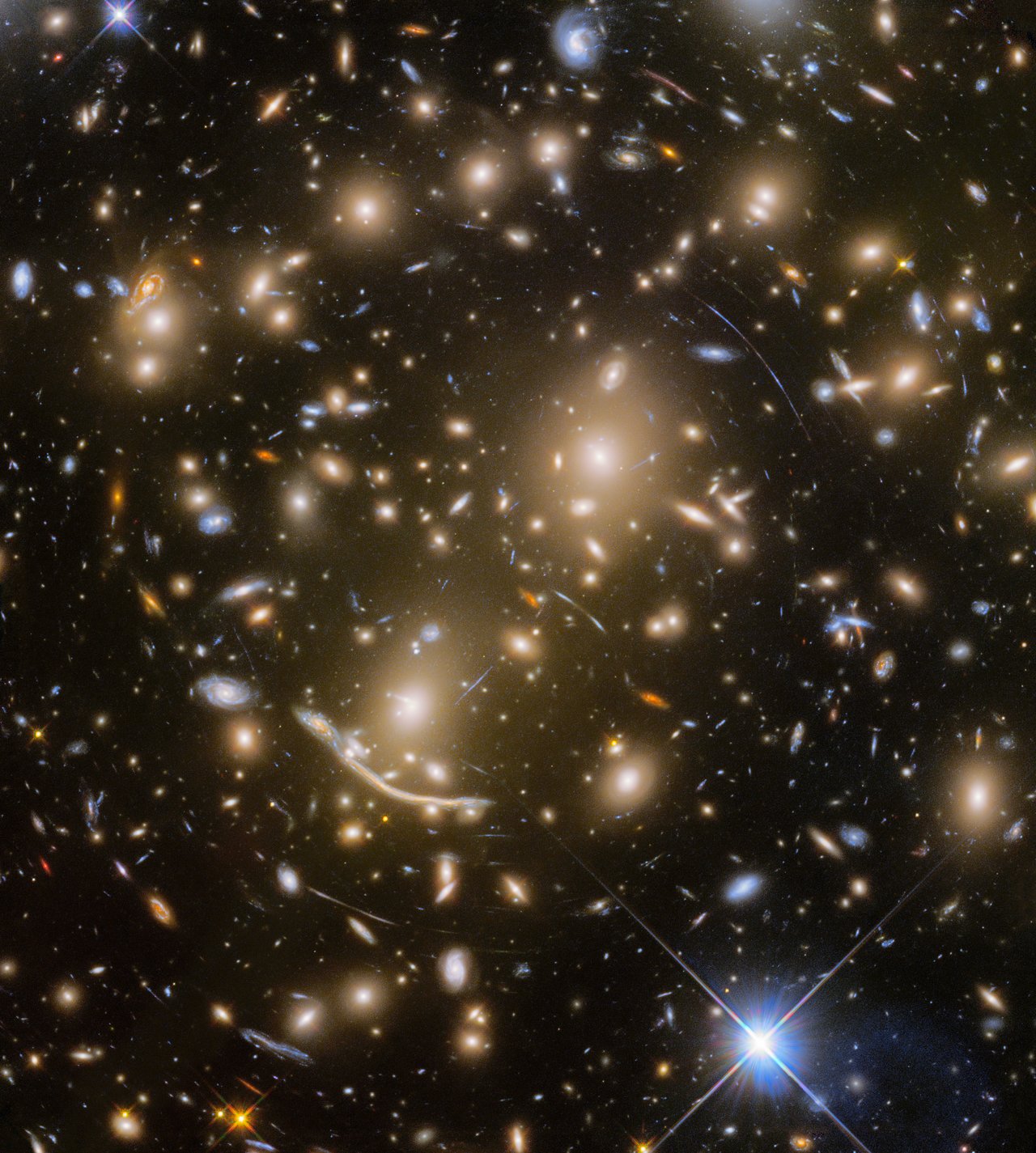
Credit: NASA, ESA/Hubble, HST Frontier Fields · Image source · Reuse information
Image details
Hubble Space Telescope / ACS / WFC3; 435, 606, 814 nm; 1.05, 1.25, 1.4, 1.6 μm
Field of view: 2.08 × 2.32 arcmin
Orientation: North 27.9° right of vertical
CC BY 4.0; retain the full image credit; publisher JPEG unchanged
- Other names
- A370 [1]
Name origin
Soucail et al. (1988), The giant arc in A 370: spectroscopic evidence for gravitational lensing from a source at z=0.724, A&A 191, L19–L21.Name variants and source provenance
Published spellings and paper abbreviations retained for matching and traceability.
Abell 370 [4]ESA/Hubble (2017), The last of the Frontier Fields — Abell 370, heic1711a.
- Catalog source
- Cited Paper
- Right ascension
- 39.96041667°
02h 39m 50.50s [3] - Declination
- -1.58555556°
−01° 35′ 08.00″ - Coordinates
- Equatorial J2000 · adopted catalog position
- Lens → Source
- Cluster → Galaxy [1]
- Appearance
- Arc [4]
- Lens redshift
- 0.374 [2]
Measurement details
Method: Published adopted spectroscopic redshift
Source location: ESO discovery-team release: adopted cluster redshift
- Discovery report
- Not available
Background sources
Giant arc / Dragon background galaxy (selected source) [2]
- Source redshift
- 0.724 [2]
Measurement details
Method: Published adopted spectroscopic redshift
Source location: ESO discovery-team spectrum: same spectrum in multiple arc segments
- Einstein radius
- Not available
Evidence & coordinate notes
- Confirmation: Published spectroscopy and gravitational lens interpretation; see cited paper. [1]
- Coordinates: SIMBAD cluster position ICRS epoch J2000 02 39 50.5 −01 35 08; quality E, approximate cluster centre rather than an individual galaxy centroid. Converted to decimal degrees; conversion digits do not imply additional astrometric accuracy. [3]
- Description: Publisher description of the observed gravitational lens. [4]
- System class: Foreground deflector and background source types described in the cited work. [1]
References
- Soucail et al. (1988), The giant arc in A 370: spectroscopic evidence for gravitational lensing from a source at z=0.724, A&A 191, L19–L21.
- ESO (1987), The Nature of the Mysterious Luminous Arc Revealed: A Gravitational Einstein Ring, eso8716.
- SIMBAD, Abell 370 cluster; accessed 17 October 2026.
- ESA/Hubble (2017), The last of the Frontier Fields — Abell 370, heic1711a.