Catalog ID: GLC-233
Jackpot / Double Einstein Ring
Confirmed — combined [1]
An elliptical galaxy lenses background galaxies at three distinct redshifts. The famous Hubble image shows the two rings that gave the system its Double Einstein Ring nickname; a third, more distant source was confirmed later. [2]
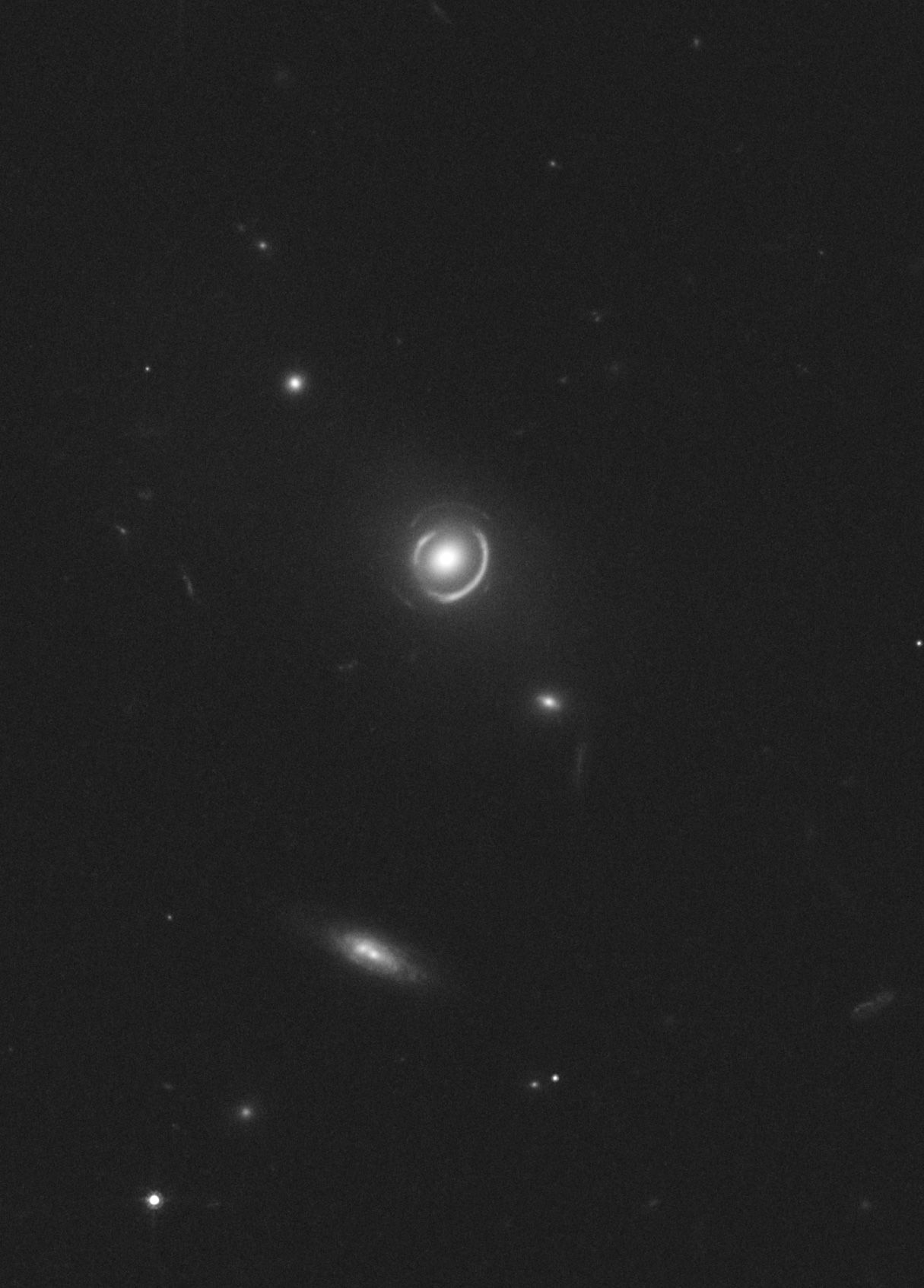
Credit: NASA, ESA, and R. Gavazzi and T. Treu (University of California, Santa Barbara) · Image source · Reuse information
Image details
Hubble Space Telescope / ACS; F814W
Field of view: 0.61 × 0.85 arcmin
Orientation: North 71.4° left of vertical
CC BY 4.0; retain the full image credit; publisher JPEG unchanged
- Other names
- SDSS J0946+1006 [1]
Name origin
Gavazzi et al. (2008), The Sloan Lens ACS Survey. VI. Discovery and analysis of a double Einstein ring, ApJ 677, 1046–1059.Double Einstein Ring [5]Name origin
ESA/Hubble (2008), Double Einstein ring, heic0803b.Name variants and source provenance
Published spellings and paper abbreviations retained for matching and traceability.
Jackpot / Double Einstein Ring [5]ESA/Hubble (2008), Double Einstein ring, heic0803b.
- Catalog source
- Cited Paper
- Right ascension
- 146.73617083°
09h 46m 56.68s [4] - Declination
- 10.11466667°
+10° 06′ 52.80″ - Coordinates
- Equatorial J2000 · adopted catalog position
- Lens → Source
- Galaxy → Galaxy [1]
- Appearance
- Ring [5]
- Lens redshift
- 0.222 [1]
Measurement details
Method: Published adopted spectroscopic redshift
Source location: Abstract: foreground lens redshift
- Discovery report
- Not available
Background sources
Inner-ring background galaxy [1]
- Source redshift
- 0.609 [1]
Measurement details
Method: Published adopted spectroscopic redshift
Source location: Abstract: inner source spectroscopic redshift
- Einstein radius
- Not available
Outer-ring background galaxy [2]
- Source redshift
- 2.035 [2]
Measurement details
Method: Published adopted spectroscopic redshift
Source location: Abstract and Sections 2–3: [O III] and C III] spectroscopy; supersedes older photometric estimates
- Einstein radius
- Not available
Third background galaxy, not one of the two visible rings [3]
- Source redshift
- 5.975 [3]
Measurement details
Method: Published adopted spectroscopic redshift
Source location: Abstract: doubly imaged Ly-alpha source
- Einstein radius
- Not available
Evidence & coordinate notes
- Confirmation: Published spectroscopy and gravitational lens interpretation; see cited paper. [1]
- Coordinates: CDS SIMBAD object thumbnail entry SLACS SDSS J0946+1006: position 09 46 56.681 +10 06 52.80; adopted system position. Converted to decimal degrees; conversion digits do not imply additional astrometric accuracy. [4]
- Description: Abstract and Introduction; updated triple-source interpretation, together with Collett & Smith 2020. [2]
- System class: Foreground deflector and background source types described in the cited work. [1]
References
- Gavazzi et al. (2008), The Sloan Lens ACS Survey. VI. Discovery and analysis of a double Einstein ring, ApJ 677, 1046–1059. DOI: 10.1086/529541
- Smith & Collett (2021), A fully-spectroscopic triple-source-plane lens: the Jackpot completed. DOI: 10.1093/mnras/stab1399
- Collett & Smith (2020), A Triple Rollover: A third multiply-imaged source at z~6 behind the Jackpot gravitational lens.
- CDS/Aladin SIMBAD thumbnails, SLACS SDSS J0946+1006 entry; accessed 17 October 2026.
- ESA/Hubble (2008), Double Einstein ring, heic0803b.