Catalog ID: GLC-232
HE 0435−1223
Confirmed — combined [1]
An elliptical galaxy lenses one background quasar into four bright images arranged around the deflector. Monitoring the varying images and their time delays makes this system useful for cosmological studies. [1]
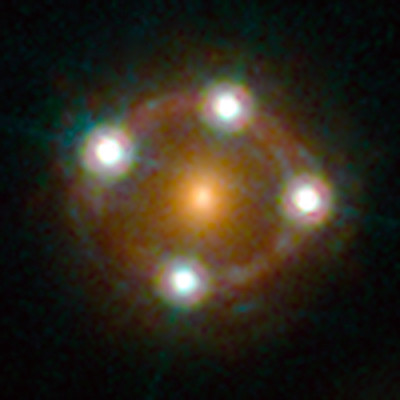
Credit: ESA/Hubble, NASA, Suyu et al. · Image source · Reuse information
Image details
Hubble Space Telescope / ACS / WFC3; V (555 nm), I (814 nm), H (1.6 μm)
Field of view: 0.08 × 0.08 arcmin
CC BY 4.0; retain the full image credit; publisher JPEG unchanged
- Other names
- No additional distinct designations
Name variants and source provenance
Published spellings and paper abbreviations retained for matching and traceability.
HE 0435−1223 [2]ESA/Hubble (2017), Lensed quasar, heic1702e.
HE 0435-1223 [1]Wong et al. (2017), H0LiCOW — IV. Lens mass model of HE 0435−1223 and blind measurement of its time-delay distance for cosmology, MNRAS 465, 4895–4913.
- Catalog source
- Cited Paper
- Right ascension
- 69.56208333°
04h 38m 14.90s [1] - Declination
- -12.28733333°
−12° 17′ 14.40″ - Coordinates
- Equatorial J2000 · adopted catalog position
- Lens → Source
- Galaxy → Quasar [1]
- Appearance
- Quadruple image [2]
- Lens redshift
- 0.4546 [1]
Measurement details
Reported uncertainty: −0.0002 / +0.0002
Method: Published adopted spectroscopic redshift
Source location: Section 3: main deflector redshift, citing Morgan et al. 2005
- Discovery report
- Not available
Background sources
One background quasar, four lensed images A–D [1]
- Source redshift
- 1.689 [1]
Measurement details
Method: Published adopted spectroscopic redshift
Source location: Section 3: adopted source redshift
- Einstein radius
- Not available
Evidence & coordinate notes
- Confirmation: Published spectroscopy and gravitational lens interpretation; see cited paper. [1]
- Coordinates: Wong et al. Section 3: published J2000 system position 04h38m14.9s −12°17′14.4″; adopted system position, not a newly measured galaxy centroid. Converted to decimal degrees; conversion digits do not imply additional astrometric accuracy. [1]
- Description: Sections 3 and 3.2: quadruply imaged quasar and time-delay measurements. [1]
- System class: Foreground deflector and background source types described in the cited work. [1]